Digital Business Transformation is disrupting enterprises across all industries by breaking down boundaries between people, companies, and things. Companies can generate new goods and services, as well as find more efficient methods of doing business, by breaking down these boundaries.
Understanding the definition and purpose of digital business transformation
To begin with, we need to fully understand what digital business transformation is and what goals it helps to achieve. The cultural, organisational, and operational transformation of a company, industry, or ecosystem via the intelligent integration of digital technologies, processes, and capabilities across all levels and functions in a structured and systematic manner is referred to as digital transformation.
In other words, the term “digital transformation” (sometimes referred to as “DX” or “DT”) implies the use of technology to innovate and build the capacity to quickly adapt to changing conditions while also generating value and new services for a variety of stakeholders.
Although DX is mostly employed in the business field, it also has an influence on other organisations including governments, public sector agencies, and organizations who work to address social concerns like pollution and ageing populations by utilising one or more of these existing and new technologies.
The profound transformation of business and organisational activities, processes, competencies, and models known as “digital transformation” is done to fully leverage the opportunities and changes caused by a variety of digital technologies and their accelerating impact on society in a strategic and prioritised manner, taking into account both current and future shifts.
Capabilities to be more people-centred, flexible, agile, innovative, customer-centric, and efficient are at the heart of the development of new competencies. These capabilities also include the ability to induce or leverage opportunities to alter the status quo, utilize big data and new, unstructured data sources, and generate service-driven revenues, with the Internet of Things serving as an essential enabler. In markets with a high degree of commoditization, efforts and strategies for digital transformation are frequently more essential and widespread. The factors that can prompt a faster deployment of a digital transformation strategy in the present and future include:
- societal shifts (such as ageing populations)
- customer behaviour and expectations
- emerging or existing digital
- societal shifts (such as ageing populations)
- and new economic realities.
The development of new revenue streams and information-powered ecosystems of value, along with the optimization of the entire customer experience from start to finish, are key drivers and goals of digital transformation in practice. These efforts also result in new business models and digital processes. Before you get there, it is important to address internal issues as well, such as those involving outdated systems and process disconnects, as internal objectives are unavoidable for the next stages.
The ultimate goal of digital transformation is to achieve ubiquitous optimization across processes, divisions, and the business ecosystem of a hyper-connected age by building the right bridges (between people, teams, front end and back office, data from “things” and decisions, technologies, etc.). Digital transformation is a journey with multiple connected intermediary goals and a successful completion of that journey is essential.
From all perspectives, the human element is crucial: in the stages of the transformation process (work culture, collaboration, risk management, skills, etc.); and, obviously, in the objectives of digital transformation. There will always be an “offline” component, depending on the situation, because people do not want “digital” for everything and value human and face-to-face relationships. Digital transformation, however, also has an impact on non-digital interactions and transactions since it empowers every employee or agent that interacts with customers.
A DX strategy attempts to develop the capacity for fully using the potential and opportunities of new technologies and their influence in the future in a faster, better, and more creative manner. Beyond silos and internal/external constraints, a digital transformation journey requires a structured strategy with a defined plan, including a range of stakeholders. This plan takes into consideration the fact that the final objectives will alter over time because, in reality, digital transformation is a continual process along with adaptation and digital innovation.
In this article we will explain what digital business transformation is all about, we will talk about its development, evolution and presence in numerous industries and business processes.
The comprehensive approach to understanding digital business transformation
The use of digital technology in our daily lives, at work, and in society has transformed the nature of business and will continue to do so. This has always been the case, but it is now happening at a rate that is increasing and quicker than the rate at which companies are changing.
The word “digital transformation” is certainly not the greatest method for expressing the reality it addresses. Some prefer the phrase “digital business transformation,” which is more business oriented. But, as an umbrella term, “digital transformation” is also used to address the changes in, for instance, government, society, and economic conditions. When considering transformations from a comprehensive standpoint, it is evident that societal changes and shifts have an effect on companies and may be quite disruptive as a result. Every business, sector of the economy, economic player or stakeholder, and societal division cannot stand alone.
At all times, it is important to understand the umbrella term dimension of digital transformation. Although digital transformation maturity models can assist in developing visions, they are either too generic or too simplistic in practice.
The term “digital transformation” refers to a broad range of activities, relationships, and changes in technology as well as to internal and external variables, industries, stakeholders, and so forth. As a result, it is important to bear this in mind while reading studies and predictions about digital transformation. Although companies throughout the world share some problems, aspirations, and characteristics, there are also huge variations by industry, area, and organisation. Even if we just consider regulatory contexts, what makes sense in one location may not make sense in another.
The major focus of this article is the transformation of digital business. Or to put it another way, it is about change in the context of digital business, where there is a decentralising change in attention towards the edge of the organisational ecosystem. Customer experience, employee happiness, stakeholder value/outcomes, collaborations, and a clear customer-centric strategy are crucial dimensions in this equation.
Such technological notions as cloud computing, advanced analytics, artificial intelligence, machine learning, the Internet of Things, and others are either:
1) enablers of digital transformation or/and
2) causes of digital transformation needs (among other things because they impact consumers’ behaviour or reshape entire industries, like the digital transformation of manufacturing) or/and
3) accelerators of innovation and transformation.
However, technology is only one component of digital transformation.
Focus on the edges – what does it mean?
Objective and end targets, customers and user experience, partners and stakeholders frequently occur at the edges and are crucial for digital transformation. In some cases, the definition of digital transformation is entirely limited to the customer experience, but this ignores many important factors.
However, the agenda is actually driven by the end objectives of the company, the clients, and the stakeholders. Since interconnection is the norm, the organization’s primary responsibility is to make connections and break down internal barriers in all sectors to achieve these many aims. In other words, even if the focus has shifted to the edges, the central capabilities are realised to help the edges function more effectively and quickly. This occurs, for example, at the organisational, technological, and cultural levels.
Technology and computer paradigms like edge computing, as well as the decentralisation of work and business structures, represent the movement towards the edges.
Evaluate the extent to which data management and analysis capabilities are shifting to the edge in a datasphere where real-time demands rise while cloud computing expands in the core, the decentralisation of information management, the shifts in security towards the endpoints, and a variety of other factors.
However, this does not imply that strategical choices become less important, or that digital transformation is only possible in companies with “new” organisational structures. Leadership is necessary for enterprise-wide digital transformation, regardless of how it is structured and as long as a holistic approach to the objectives with a view toward the edges triumphs over internal silos and de facto gaps between reality and perception.
In practice, we notice that pilot initiatives on the path to a more holistic and enterprise-wide strategy frequently take a bottom-up, ad hoc, or decentralized approach. This is common and common in the initial stages, but if not followed through on a larger scale, it carries a risk to long-term success.
As attacks increase and technological environments become more complex with growing attack surface challenges, and software supply chain attacks, it is essential to note that digital transformation security indeed requires a holistic view and even a cyber resilience strategy from the same holistic imperative.
It is evident that enterprises engage with additional (kind of) partners since digital transformation is an ecosystem play, including a variety of digital business partners in addition to vendors and suppliers. The dangers associated with connecting with more third parties are also increasing, which is why TPRM, or third-party risk management, is becoming more and more important in a variety of contexts, even beyond the security environment.
Areas of digital transformation
In the sense of interconnectedness and integration digital transformation necessitates the modification of:
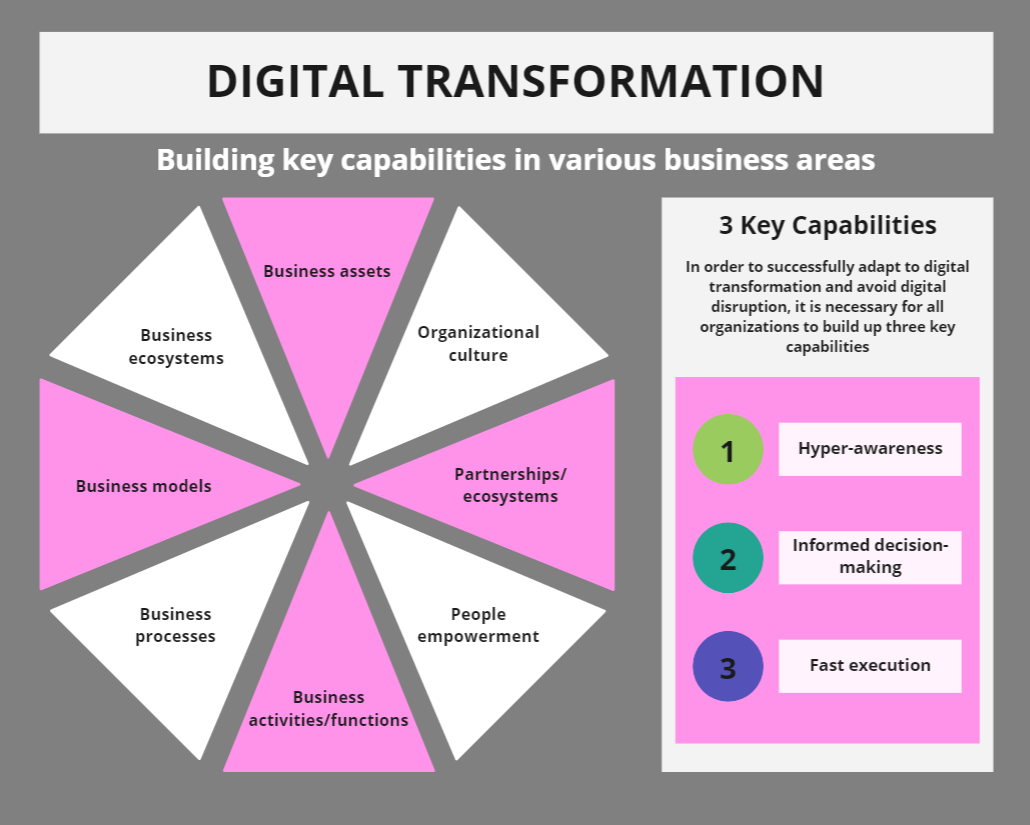
- Business ecosystems: the networks of stakeholders and partners, as well as external elements influencing the company, such as economic or regulatory goals and changes. On the information-based framework of digital transformation, new ecosystems are being developed amongst businesses with varied backgrounds, where data and useful insight are turned into assets for innovation.
- Business models: how firms operate, from the value proposition and go-to-market strategy to the methods they try to generate money and successfully alter their core business by using innovative income sources and techniques, and occasionally even abandoning the conventional core business after a period.
- Business functions /activities: customer service, human resources, operations, human resources, administration, marketing, etc.
- Customer, partner, and worker approaches. The human element and strategy come first in digital transformation. It is important to consider how every stakeholder’s behaviour, expectations, and demands are changing. This is demonstrated in a variety of change-related projects where factors like customer-centricity, user experience, worker empowerment, new workplace models, shifting channel partner relationships, etc., may all be significant. It is crucial to remember that no matter what these human aspects are, from improving customer experience to increasing worker satisfaction, digital technologies are never the only way to address them. Technology is an extra facilitator and a factor in the equation of choice and basic requirements; people are what involve, respect, and empower other people.
- Business processes: one or more interconnected operations, tasks, and sets that work together to accomplish a single corporate objective; here is where business process management, business process optimization, and business process automation come into play. Business process optimization is crucial to digital transformation initiatives, and in the majority of businesses and situations, it combines internal and customer-facing objectives nowadays.
- Ecosystem and partnership models: a growth in cooperative, collaborative, co-creative, and last but not least, completely new business ecosystem techniques, which result in new company models and income streams.
- Organizational culture: the acquisition of key competences across the board in areas like leadership, digital maturity, knowledge worker silos, and so on that enable one to be more future-proof is achieved by having a clear hyper-aware, customer-centric, and agile aim. Processes, commercial activities, cooperation, and the IT side of digital transformation all mix with culture. Changes are needed to bring applications quicker. Development and operations make up DevOps’ fundamental components. Change is also necessary for enterprises, processes, and activities to integrate IT and OT.
- Business asset management: within which traditional assets are prioritised, but less “tangible” assets like information and customers are also given more attention (improving customer experience is a key objective of many “projects” of digital transformation, and information is the foundation of all business activities, technological advancements, and interpersonal interactions). Customers and information must both be considered real assets from all angles.
This is not a complete list, and many of the described factors actively interact with one another. The focus is on the business, which by definition requires a holistic view of the digital transformation, where factors like customer experience, technological advancements, and innovation with a clear purpose, as opposed to buzzwords, are crucial components. We also look at “disruptions” and “digital transformation” phenomena that have less to do with business.
Therefore, digital transformation is unquestionably more than just disruption or technology. It goes beyond simply changing for the digital era. If the latter, one needs to acknowledge that the digital era has been around for a while and is still very vague.
What is digital disruption?
In addition to being one of the most overused terms in recent years (along with digital transformation as a whole), the term “digital disruption” applies when an industry, method of doing business, or ecosystem (such as the societal one) is seriously threatened by established (mostly tech) companies, newcomers, or incumbents who have mastered digital business skillsets and developed solutions, business models, and approaches that significantly alter consumer behaviour and leave a lasting impression.
However, disruption is not limited to activities by newcomers or incumbents using disruptive tactics. In the end, disruption is about people, about consumers.
Or, to use Charlene Li’s statement: “Disruption ultimately results in a change of power in relationships.” As a human phenomenon, disruption is brought on by changes in how people utilise technology as well as in their behaviour and expectations. New technology and the way disruptive newcomers use them to their advantage may be the cause of these shifts. The change, meanwhile, may also have a larger significance unrelated to technology. Is this still considered “digital disruption”? No. Digital technologies, however, may occasionally be used to address such shifts in behaviour, expectations, demands, and so on.
Disruption frequently occurs in the final mile of the consumer experience, as Sameer Patel notes. We would claim that disruption generally frequently occurs at the many business edges, including the last mile, the consumer, the larger ecosystem, etc. Considering the disruptive effects that evolving economic realities and laws, for instance, might have on the larger ecosystem is crucial; this emphasises the necessity to place advice on digital transformation in perspective.
When you consider the disruptions and rising demands at the edges (for example, consumer expectations) which then push digital transformation, it seems logical that digital transformation frequently focuses on the edges as we stated.
We frequently claim that technology never causes disruption. However, it is a bit of a challenge sometimes.
We prefer to suggest that, as was already noted, the disruptive potential of technology lies in how they are used and embraced. If we ignore the minor point that certain technologies are not disruptive, it becomes evident that some innovations have caused greater disruption than others. We have already covered a few. A major game-changer was social. Mobile is another since it results in the ability to “be mobile”. Other examples are cloud and massive data analytics. In reality, artificial intelligence and information play a crucial role in all so-called third-platform technologies and their accelerators.
Recently, the development of an Internet of Services and an Internet of Transformation, which will ultimately become the Internet of Things or IoT, began playing a significant role in digital transformation.
However, the Internet of Things, or IoT, the mechanism by which we advance to the next stage of the Internet, is still in its early stages. As a result, the concept of the Internet of Things, which is just another word for the network of items with integrated or linked connectivity and the ability to sense, send, analyse, and/or receive data using Internet technology, is useless. But it will also serve as the common thread for most transformative evolutions. The Internet of Things has so far failed to provide many consumer applications with genuine innovation or concrete benefits. The latter is also owing to technologies such as additive manufacturing and sophisticated robotics, which are just scratching the surface of their disruptive potential.
Is there a further stage? There most certainly is. For the time being, we’re going totally hybrid in all aspects, including the integration of digital technology into humankind, which will be the fourth platform.
We believe that, given the information we just provided, the Internet of Things, cognitive/AI, big data, and artificial intelligence (AI) systems will be the next most disruptive technology. The hybrid stage has already settled, for example in an industrial environment where the cyber-physical system and, again, (industrial) IoT, are essential elements of Industry 4.0 and the Industrial Internet. The human aspect and value, however, continue to be crucial at all times.
Possible origins of transformation and disruption
There are many aspects that may cause digital business transformation and disruption:
- Innovation- and invention-induced. Disruptive innovations include those that establish a new reality, whether in science, business, technology, or even a non-technological setting, as well as wholly original responses to societal and commercial difficulties. What could come after the printing press, the train, and the discovery of medications that transform healthcare and society (as has happened several times in the past)? The biological sciences and the use of technology within the human body and mind are probably your greatest bets.
- Technological innovations, which have greater influence than before. Yet again, the disruption or change is not being driven by technology. It is how consumers, partners, rivals, and other stakeholders use and adapt it. IoT, AI, edge computing, virtual and augmented reality, blockchain, and other technologies have a strong potential for disruption. However, when they come together and open up new applications, as we see in the convergence of AI, IoT, and big data analytics, they have the most disruptive potential. The integration of IT and OT is also a game-changer in industrial transformation.
- Ecosystem-induced. Organizations are a component of larger ecosystems, which include business ecosystems as well as the social and environmental ecosystems in which they and we exist. Businesses, as well as the social and natural ecosystems in which they and we exist, are all parts of larger ecosystems, which include business ecosystems. Economical changes, partner demands for you to adapt, advancements toward collaborations in transformational business ecosystems, regulatory changes, geopolitical and societal changes, as well as unforeseen occurrences like natural disasters or even a pandemic, like the impact of COVID on digital transformation and society, are all factors that can have an impact and push transformation.
- Customer behaviour and demands. Technology is not always an element in such a ‘customer-induced’ transformation and disruption. This so-called customer-induced revolution and disruption have nothing to do with technology. When technology is incorporated and transformed into business issues, it frequently facilitates or, as previously said, causes it. A force that drives digital transformation that is not caused by technology but rather boosted by it in tandem with other causes is consumer demand for ease of use and simplicity in dealing with companies, which is much older than today. It dates back to a time before the Internet was even invented. In that sense, digital transformation may just be catching up because businesses no longer have any choice. Disruptions on a social level might also influence customer behaviour and requirements.
And this ecosystem factor leads us back to a key part of digital transformation: the interdependence and connectivity of everything – and the necessity to think holistically, across industries, and with present and future transformations in mind, as previously discussed.
Everything overlaps and is interconnected, from disruption to business processes and models to business operations and each activity of the firm and the larger ecosystem in which it functions. Consider how nearly all business operations are in reality linked, the interconnectivity of company activities from the customer’s perspective, the way information flows across all digital changes, the influence events might have on an economy, and much more. Scenario preparation is essential in this case.
Why is it important to use the holistic approach?
So, while we have only discussed certain aspects of digital (business) transformation, it is critical to have a holistic view.
Businesses have always changed and improved, technology has always brought with them new difficulties and possibilities, and norms and ecosystems have always developed. That is not new.
Digital (business) transformation is to be seen as more than just a buzzword but as a challenge, force, and most importantly opportunity for organisations that will enable them to achieve the core business competencies they need to succeed in rapidly changing environments.
Are we on the same page?
To ensure that we are on the same page we need to stress that digital transformation is not just about the following things:
- Technological disruptions, despite their connection to technology evolutions and awareness that “new” technologies might in fact have a “disruptive” impact since the disruptions are always about consumers, employees, markets, rivals, and stakeholders.
- Digital marketing, even though it is a significant component of corporate operations and the setting in which digital transformation is frequently applied.
- The digitalization of information (flows) and business processes, which is just a condition basic condition, or the conversion of paper into digital information as originally intended.
Finally, the reason we prefer to talk about accelerated business transformation—or, if necessary, digital business transformation—is because it will not be long before people stop distinguishing between digital and physical, offline, and online. For instance, customers do not think in terms of channels or any of these concepts at all.
The usual suspects and digital business transformation
Digital transformation is not only about technology, and it is not just about businesses in the technology sector or the tech start-up environment, either. This common misconception can partly be explained by the fact that these “usual suspects” (Uber is arguably the most cited and problematic example) are really “disruptively” leveraging digital technology to modify current patterns and marketplaces and – at least as important – get a lot of attention.
But focusing just on the numerous IT businesses that we constantly use as illustrations of the digital revolution is a mistake. It is easy to overestimate start-ups and the technology success stories that everyone talks about, even though some have in fact been “disruptive” in the sense of forcing larger players to adapt or fail. This is especially true when compared to the organisations that have successfully implemented digital transformation in “less attractive,” but occasionally much more difficult and interesting fields.
Disruptors like Uber and the other typical suspects are receiving attention from the media and tech enthusiasts, but this attention is not without risk and hype. Leaders of digital transformation may be found in almost every sector and are frequently not the darlings of people who are fascinated by digital technology and businesses in general. The business goals, issues, customers, and context of the company come first in digital transformation, which is industry-agnostic.
Although not all and at varying rates, incumbents are also changing. In certain areas, including banking, there are changing alliances between established companies and “disruptive” start-ups. Last but not least, any future evolution has the potential to disrupt these so-called disruptive businesses as well. Long-term success is not assured, and digital-only players eventually satisfy the desire for human contact as well.
Digital transformation can be implemented in any field
So once again, digital transformation affects every industry. However, since it may have an influence on the business model itself, it can also have an impact on all of the organization’s activities, divisions, functions, and procedures.
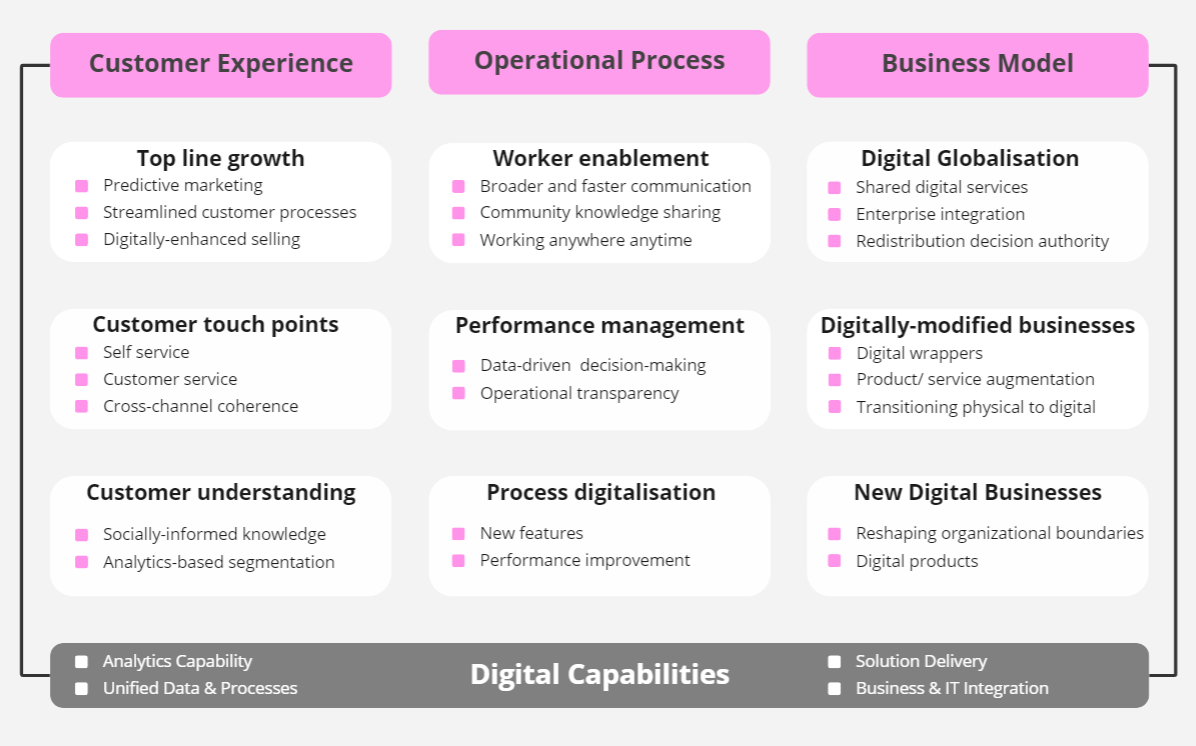
As you can see in the example below, CapGemini Consulting was one of the first to develop the idea of digital transformation and a framework for it. A three-year study by the corporation and the “MIT Center for Digital Business” described an effective digital transformation programme as one that considered the what and the how.
The following McKinsey chart highlights a few areas where digital transformation might be useful:
- Risk optimization, digital fulfilment, enhanced corporate control and so on.
- Innovation in products and services, for instance, where co-creation approaches may be applied.
- Distribution, marketing, and sales are three other common suspects that, together with customer service, are frequently among the first industries to experience a digital transformation.
- The consumer experience.
We can also add other fields such as:
- Education and learning.
- Human resources and workforce engagement.
- Intelligent management of information where processes, information and data are the key and a focus on activation.
- Supplier relationships and supply chain management.
- Customer relationship management and customer service.
It is crucial to remember that in the context of a digital transformation (and, for that matter, a digital business), all these aspects, functions, processes, etc. are interconnected and silos have less (or no) place, not just from a technological perspective but also, and most importantly, not from a perspective on processes and people.
The example below demonstrates that digital technologies can influence every aspect of modern businesses.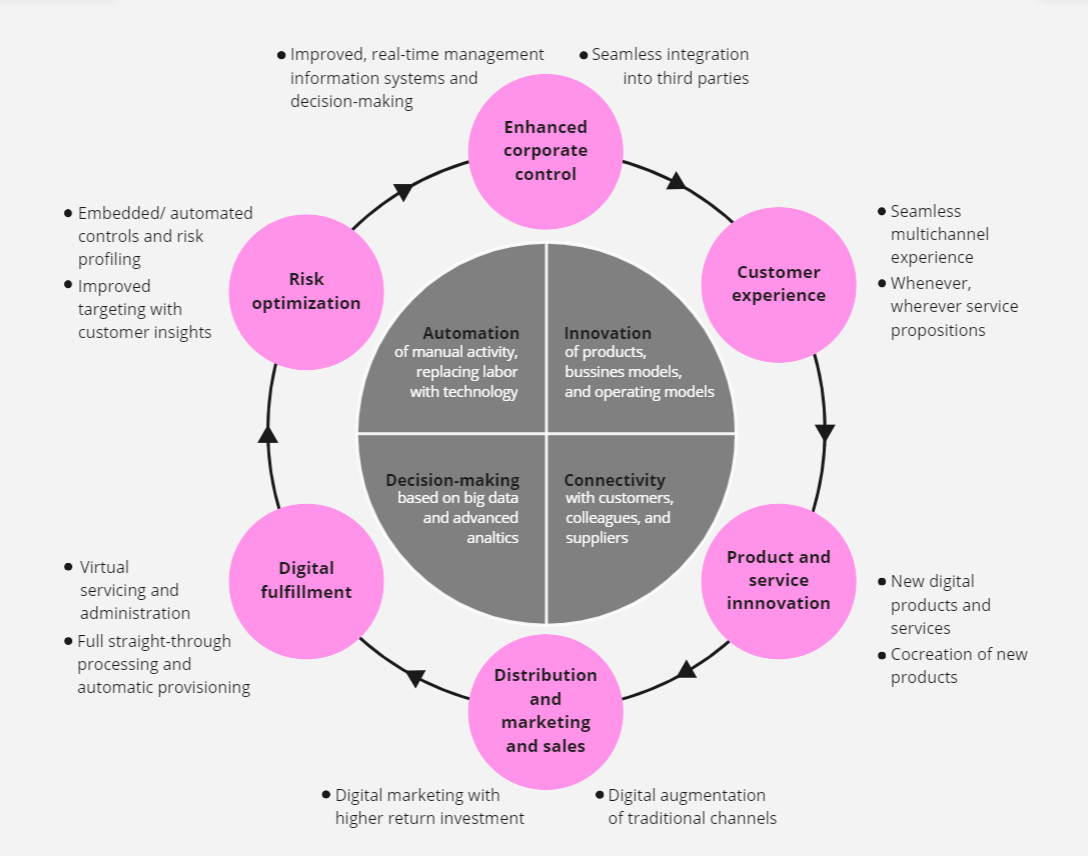
Myths and realities about digital transformation
Many businesses are paying close attention to digital transformation. Focusing on real business and consumer concerns, having a clear, constantly staged strategy, prioritising, and including all stakeholders in any digital transformation project are crucial for reaping similar benefits.
In this article we would like to highlight these particular realities:
- Top-down leadership is guiding digital change (or at least requires firm buy-in from the top – and all stakeholders if it wants to succeed in an enterprise-wide way).
- As mentioned before, each field (including yours) is influenced. No matter the industry, neither clients, staff, partners, rivals or new, disruptive competitors will wait for business to catch up.
- There are common traits both among digital leaders and the paths to digital transformation.
- IT relationship is the key.

Digital transformation economy
The role of digital transformation is evolving, with strong roots in the growing use of 3rd Platform technology and the transformational consequences of this adoption by enterprises, employees, customers, and even people.
IDC describes a digital transformation economy as having a clear focus on the (digital) customer experience and the entire stakeholder experience while also minimising costs, innovating, and creating competitive uniqueness.
IDC imagines a future in which this layer—where the optimization, transformation, and innovation as a whole accelerates—is added to the third platform, which is more significant than simply observing an additional layer to the core technologies and innovation accelerators of innovation and transformation.
As a result, the DX economy will develop. But do not forget that despite all of the technology, it is still about the (digital) customer and stakeholder experiences, or the human dimension, which is enabled by processes, information, and 3rd Platform evolutions in the first place.
5 steps to move from transformational technology to transformation economy
Considering the previously noted remark concerning technology and IT, there is, of course, an obvious relationship with digital technologies. So, let us analyse the evolution of the digital transformation economy.
- Step 1: Digital business and the 3rd Platform
IDC launched the Third Platform in 2007, which at the time had four technology and commercial pillars: the cloud, big data/analytics, social (enterprise), and mobility.
Gartner referred to it as the “Nexus of Forces” and spoke about SMAC, as did others (social, mobile, analytics and cloud). Whatever the name, what mattered was that these technologies and, more importantly, their adoption by consumers, employees, and businesses, their impact on changing behaviour, and the ways they were leveraged to achieve various goals, were significantly altering the business reality—a digital business reality.
- Step 2: The third platform’s innovation accelerating mechanisms
Several other technologies that IDC referred to as innovation accelerators were added to the 3rd Platform, which is followed by the client-server model period and mainframe era, respectively.
3D printing, the IoT, robotics, natural interfaces, cognitive systems, and next-generation security are a few of them. With a stronger emphasis on business and customer innovation, we are still primarily dealing with technology.
- Step 3: From the stage of digital transformation to innovation
We now know that new business models, new ways to engage customers, new revenue ecosystems, and other forms of innovation become essential as long as the foundations, goals, strategy, culture, and vision are in place This is true, at least at companies that have deployed initiatives with a clear maturity in various areas and a longer-term vision.
The aforementioned technologies and how they are applied lead to that infamous next wave or an additional layer of innovation and digital transformation, with the digital customer experience, innovation, competition, differentiation, automation, cost reduction, optimization, speed, and experiences of stakeholders serving as business drivers. Information is crucial to allow innovation, according to IDC, which in turn led to the innovation stage. Information and IT proficiency are required for digital transformation.
- Step 4: The acceleration of transformation and innovation
In the upcoming years, this stage of innovation and further issues caused by disruptive business models will increase.
In other words, we (will) see that the pace of innovation and transformation is changing, leading to a stage where the disruptive impact of digital transformation is about to be felt in every industry as businesses flip the switch and massively scale up their digital transformation initiatives to secure a leadership role in the “digital industrial revolution,” as IDC’s Frank Gens put it.
- Step 5: Digital transformation at the centre of a new economy
Last but not least, it is this “digital industrial revolution,” also known as the “DX economy” or “economy of digital transformation,” that will place digital transformation at the core of growth and innovation plans.
They will have a much greater and quicker impact on all industries. Additionally, the “conventional” pillars of the third platform (cloud, big data/analytics, mobile, etc.) as well as innovation accelerators like the Internet of Things, cognitive (artificial intelligence), and others will be crucial in this progression.
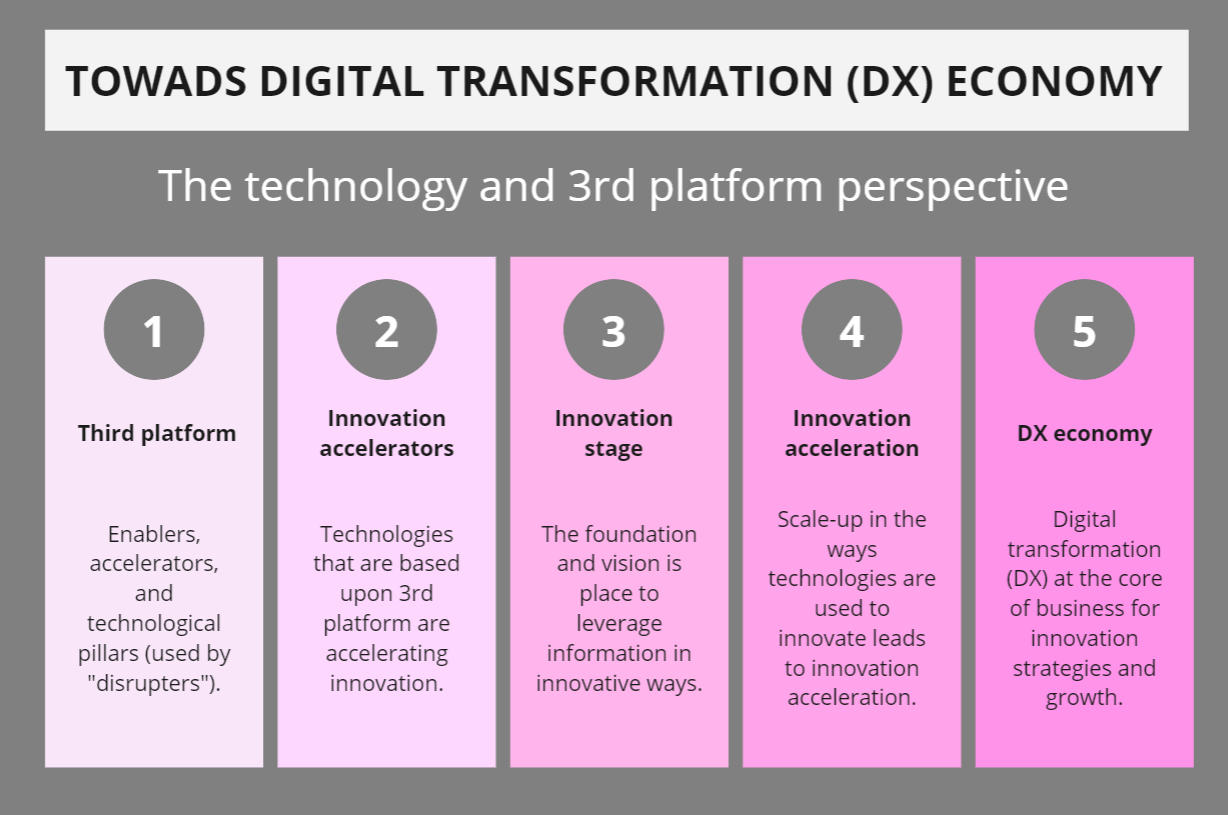
The economy of digital transformation: DX shifts to the centre of business
Technology in general, including digital, has always had a significant influence on business and society. One of the changes we have noticed in recent years, as was already noted, is how quickly everything is developing. The rate of technological development and evolution is increasing quickly, with consequences that are constantly growing.
Different sectors will experience this speed differently depending on the circumstance. It is closely related to the potential impact “new technologies” may have on a certain sector of the economy, as well as to market dynamics, consumer and stakeholder types, go-to-market strategies, and many other factors. Speed is still essential in many ways. Any field can always have a company that recognises and seizes chances that its rivals do not. And regardless of industry, in some areas and operations of the business, a delay is simply not an option.
Finally, exponential growth or rapid change may occur at the most unexpected times in any field (consumer behaviour, legal frameworks, technological advancements, etc.).
Business transformation involves altering the status quo and creating the circumstances necessary to be prepared for quick changes and, ideally, proactive and in control.
Acceleration of innovation and transformation
Although a number of technologies have increased disruption, corporate innovation, and changes in human behaviour, the exponential growth and speed of change are still only a small portion of what is still to come.
Even though digital business transformation is not specifically about digital technologies, it is evident that the adoption of technologies such as social business, cloud, mobility, Big Data (analytics), cognitive computing, and the Internet of Things, among others, will always accelerate social change.
The actual acceleration, however, occurs when innovation and change as a whole accelerate at an exponential rate. And that is what analysts mean when they refer to the “digital transformation economy,” or DX economy: not just the acceleration of disruption and change, but also the acceleration of the actual digital transformations and innovations leading organisations will undergo, increasing the size the of the gap with laggards.
Concentrate on the outcomes and the future
There is a “pro-sponsive” component in addition to a dimension of responsiveness/agility in a quickly developing context (remember: not linear but exponential), which de facto necessitates a higher degree of agility and connectivity.
Being the disruptor rather than being disrupted, anticipating change, innovating, and simply thinking and acting outside the box of the usual, the past, and the present are all aspects of this. What counts is how these “pro-sponsive” techniques perform, which takes us to our next issue.
But to accomplish them, many requirements must be met, in a frequently staged approach and always involving people, processes, and technologies.
Digitalization, digital transformation, and vital elements
Digital transformation has also been used historically to refer to the digitalization of paper into digital formats and procedures.
Digital transformation in the broad sense obviously requires these digitalization elements, which involve converting paper-based information into digital data and processes in a more ad hoc manner.
Digital transformation initiatives need several components to be successful, and digitization is one of them. Four of the various components—related to technology, people, and/or processes—are mentioned below.
Change management
There is not only a chance for change and examining what can be done better and what should be (re)connected, but also a requirement for change management, as is the case with almost all significant changes that influence numerous stakeholders, divisions, processes, and technology.
There are now even more chances for change and demands for change management as a result of understanding the significance of data and analytics in digital transformation. This is not new; for instance, when web analytics gained popularity, their implementation and the linking of various data and analytics “silos” in the customer/marketing space frequently demonstrated a clear need for digital transformation in many customer-facing and customer-oriented operations, long before the term was created. Take advantage of the possibilities and meet the challenges.
However, it is clear that the human element of change management comes first and foremost—internal customers, stakeholders, and the larger ecosystem in which organisations operate. Without putting people first and getting them on board, no organization—business, government, or non-profit—can achieve a significant digital transformation. Failure and, on a larger scale, resistance may result if changes are made too quickly for people to adjust to them or if their concerns are not taken into consideration.
Prioritisation
For almost any project involving digital transformation, there are road maps available everywhere. However, roadmaps are what they are, and what counts more, within a larger reality, is the goal, priorities, pain points, and actual demands of the particular company and the individuals in its ecosystem.
There is seldom a single solution that works for everyone, and digital transformation initiatives are guided by goals, objectives, and priorities in addition to shifting ecosystem conditions. Priorities also refer to prioritisation, which frequently entails taking a look at low-hanging fruit while always keeping the next steps and ultimate objectives in mind, as well as understanding that these goals will change over time, as would the environment in which they were created.
Digitalisation
It has been brought up before, but it is significant. It is wrong to believe that businesses are truly prepared for substantial digital change on a large scale.
Too many gaps still exist between the automation and digitization of current operations. Even worse: Sometimes what is described as digital transformation is “simply” digitalization (turning paper into electronic information into processes). In a setting of digital transformation, you need digitalization to optimise, but digitization is different from digital transformation. The combination, strategic connections, and the activities you do to accomplish company objectives through digitalization and data combining are important.
The gap between front-end operations and back-office procedures is also getting wider. The banking sector provides a good illustration of this phenomenon because of the severe divisions between the back office and the front end. We all are aware of the numerous digitization efforts that are still needed in many facets of business and society, whether it be in our day-to-day interactions with other “business people” or in the frequently pointless administrative tasks associated with our governmental or financial “duties” and interactions with businesses that force us to use paper, the phone, or channels we really don’t want to use any longer.
Skills, silos, and responsibilities
The capacity to collaborate across silos is essential for successful digital transformation, just as it is for social business, digital business, and any other customer-centric marketing and business activities. In certain instances, digital transformation even entails a total redesign of organisational structures, which may involve the removal of specific silos and collaborative approaches, Centers of Excellence, and other structures.
Even while it must be held because Chief Digital Officers, CIOs, and other CxOs all play a role, the discussion about who is ultimately responsible for digital transformation as a whole and inside certain activities and processes is outdated. Again, there is no perfect answer when it comes to duty since context matters.
Both IT and marketing should learn from one another. Or, for example, customer service from sales, sales from the contact centre and so forth. Although the purpose of digital transformation is not to create a digitally literate culture, today’s CxO must not just be digitally literate but also aware of 1) what others are doing and 2) their experiences, approaches, and skill sets. Concerning the discussions surrounding responsibility, there are several choices available since “no one size fits all.”
Strategy is the key to success
A strategic plan is essential for enterprise-wide digital transformation in the genuine sense as we previously described it.
It appears to be nearly impossible to create a digital transformation plan given the numerous elements, technology, processes, people, goals, and linkages that are needed. But luckily you can achieve it if you study the topic thoroughly.
Asking proper questions will give you proper answers
It is undoubtedly one of the causes of the variety of generic frameworks and maturity models for digital transformation.
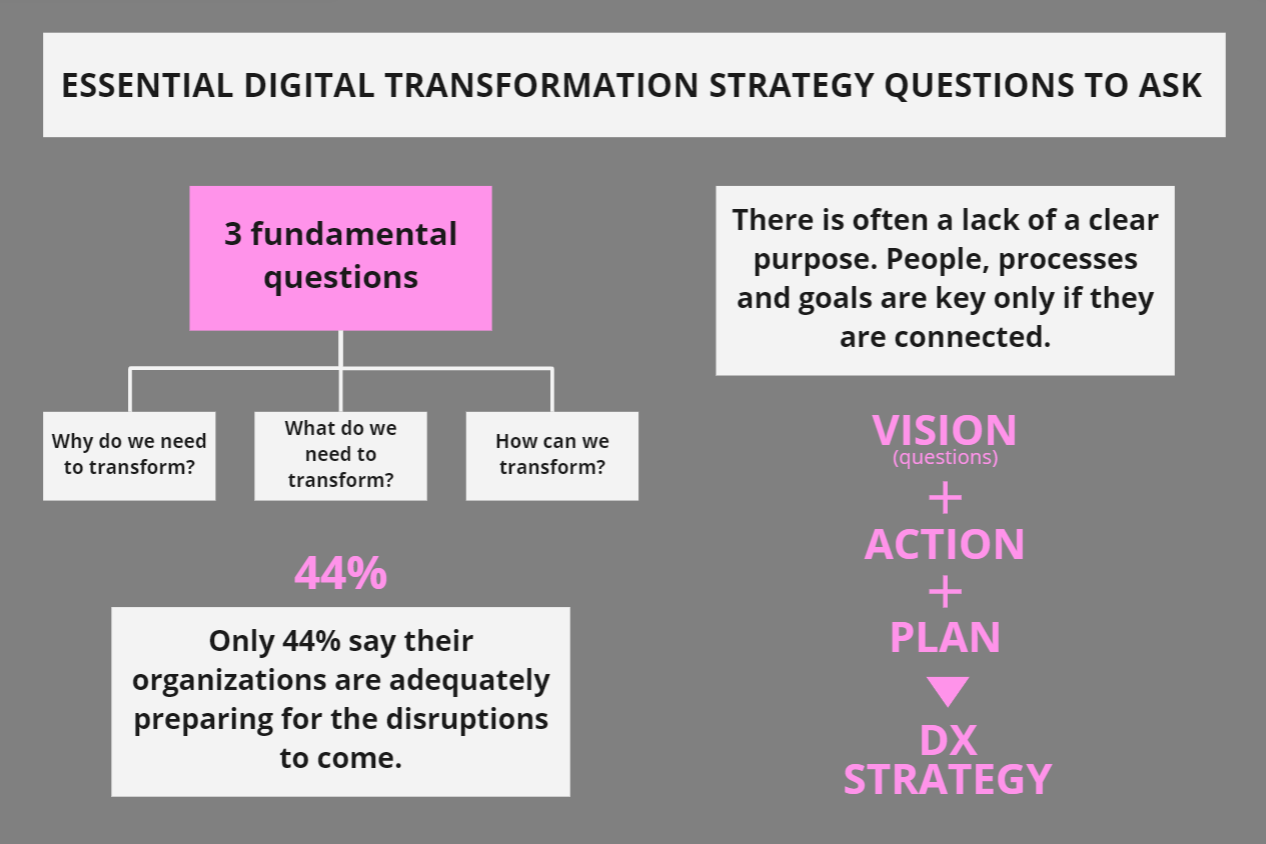
However, how can you begin with a digital transformation plan that works for your present, your goals, any prospective disruptions, your employees, your market, and your clients given that every company is unique?
Simple solutions and frameworks are rarely sufficient for dealing with complicated problems and questions. However, we observe in practice that simple questions are rarely even asked, hence simple answers are likewise absent.
It is a common pattern that we observe in many economic and technological fields. When technology is engaged in digital transformation, Internet of Things initiatives, marketing, or anything else, we seem to neglect the basics.
Digital transformation and digital maturity benchmarks
The importance of benchmarks and frameworks for digital maturity is substantial. Frameworks and standards for digital maturity are useful. They show that, as we defined digital transformation earlier, it is a journey towards acquiring a set of capabilities and changing a variety of processes, functions, models, and more to (be able to) leverage the changes and opportunities of digital technologies and their impact across society in a strategic and prioritised way.
There are, however, a few consequences:
- Digital transformation involves more than simply one project, approach, or exercise in optimization. It takes time and is a given from a holistic perspective. There are various elements and intermediate objectives. The views of digital maturity illustrate the fact that it comes in little steps.
- The numerous phases, processes, initiatives, and so on that make up the context of digital transformation all have one or more objectives as such, but they also fall within the more general purpose that we just defined by making reference to (part of) our definition. Or, to put it another way, you have a plan and an aim in mind.
- Although it may appear to be a contradiction in terms, digital transformation is a journey rather than a destination. Along with shifting market conditions, competitive landscapes, and other factors, new technologies will present both opportunities and problems. While preparing us for them is one of the objectives of digital transformation, that goal itself is changeable.
- Change is a constant. This means that from the perspective of a digital transformation strategy, uncertainties, risks, and changes are taken into account for each incremental step and the larger goals. However, it also means that a digital transformation strategy comes with agile possibilities to change course, thanks to intermediate checks and balances and a “hyperaware” ability to continuous improvement or change.
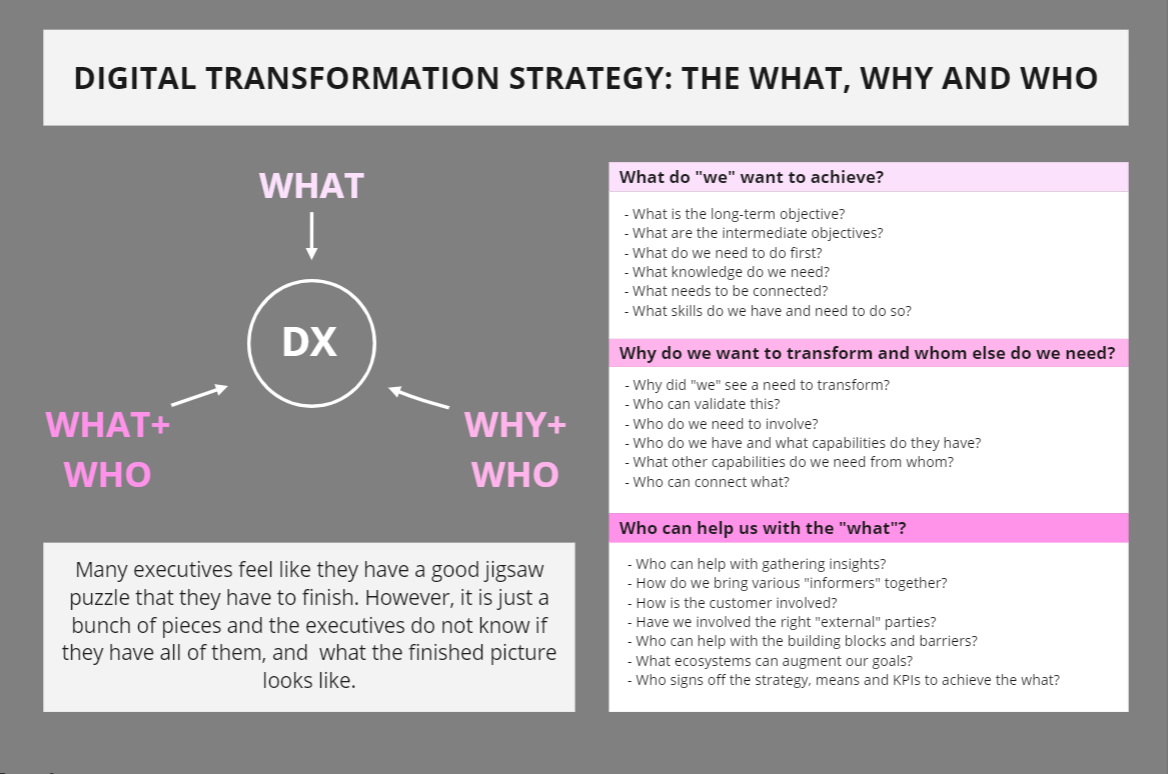
Digital transformation strategy – the first step
The fundamentals that were previously discussed deal with the initial stages of developing and implementing a digital transformation strategy. Furthermore, they are about what, why, and how as always.
But we have to draw a distinction in this case. As you are aware, there are many different perspectives on digital transformation.
- Some view it as one or more initiatives within the framework of digitization (which it is not) and digitalization (which it can be). Depending on the type and size of the project, what, why, and how might be answered quite differently in certain situations.
- The term “digital transformation” is used by others, including us, to refer to this comprehensive transition. In this situation, the objective (the what, supported by the why) is a digital transformation capability as such, at the very core of the business, whereby digital transformation becomes the condition and enabler of the capacity to fully leverage changes and opportunities of (digital) technologies and their impact.
However, as previously said, this process takes time and calls for many little steps. The aim, or “the what, why, and how,” then combines with more general, major objectives to take on greater significance.
Sustainability, coronavirus, and the influence of challenges in the future
Due to the COVID-19 pandemic, the pace of digital transformation began to increase in 2020. Many – obvious – sectors became more “digital” than before as corporations and communities as a whole were forced to use technologies across almost all facets of business and even our personal lives.
COVID-19 and the beneficial effects of the actions made by enterprises and the government are omnipresent in predictions for the world economy, which also include IT, digital transformation, etc.
One of the most important long-term effects is that companies increase their investments in digital ecosystems, digital experiences, and other related areas in addition to revising their digital transformation roadmaps and organisational structures.
Additionally, even while this is not only about COVID-19 alone (climate change is becoming more important, and with it, sustainability, to offer just one example), we should expect the maturity of digital transformation programmes and systems to improve.
Simultaneously, it is anticipated that an increasing number of companies will have thorough implementation roadmaps for digital transformation that consider “real change” in all spheres of business and society.
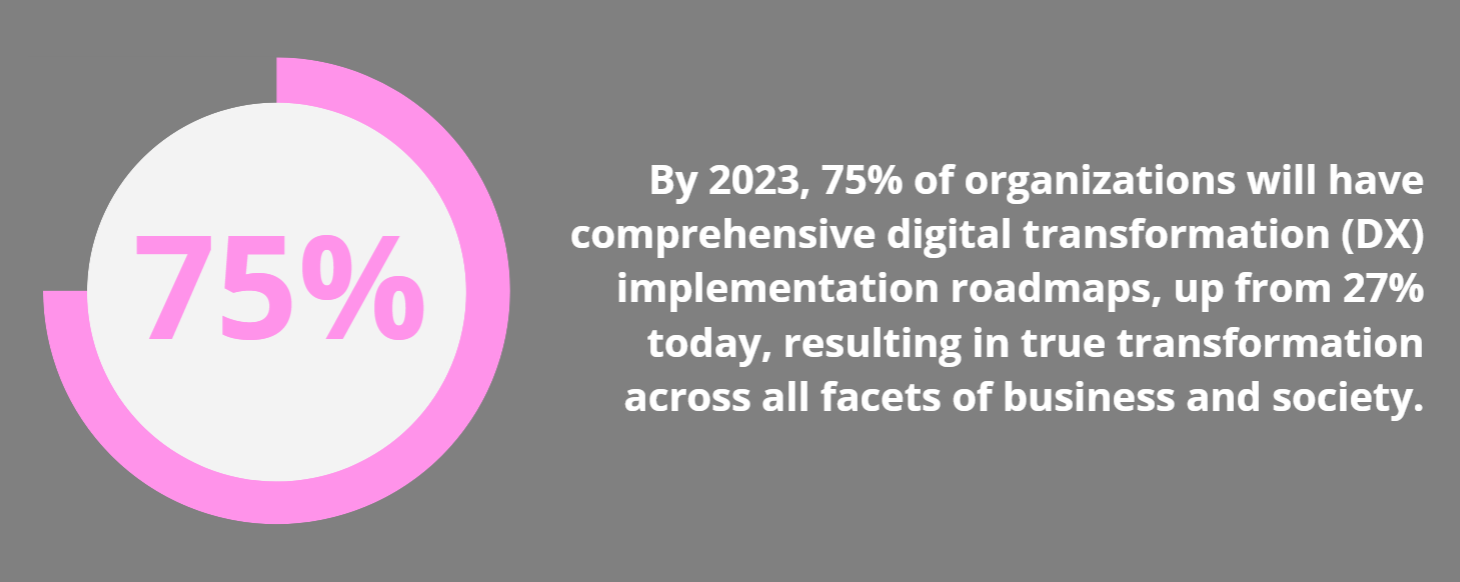
In addition, IDC anticipates rapid investments in digital transformation with a growing emphasis on business model innovation (futureproofing) and the integration of digital and sustainability, among many other predictions.
Now possibly more than ever, the future will bring extremely uncertain and subject to geopolitical developments, and IDC considers larger enterprises. However, it’s evident that generally, digital transformation has accelerated and will do so in many domains.
In recent years, COVID-19 and our present challenges have further accelerated the need for a holistic transformation approach rather than just ad hoc optimization and digitization/digitalization initiatives whereby business model transformation, futureproofing, ecosystems, etc., become more critical in this way.
This could be a few steps too far for many businesses. Even so, it may surprise you how small organisations that are a part of the right ecosystems can change from the edge and even at the core, where such change is frequently required due to, among other things, the pandemic (and a change in thinking), those geopolitical events, climate change, an unavoidable few years of economic hardship, etc.
Customer experience and digital transformation
The user experience and the customer experience, which are not the same things, are typically prioritised in initiatives involving the digital transformation. But for many digital transformation initiatives, the customer experience serves as a catalyst and motivator.
The customer experience is not the sole responsibility of one department, and a transformational strategy by definition involves several stakeholders, including the customers.
Although customer behaviour and expectations have been impacted by technology, which also makes changes possible, the emphasis is on people and processes. Multiple components, divisions, caveats, procedures, and technologies must be considered to genuinely improve the customer experience in an organizationally wide and comprehensive manner.
In the context of customers and the customer experience, the people dimension is possibly the most important of all. The customer experience is arguably another important area where business and IT come together from a transformational standpoint.
Marketing and digital transformation
The customer experience has taken on a central role in marketing, customer service, and other procedures that are directly related to customers, just as it serves as a driver for many digital transformation initiatives.
One of the many industries undergoing a digital shift is marketing.
Important factors in this area include the digital customer journey, analytics and data-driven marketing, social CRM, the contact centre, and – once again – the customer experience. Before everything else, the urgency for digital marketing transformation is driven by shifting consumer expectations and behaviour. Marketing must evolve and collaborate more closely with other departments, including IT and customer service.
Last but not least, the linked optimization objectives go hand in hand with the requirement for digital marketing transformation.
Hyper-connected optimization and digital transformation
The urgent requirement for a more comprehensive and linked strategy towards (customer-centric) optimization is a key driver for “digitally” transforming, regardless of technology advancements, their rapidity, or the impact of their adoption.
For far too long, attempts to optimise have been carried out in isolated and disjointed ways, whether they were focused on business operations, marketing optimization, or raising the bar for customer service.
This is no longer possible given the environment’s rising connectivity and complexity among customers, employees, partners, and other stakeholders.
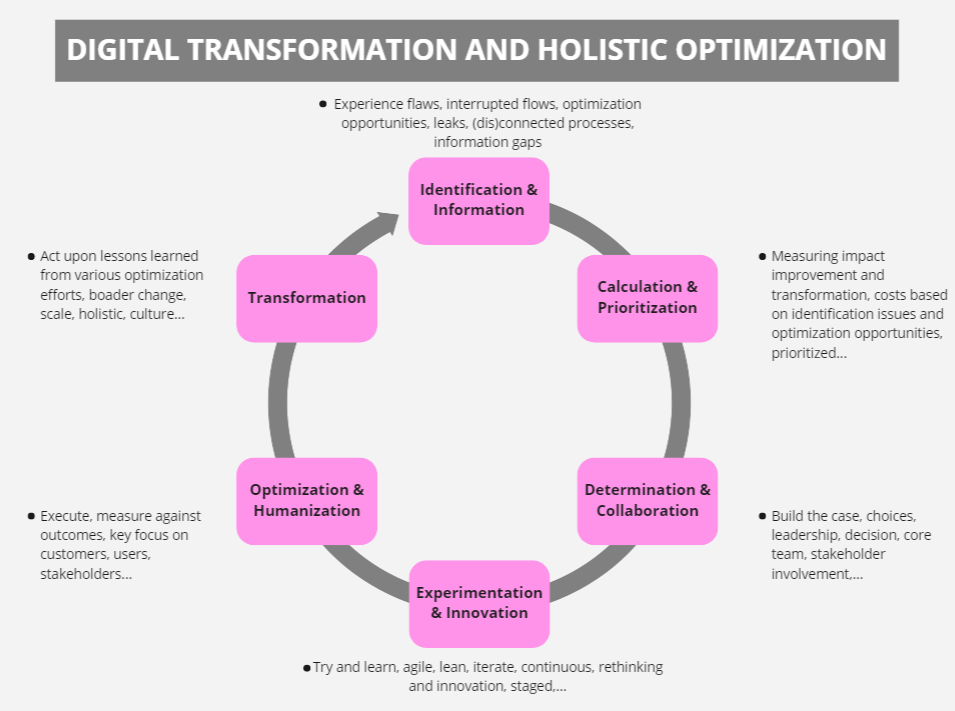
Holistic optimization considers the big picture of improvement, not just by observing how everything in an optimization ‘chain’ is in fact connected, but also by putting in place the necessary transformations and innovations to optimise in a far broader and more interconnected way than ever before: beyond functions, divisions, silos, and anything else that prevents end-to-end optimization and experience flow.
This emphasis on optimization through digital transformation is closely related to the aims of improved (customer) experience and stakeholder involvement. It is typically associated with the process improvement, automation, and cost savings.
Digital transformation and the main role of information and data
Despite the fact that information is at the heart of digital transformation, the connection between information management and digital transformation is not usually made. This is unfortunate when we consider other components at the core of digital transformation.
After all, regardless of the form of optimization, communication, cooperation, contact, experiences, innovation, and so on, information (or content or data) is a critical success component (on top of human factors, leadership, processes, organisation etc. which also require information).
Info chaos and information in the role of an enabler
According to John Mancini of the AIIM (association of information management professionals), there are four so-called information chaos challenges:
- How can we optimize business processes?
- How can we extract any business insight from all of the data we collect?
- How do we use data to better engage consumers, workers, and partners?
- How can we manage the risk of increasing content volume and complexity?
Converting these ‘information chaos’ challenges into solutions is crucial to the relationship between digital transformation and information management.

However, there is more. Information management plays a role as a digital transformation facilitator and in each step toward attaining digital transformation goals such as improved customer centricity, effective knowledge workers, and operational excellence.
Information and information management are also important in all three sections of the well-known triangle of 1) people, 2) process, and 3) technology/tools.
Intelligent transformation and DX
In the context of digital transformation, ‘managing information’ and data is critical, but it is not enough. In today’s and tomorrow’s information- and data-driven business, the results are more important than insights, intelligence, and actions.
Context, semantics, artificial intelligence, and activation all play a role in this. With the Internet of Things and Web 3.0 on the horizon, the intelligent component is becoming increasingly crucial in terms of making sense of unstructured data, automating, and connecting devices, and putting information to work. We refer to it as “intelligent information activation” for this reason. An intelligent information management strategy enters the boardroom as we transition to information-based companies and as information becomes a component of the capital and business assets of the corporation.
At the same time, engagement, results, and the final mile are taken into consideration while discussing the activities around the value of data.
Making data actionable, introducing devices (IoT) in a more complicated and expanding data landscape, the rapid rise of unstructured data, getting meaning and insights from data, and using it at the appropriate time and right moment for the right reasons and actions are all crucial.
From data management to intelligent data activation
Information management in the conventional sense is no longer the only concern here. Additionally, linking systems and data and even connecting via information is not all that it involves. The requirement to guarantee data quality and the growing need to utilise and unlock data quicker, despite the sheer volume, add numerous components to the information and transformation equation with the introduction of the Internet of Things.
These are some of them:
- Speed.
- Intelligence (as in artificial intelligence as the only method to add and extract meaning from ever more data and as the only way to utilise information and data in an IoT and inter-device environment).
- The necessity to digitise and collect paper-based information (digital transformation requires digitization and thus scanning) closer to the owner, source, and process by switching to paperless (paper slows down digital transformation).
- A holistic security approach.
- A growing emphasis on accuracy, quality, and results.
What all of this mean, and how will it develop? Along with systems of records and systems of engagement, both of which are necessary, we are moving forward into systems of intelligence, intelligent automation, and optimization, ecosystems of code, algorithms, cognitive computing (understanding and beyond), and fast/smart data as strategies for navigating the digital transformation and, conversely, information-based challenges as transformational drivers.
Digital business transformation in a variety of industries
Every company is unique. However, a lot of the lessons we can learn from successful businesses demonstrate that digital transformation has quite comparable effects on different industries. However, it is also important to think about your company and, obviously, your industry.
DX in manufacturing
The third industrial revolution, as defined by the Industrial Internet Consortium, is also referred to as Industry 4.0 or Industrial Internet. The digital transformation of manufacturing is occurring at varying rates, with the integration and convergence of IT and OT serving as critical factors to increase speed and efficiency.
While laggards in the manufacturing industry continue to concentrate only on optimization, leaders are changing to optimise operations, improve customer centricity, address risk, innovate, increase revenues, and, most importantly, tap into entirely new revenue streams with new business models centred around information and services.
This is a crucial error since major manufacturers risk emerging as disruptors without a more comprehensive view of digital transformation.
However, things are changing, and it is becoming evident what the major obstacles are to the Industrial Internet or Industry 4.0 approach.
There are numerous obstacles and opportunities to move beyond the simple optimization dimension and truly transform at the core with the customer and data taking centre stage. These obstacles and opportunities include skill gaps, connected supply chains, real-time economic needs, and uncertainties caused by changing macroeconomic and geo-political changes.
The Industrial Internet of Things, a crucial transformational component of the Industry 4.0 cyber-physical, data-intensive, and innovative services systems and technologies stack, makes up for the fairly delayed enterprise-wide digital transformation in manufacturing. The cyber-physical systems approach and digital twins are two more key concepts in the digital transformation of manufacturing.
By far, the leading sector for the Internet of Things is manufacturing, and as a result, more and more businesses are taking advantage of the enormous prospects. All others aside from those who are behind or lack a clear knowledge or approach.
DX in the retail industry
To keep up with the changing requirements of a client base that is available around the clock, retail is one of the industries that is changing the fastest in the world.
These are the main drivers of digital transformation in the retail industry:
- The COVID-19 pandemic-related risks and uncertainties that have a significant negative impact on the retail sector.
- The results and prospects in fields including data-driven marketing and optimization, employee empowerment, and new technology.
- A desire of many customers for a personalised experience, which is challenging to meet because it depends on the situation and can range from the need to locate and purchase items quickly to the exact opposite: a relaxed and immersive shopping experience with digital technologies that are widely available and used for everything from smart displays to music and ambience.
- Competition from digital and total customer experience champions, as well as rising cost pressures. Fortunately, because of new digital capabilities, there are several solutions to reduce expenses, including digitalization and supply chain management.
- Challenges at the supply chain level, which is critical but is all too frequently under-digitized. Speed, timing, and a clear view are essential.
- The changing expectations of the so-called digital or omnichannel shopper, who doesn’t care as much about channels as we do.
That is OVUM’s crystal-clear message about the shifting retail customer in the age of the digital revolution. We have no choice but to accept and would further add that the retail business is undergoing a complete digital change. From the front end where consumer expectations are requiring reforms and advancements involving a seamless channel-agnostic customer experience, data and information optimization, supply chain digitalization, delivery, back-office operations, and so forth.
Make no mistake, the physical store is still crucial to the retail industry, but customers have also grown to demand innovative experiences that connect the in-store and online journeys—journeys that, in their eyes, do not really exist.
There are other new technologies that are altering the face of retail on top of typical third-platform technology like the cloud and big data. Analysts predict that the Internet of Things will play a larger part in retail, particularly in cross-channel and digital signage scenarios. These application cases obviously have a tight connection to the aforementioned technologies. Expect an ever-increasing presence of information-driven in-store changes that combine a variety of technologies but primarily focus on the fundamental requirements that retail customers have, such as empowered employees who are equipped with the resources necessary to provide prompt and accurate product information.
Winning retailers concentrate on these fundamental consumer expectations and methods to reinvent how they are provided, along with some more “futuristic”-seeming innovations that are beginning to appear in concept shops but of which many will turn out to be insufficient.
DX in the utilities industry
Utility companies encounter a lot of difficulties. However, they are also operating in a sector where digital transformation has the potential to bring about significant cost savings, new products and services, alternative pricing models, improved customer experiences, and even radically new methods of conducting business and connecting with clients.
The Internet of Things, Big Data, and anything deemed “smart” is crucial from a technology perspective. Additionally, investments and developments aimed at increasing consumer awareness of their consumption and giving them hidden controls over it expand the range of potential applications in fields like ecology/environment and shifting supply chains.
DX in the public sector and government
Different countries have different national and municipal governments, government agencies, state-sponsored organisations, and public sector institutions.
There are numerous similarities in the challenges and priorities, not the least from the perspective of digital transformation, despite the organisational structures of the typical areas where governments are involved, such as public healthcare, transportation, public infrastructure, policing and defence, citizen services, or regulation.
While e-government and digital identification projects, from the standpoint of the citizen experience, make the significance of digital transformation evident, in many other areas, the digitalization of processes and project management relies heavily on transparency, efficiency, and coordination.
According to research, most professionals in the public sector are aware of how disruptive digital technologies are for the political system.
- Cost savings are the first driver of digital transformation in government and the public sector. In a world where populations are ageing and a combination of local, national, and geopolitical developments compel choices and adjustments, increased cost transparency and cost reductions are crucial.
- Meeting the needs of a “digital” citizen and improving the citizen experience is the second driver of digital transformation in government. Citizen demands are changing because people’s needs are changing, whether it be in their roles as customers, employees, or citizens. A top goal is to improve the citizen experience for an increasingly mobile and digitally savvy population, whose digital lifestyle conflicts with the frequently paper-intensive reality that is still too prevalent and frustrating.
- Along with pushing digital agendas, governments have recently demonstrated a tendency to lead projects to accelerate digital transformation in areas where the public and private sectors converge as well as in private-to-private environments. Then, frequently in the context of data, they take on an enabler role. An example of this is data-sharing programmes for data-driven transformation and innovation, as demonstrated by the example of a regional European government.
DX in healthcare
The problem of an ageing and growing population, the increase of chronic illnesses, rising expenses, and changing consumer expectations and behaviour are some of the factors driving the digital transformation of healthcare, with digital health playing an increasingly significant role.
One of the factors contributing to the greater emphasis on patient-centricity is the effect that these changed expectations and behavioural patterns have on us as patients. But let’s not forget about the healthcare professionals who use digital and mobile platforms and exhibit changing behaviour as well, making healthcare even more information-driven.
The healthcare industry has undergone a complete transformation thanks to mobile (or “mobile ability”), making it more difficult to boost productivity and employee happiness. In the midst of financial constraints, doctors, specialists, and nurses sometimes have to work in challenging conditions.
This brings up the apparent benefit of efficient and quick access to healthcare information. Another issue is how to pay for healthcare, which makes it necessary to use digital technology to increase income in addition to cost savings. In certain nations that are transitioning to a more services-oriented economy, healthcare tourism, for instance, is even a national goal.
The Internet of Things (IoT) emerges as a crucial game changer to address many of the above difficulties and reinventions of healthcare models as we move towards a more connected healthcare system.
DX in the insurance industry
There are many prospects for the insurance sector to transform via the use of technology.
Telematics, the Internet of Things, the use of predictive analysis (risk), new business models, and pay-as-you-go insurance strategies are a few of the common topics that are frequently highlighted.
For instance, the majority of customers would agree to have a sensor installed on their home or automobile if it meant lower insurance costs. Although technology presents enormous potential that insurers are embracing more and more, there are also drawbacks. Younger customers and policyholders’ changing expectations are key factors in this. Additionally, there is a lot of work to be done in crucial business processes including managing insurance claims, providing customer support, and responding to changing regulations. InsurTech’s growth and the fact that consumers purchase insurance through non-traditional suppliers, such as retailers, are further factors.
DX in banking
Banking is another example of a sector or business that, despite contextual differences, faces urgent challenges related to digital transformation.
DX in retail banking
Although retail banking is experiencing several changes, disruptions, and digital transformation (challenges), some of them are restricted (or more/less important) to certain geographical areas due to factors like regulations, consumer-related issues, focus-related issues, and even broader societal problems.
Retail banks are working with FinTechs more frequently as a result of their lack of speed, technology, agility, technological (non-legacy) experience, and occasionally even the customer experience skills and in-depth customer knowledge that FinTechs possess. These cooperative initiatives are more significant in certain regions than in others, but there is unquestionably a convergence of incumbents and FinTech in many different forms and sizes.
DX in regional and ‘small’ banks
Without doubt, huge banks are not the only ones undergoing digital change.
An article by Konstantin Didur in the context of community banking provides a nice digital banking framework for regional banks and community banks in practice, with a focus on mobile banking and the gradual deployment of an omnichannel banking platform, as shown above, leveraging tools such as mobile, chatbots, digital payments, and Fintech technologies. However, it also shows deployment stages that might be relevant for larger banks.
DX in transportation and logistics
Few industries have as many interrelated organisations, ecosystems, processes, information flows, devices (from single items, boxes, and pallets to trucks, ships, and distribution centres), and physical distribution and handling activities as transportation and logistics.
The logistics and transportation business is in a state of change due to globalisation, shifting consumer expectations, intense margin pressure, and significant hazards associated with extremely large amounts of data.
In a strict sense, we must distinguish between the transportation of people, animals, and products. While there is no doubt that the transportation of people is being changed, a substantial part of the budgets for digital transformation projects are allocated to supply chain transformation initiatives with the goal of moving from a hybrid model to a fully digital supply chain network model of smart supply chain management in smart industry and manufacturing.
Speed, visibility, digitalization, and digital transformation are top priorities when it comes to supply chain management and the movement of commodities.
The (goods) transportation and logistics industry occupy a leading position in the deployment of Internet of Things projects, Internet of Things spending, and the Industrial Internet of Things market due to the long-standing use of sensors and RFID as well as the need to dispose of over data that enable new business models and better processes.
In this field, which has been using big data since before the term was invented, data analytics are also widely used. The fact that data maturity levels must increase and that digital strategies must be implemented across end-to-end supply chains, however, is one of the many transformative obstacles. It is a complicated situation considering that the sector is quite closely connected and involves a wide range of operations.
DX and business process outsourcing
There is a fine line between business process management and digital transformation, and more particularly, between business process optimization and reengineering for the digital era and the customer.
However, business process outsourcing (BPO) and consequently the BPO industry is also significantly impacted by digital transformation. Business process outsourcing is evolving from its conventional origins of cost reduction and (outsourced) process optimization to a cost plus optimization plus innovation plus value promise.
Businesses have evolving expectations of their BPO partners, who in response must adapt to match these changing needs of disrupted clients.
Business process outsourcers must become much more business-aligned, pick up new skills, optimise and restructure their own processes, and last but not least, look for ways to increase the value of their offerings.
The partners to whom organisations outsource particular business operations also undergo transformation.
The human differentiator in digital transformation
To comprehend digital transformation, it is vital to place people and processes above technology, even though the technology is a change agent – or at least the ways we use it to evolve, innovate, adapt and “pro-dapt”.
Digital transformation involves applying diverse and digitally intensive methods to find new and better possibilities while using digital technologies to improve processes, enhance customer experiences, and concentrate on the area where business and customer value meet.
Digital technologies are now used in ways that go beyond just assisting or enhancing current procedures and approaches. It is a way to use digital technology to modify existing business models or perhaps create new ones. In that way, it also transcends digitization (although it is sometimes a requirement to make it happen) and surely transcends a digital-savvy skillset and capacity.
However, this so-called digital culture is neither the beginning nor the core of the digital transformation. Responding to the changes that digital technologies have caused and will continue to create in our everyday lives, specific businesses and organisations, sectors, and different societal groups is another aspect of digital transformation. These developments are not the result of technology. The human dimension is not only an essential area of attention for the digital transformation; it also catalyses the usage and perception of digital technology, which may have extremely unexpected effects on consumer behaviour, disruptive company innovation, and ultimately, people.
In the end, we need a mindset and approach of continuous optimization, holistic improvement, and a focus on what people need, far beyond the digital context.
DX and linear management thinking
Linear management thinking and siloed approaches have been replaced by hybrid, integrated, inclusive, and fluid ecosystem views that go beyond the traditional extended enterprise model in the face of digital transformation.
In practice, this means that executives need to know more about the various domains involved in digital transformation processes and have a better set of skills.
Understanding customer-centricity is essential for a CIO. A CEO must be familiar with a variety of IT, cybersecurity, and business process reengineering topics. There is more on the list. The ability to connect the dots and shift from a linear perspective toward elasticity and hybrid approaches is necessary because the forces that drive technological innovations also influence the paths taken by economies and businesses (and vice versa). One of the biggest challenges for executives today is figuring out the effects of transitions in so many different fields.
Digital business transformation: the main advantages
While everyone believes that digital transformation is essential to the success of all modern businesses, no one says that it is easy. Digital transformation is multidimensional, complicated, and filled with obstacles that may make even the most experienced businessperson’s head spin. Check out these digital transformation benefits if you need some motivation before beginning your digital transformation journey. These advantages are so important to the success of a modern organisation that you will not believe you ever considered foregoing them.
- Digital transformation provides a high-quality user experience.
High-value businesses understand that they are not only offering things, but also experiences. Beautiful, seamless experiences are enabled through digital transformation, which is based on automation, AI, and self-service technologies. Demonstrate your knowledge of the digital world by providing your consumers with a flawless user experience.
- Human mistakes are limited by DX.
Going digital has the evident advantage of reducing mistakes by removing time-consuming manual data input and human inefficiencies. Digital operations are naturally smoother and less dangerous than any process involving error-prone people.
- Thanks to digital transformation, you can increase customer satisfaction.
Never before have customers had higher expectations. Customers need customized services that respond to their unique demands, on the one hand. However, they do not want to interact with people when it comes to things like accessing, updating, or deactivating and reactivating software since they want things to happen automatically. The ability to apply strong digital tools and strategies, such as automated business processes and per-location or per-industry licence modification, is one of the most obvious benefits of digitalization in business. Directly as a result of these digitalized procedures, consumer satisfaction has grown.
- Digital transformation increases operational efficiency.
By connecting with back-office systems, automating delivery procedures and product updates, enabling inter-device activation, managing numerous product variants, and more, you may decrease overhead costs and simplify tedious manual operations. You can cut down on irritation, increase productivity, and fill income gaps using digital business processes.
- Future digital growth is enabled by DX.
This is one of the most fundamental benefits of dx. The first step that prepares the ground for all subsequent corporate growth is digital transformation. Your company will quickly become outdated if you do not invest in digital business transformation. Industry giants like Blockbuster, Toys R’ Us, and Kodak have declared bankruptcy in the last several years. Why? Because their digital transition failed. The digital transition must happen. It is not the cherry on top of a successful business. You must make changes if you want to survive the digital tsunami that is overtaking the planet. Once you do, you will experience the advantages of digital transformation, and become stronger and more successful over time.
Digital business transformation: the challenges
Although we have more technology tools available to us than ever before, moving forward is not always simple. There are several challenges that can hinder even the most ambitious projects.
Below we present common difficulties associated with digital transformation. But do not worry, we will also explain how to solve these issues.
- You lack a defined strategy.
Digital transformation is much more than just a catchy buzzword. Nevertheless, it’s frequently used without a precise definition. As a result, businesses go on under uncertain circumstances, knowing that they must move forward even when they are unsure of their exact destination.
Your change could not succeed if you do not have a plan in place from the beginning. So, ask yourself: What are the priorities and goals of my company? Are they consistent throughout the company, or are they different for certain stakeholders?
- You lack a skilled IT team.
Every effective digital transformation has committed, experienced IT personnel at its core. Building this team, though, is becoming more difficult. A workforce shortage is growing as more businesses invest in new edge technologies.Is there a solution to this problem? To support your internal team, think about employing outside consultants and specialists in software.
- You lack organizational change management.
The effectiveness of a digital transformation might be hindered by out-of-date organisational structures, ineffective procedures, and restrictive leadership styles. The difficulties of businesses to swiftly shift to a remote business model in 2020 made this more obvious than ever before.
It is challenging enough to learn new tools, but when you include change resistance, transformation may seem impossible.
Fortunately, organisational change management may help your company in assisting employees in becoming more prepared for the future. Instead of only concentrating on the technical aspects of digital transformation, you need to take into account how it will directly impact people by creating a thorough change management strategy.
- It takes time to integrate new technology effectively.
Even if the majority of us are already familiar with using mobile phones and sending emails, implementing new corporate management systems requires a bit more time and effort.
Finding the correct technology is definitely one of the most urgent issues affecting businesses. Implementing too many optimization platforms can, in fact, cause chaos.
It takes effort and research to find the tools that are best for your company. Then there is the adoption period required to teach staff members how to use them efficiently. To shorten the time to proficiency in this, a Digital Adoption Platform (DAP) is strongly advised.