Ripple Accused SEC of Causing $15,000,000,000 Damages, in early December, the United States Securities and Exchange Commission (SEC) settled its gaze on Ripple for legal inspection. The problem arose when the SEC suspected that Ripple sold its digital currency XRP without legally going through the registration process. XRP, worth $1.38 billion, was sold during 2013-2020. The illegal act was conducted even though SEC stated that lawyers had made Ripple aware of the legal standard procedure. According to SEC, Ripple ‘choosing to ignore’ the issued memos was bound to get it in trouble.
The quarreling over details of the content of those memos continued, according to news reports. On one end, Ripple presented its view on the memo it was issued as Ripple believes they have legitimate reasons to believe that XRP is not a security. Nonetheless, Ripple was charged by the SEC in a vicious lawsuit for selling over $1.3 billion in unregistered securities. The lawsuit in itself resulted in a traumatic loss for Ripple and XRP users in a total sum of $15,000,000,000. The news brought forward devastating reputational crisis reports around the payments, and now XRP is going downhill and affecting its investors negatively.
“Today, Ripple filed our answer to the SEC’s amended complaint. Notably, with full transparency to the SEC: XRP was listed on 200+ exchanges, billions of dollars in XRP were bought/sold monthly, many market makers had daily XRP transactions, and 3rd party products (not developed by Ripple) used XRP. We’re looking forward to learning more about the SEC’s meetings with major XRP market participants who asked for guidance but were never told that XRP txns would be subject to the federal securities laws. Full filing here.”
SEC was accused by Stuart Alderoty, General Counsel at Ripple, for knowing that Ripple’s asset was already amongst the list of several exchanges. Despite SEC alleging that XRP’s sale has been illegal, throughout the past decade, SEC had been kept in the loop about XRP’s status, and yet they never guided them in the past over those major exchanges. Hence, Ripple is fighting back the accusations by putting forward evidence regarding SEC’s failure to disclose that XRP could be prescribed as a security lawfully. Some may be concerned that Ripple is simply trying to save a sinking boat, especially a boat that is drowning in the U.S. market. Nonetheless, this is merely news reports speculating.
Organizations such as MoneyGram (a money transfer business platform) have revoked their access that Ripple had. They have disassociated several investors before they face a serious loss as Ripple did. Fortunately for Ripple, 5% of their customers are from the U.S. market; they will recover soon enough once the lawsuit is settled. The value Ripple touched was around $0.63 in the previous month, but it came tumbling down to $0.2 after the SEC accusation.The CEO of Ripple, Brad Garlinghouse, was confident, as he stated, having acquired 15 new contracts with banking organizations internationally. He claimed that Ripple’s customers were majorly not from the U.S. in the first place, around 95%. He simply looked at the matter as an obstacle only faced in the United States market to slow down innovation. In the Asia Pacific region, the liquidity of Ripple has mainly grown, especially in Japan. The Financial Service Agency declared that they did not view XRP as a security in Japan.
In some ways, it can be looked at as SEC stumbled in the Ripple case and lost itself in a maze they created. When they filed that lawsuit against the blockchain technological giant company Ripple, the event happened at a peculiar time. The cryptocurrency XRP was declared to not simply be a distribution of digital tokens in a payment platform. A commonly observed judgment was how the SEC took seven years to make this accusation against XRP. Billions of XRP’s tokens flowing through secondary markets of cryptocurrency were in the process, and the accusation was made in the midst of it. An incredibly odd noticeable portion was the retirement of Chairman Jay Clayton(now Ex SEC Chairman). With the new administration in line and filings heating cases, one may only conclude the SEC’s judgment being misguided. The developments that followed made it further seem like a disastrous move. Gary Gensler, presumably the incoming chairman, will not deal with the aftermath of Clayton’s mess.
The hurricane was unforeseen by the SEC but well understood on January 1, as XRP holders prepared to fight back with clear intentions to fully expose the scandal for what it is. Rhode Island attorney John E. Deaton struck back and exposed the weakness SEC’s lawsuit had within. He filed a petition in the U.S. District Court in support of the CRP holdings to not be described as a security lawfully. XRP wasn’t bought by him as an investment contract, as it is not a security and all SEC lawsuits resulted in was damage for him and several other investors in the run. The value of the cryptocurrency went spiraling down, and they were removed from lists in crypto exchanges. Many XRP retail holders were willing to backup John E. Deaton when he stood up to fight this case, and they wanted to stop the delisting of this token.
An incredible argument was carried out last Friday by the SEC as they responded to John. E Deaton. SEC simply tried to avoid Deaton by establishing that they were still not settled on whether XRP was a security or not. Hence, they believe that his petition should be completely dismissed. This is where one is utterly shocked at how the SEC blatantly filed a lawsuit about something they are still not quite sure about; who will now account for the losses? Another question that arises is how they will not defend themselves and which segment exactly of the 193 Securities Act will SEC use to struggle its way out of the hole they dug up for itself? Lastly, what does it really take to operate lawfully in the United States?
On March 3, New York judges were sent letters by Garlinghouse and Chris Larsen (co-defendants) regarding ‘fair notice and due processes.’ The SEC’s response supported them as the Security and Exchange Commission failed to show up with their respective attorneys to attend the Zoom meetings to communicate effectively. Ripple had filed the Freedom of Information Act to ensure that the internal documents of SEC and communications could present that all those years, the developments that occurred relating to XRP didn’t go noticed as unclear. The SEC was moving in contradicting ways and only seems lost in their maze.
Another example of SEC’s confusion was observed when they sent a letter to the New York judge in a rush demanding that the ‘fair notice’ defense shouldn’t be accepted. They used the words ‘improper’ and ‘spurious’ to describe Ripple’s defense and urged for an immediate hearing. If things align with what SEC hurriedly demanded, it would raise suspicions,and Ripple’s FOIA request would come in handy to discover the hidden weaknesses.
William Hinman (former Director of the SEC’s Division of Corporation Finance) announced in 2018 stating that Ethereum (ETH) was not a security, even though it shares similarities with XRP.
“And putting aside the fundraising that accompanied the creation of Ether, based on my understanding of the present state of Ether, the Ethereum network and its decentralized structure, current offers and sales of Ether are not securities transactions.”
One may wonder what internal work took place behind the decision of that announcement. Certainly, some crypto exchanges must’ve asked SEC whether the legal status of XRP is stable enough to list it. What did SEC respond to them for the guidance of usage of those tokens? Since 2013, Ripple and XRP holders have been working smoothly, and yet SEC did not take a single opportunity to question XRP’s status. Why did they choose not to interfere then?
Each development that we notice in this case makes it more and more shocking. The entire future of the U.S. cryptocurrency will be impacted by how this lawsuit pans out. Making enforcement through trials due to the arrogance of regulators is unethical, and through SEC’s actions, it is obvious that they do not care about the investors they swore to protect. SEC is demanding to be heard and viciously fighting the case with lack of evidence, but it realizes the waves it can create to damage companies. There has been a definite backlash, and it was witnessed not too long after the class action lawsuit.
However, an encouraging development was made this week as Rep. Patrick McHenry (R-NC), senior Republican in the House Financial Services Committee, may inaugurate a public-private working setting that is led by the Commodity Futures Trading Commission (CFTC) and SEC. Through this, they will begin a transparent regulatory framework for all digital assets. McHenry seemed eager and determined to put an end to the overreach of the agency. He mentioned it on a crypto regulation session in January in a ‘Real Clear Policy Panel’ discussion. This event took place on the same day President Biden had nominated Gary Gensler for the SEC chair position.
Gary Gensler stated regarding his Senate confirmation hearing in February how he believed that the SEC should stay within its capacities without using enforcement resources for events that don’t need to be addressed in the markets. Hence, it is now expected that Gensler may finally be the one to acknowledge this problem and settle the crypto markets by investigating further. He may invest SEC into McHenry’s working group rather than focus on the Clayton lawsuit that has already caused too much trouble for the agency.
Meanwhile, Ripple CEOs and SEC agreed on their timeline for arguments. They finally settled on dates concerning the discussion for a motion to dismiss. It may run through June 2021; the attorney James K Filan, who represents Christan Larsen –the former CEO Ripple, had tweeted a copy of the letter that SEC filed with the Southern District of New York. Filan will also be representing Garlinghouse in the SEC suit. The letter provides clear details that both sides have settled on dates to present their arguments and shreds of evidence relating to whether the defendant should dismiss the case.
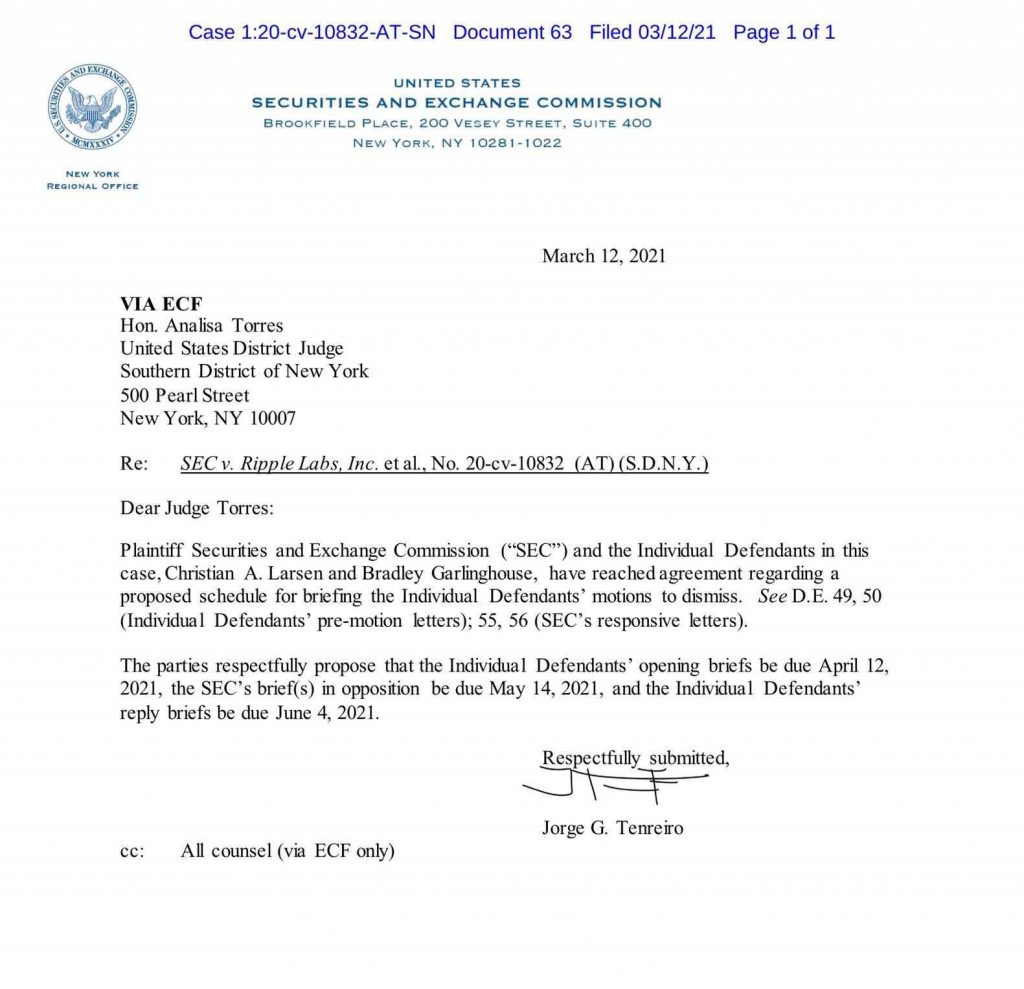
The details specifically mention a request to the court for accepting their timeline. The defendants will open on April 12, 2021, and the SEC on May 14,2021. Later, the defendant will have time until June4, 2021, to reply and conclude if possible. Dates that have been mentioned are solely regarding the motion to dismiss from the defendants. It will provide clear insight nonetheless on what the bigger picture may turn out to look like.
For the Southern District of New York, the legal letter informed Judge Analisa Torres at the U.S District Court of a motion to dismiss, but the SEC’s complaint “still fails to state a claim against Mr. Larsen.” Mainly, the complaint is focused around Larsen “knowingly providing substantial assistance to a person in violation of [Section 5] of the 1933 Securities Act.” referring to the amended complaint filed in the previous month.
Hester Pierce, SEC Commissioner, stated that the SEC might potentially settle this out of court near the end as it often does.
“Often, you’ll see that the litigation ends in a settlement — sometimes it goes through and the litigation actually plays out in court.”
On the other hand, this cryptocurrency lawsuit is unlike any they’ve ever filed before, which is why there’s no guarantee whether this will be settled out of court. Overall, it is unlikely that this may end before summer 2021.
Ripple itself was stipulated formally by the Security and Exchange Commission in Dec 2020. XRP was charged by SEC for the sale of unregistered securities, and Garlinghouse and Larsen were accused of raising further $600 million by XRP sales. Ripple Labs rejected the charges, and they claimed that XRP functioned similarly to other cryptocurrencies price-wise.
Larsen’s lawyers, on those grounds, had stated that the SEC didn’t prove that he was aware at that time about XRP units being securities and continuing illegal activities.
“The SEC’s own allegations are not only deficient but affirmatively show it cannot meet this standard. At a minimum, the SEC must allege that it was ‘so obvious’ that XRP transactions were securities and Ripple’s conduct was improper that Mr. Larsen ‘must have been aware of it.”
The state of New York, cleared by the Financial Crimes Enforcement Network (FinCEN) in 2015, recognized XRP as a digital currency. The lawyers made several points regarding this, including that FinCEN and the Justice Department had both regulated XRP as a virtual currency, which is inconsistent with the claims of labeling XRP as a security.
Several corporate giants such as MoneyGram were involved with XRP trading for international transactions; however, many exchanges have delisted it. MoneyGram itself is currently facing a lawsuit as it allegedly misled investors about the cryptocurrency XRP. Even if the damage and case were to be folded soon, the damage would remain irreparable.
16 August: XRP Price Update
In addition, the price of XRP has spiked above the $1.00 threshold because Ripple is working on preparing documentation for an upcoming regulatory filing.
Another Twitter user, James K. Filan issued a timely update about upcoming events related to XRP. A Ripple spokesman said they will have their response to the SEC’s motion for communication with the Slack messaging platform on August 16th. In the meanwhile, the SEC will return to this subject the next day. August 31st is the deadline for fact discovery, with the October 15th expert discovery deadline now approaching.
Moreover, Stuart Alderoty replied to RollCall in his tweet and stated,
It’s increasingly obvious to many in the industry that the outcome of this case (and what is learned along the way) will set a precedent for crypto innovation in the U.S.
Cryptocurrency specialists are watching the conflict between Ripple Labs Inc. and the SEC closely in anticipation of a precedent-setting case.
In an action brought by the U.S. District Court for the Southern District of New York, the court issued the company, CEO Brad Garlinghouse, and chairman of Ripple Labs Chris Larsen, arguing that they had a legal obligation to register XRP as a security under federal securities laws. Because Ripple and its management are confident that the allegations will be dismissed in court, they have recommended the lawsuit be dismissed and the charges be dropped.
As a result, Ripple has gained preliminary injunctions granting access to the SEC’s internal data and protection of the company’s executives’ private bank records, among other things. A pending legal action is being taken by the XRP holders as well.
According to Drew Hinkes, a legal counselor at Carlton Fields PA in Miami who works on cryptocurrency matters. If Ripple has a valid complaint, then this is setting a precedent for the SEC’s control over digital currency offerings (ICOs).
According to Hinkes,
“This is a significant case. Ripple has tremendous financial resources, has assembled an incredible team of well-respected lawyers, and has one of the most high-profile projects in the industry.”
It is estimated that once it gets to the 2nd Circuit Court of Appeals or the Supreme Court, Hinkes predicts this case will provide industry-wide direction that is more dependable than the current amount of case law, court judgments, and settlements that is circulated at the district level.
He also stated that,
“The 2nd Circuit is incredibly sophisticated in this area, and it will be very interesting to see how they rule on these keystone issues,”
Suit Over Registration
Ripple is a blockchain-based real-time payment settlement network that was launched in 2012 in San Francisco. A judicial document reveals that the sale of 14 billion XRP units generated $1.38 billion in money. The market capitalization of $70 billion puts it in fourth place as the world’s fourth-largest cryptocurrency.
Ripple does fit the SEC’s definition of security, and that is why it is legal to trade it. According to a complaint, section 5 of the Securities Act is very comprehensive. Former SEC enforcement lawyer Thomas Gorman, who was previously the head of the SEC’s office of enforcement’s market abuse unit, believes the SEC wants to put the spotlight on whether XRP qualifies as a digital currency.
In investing, pools of investors each expect to be rewarded by being a shareholder. If that is the case, Gorman explained to CQ Roll Call, it is almost certainly security that has to be registered. Ripple claims that XRP is neither a security nor an investment contract. Instead, it is a medium of exchange like cash or other cryptocurrencies. To comply with the terms of the settlement, the corporation had to register as a money services firm with both the Department of Justice and the treasury department’s FinCEN (Financial Crimes Enforcement Network), which was reached in 2015.
As a result, the SEC does not have jurisdiction over these cryptocurrencies, which implies they are commodities, not securities. Ripple sued and received access to the government’s records about how it decided to treat XRP differently.
Though Ripple and its executives claim that the SEC was unable to substantiate their claim that they were aware of the fact that XRP needed to be registered and that they remained silent for years as the XRP market grew globally.
According to Linda Jeng, a former SEC lawyer and adjunct professor at Georgetown Law School, court records show that delay that is too long can constitute reasonable cause.
Linda Jeng further added,
“As a former regulator, I am disappointed to see the SEC wait so many years after the introduction of a product to launch an enforcement action,”
Jeng holds that regulators should be slow, precise, and predictable in their application of authority. Inaction on the part of the agency creates the impression of capriciousness and undermines their credibility.
Despite Hinkes’ attempts to damage the government’s case, their stance is not only damaged, but it is even tardy because the government’s agency is late in classifying other cryptocurrencies. However, it is to be understood that this does not mean the agency lacks the authority to prosecute this person. One of the attorneys that spoke out about the complaint noted that there is a wide range of enforcement possibilities for the SEC, and it appears that the complaint was filed inside the statute of limitations.
More and More General
Gorman expects the court will concentrate on the decision of the investment contract analysis and underplay the length of time between when the lawsuit was filed and when it was heard.
Gorman said,
“The SEC has been increasingly broad in recent years as to what constitutes intent to pool an investment, so greater clarity on that issue would be beneficial,”
Gorman believes that the judge granted Ripple broad access to the evidence. Since the SEC is expected to reveal its internal notes when they are discovered, there will not be any surprises. But industry insiders are curious to know what is happening behind the scenes.
Hinkes stated the following,
“To my knowledge, these documents have not been publicly disclosed before. Though it’s unclear whether they’ll be made public here, I imagine many in our industry would find those interesting.”
Changes in leadership
On Dec. 22, 2020, the SEC filed a lawsuit against Ripple, the day before Jay Clayton resigned. Considering this event, Jeng stated that,
“It made it seem more political,”
She maintained that regulators should not be seen as biased or having a political agenda, and they must act impartially and apply the law uniformly.
The SEC chose not to respond to the comment request. The fans of the incoming SEC Chairman Gary Gensler said that they believe he is more than ready to go into more detail about the regulations for crypto tokens. However, Gensler has said he is unwilling to compromise or withdraw the Ripple case and hence is unlikely to reach a quick agreement.
Jeng argues,
“I think the SEC has already headed down this path and they’re not turning back,”
Ripple’s General Counsel, Stuart Alderoty, said,
“Ripple isn’t backing down either.”
Furthermore, Alderoty told CQ Roll Call,
“The SEC is out of step with the rest of the world. This is much bigger than Ripple. It’s about the future of digital assets in the U.S.”
Moreover, if we look forward to the news of August 4, 2021, Brad Garlinghouse shows no signs of anxiety or concern even though the company in question has found itself entangled in a dispute concerning its digital currency. He stated,
“We can’t ignore governments. We can’t ignore regulation,”
Brad Garlinghouse joined Ripple as the company’s Chief Operating Officer (COO) in 2015 and then became CEO in 2016. He is a technology industry veteran who previously worked at Yahoo, and gained infamy after writing a scathing 2006 article called the “Peanut Butter Manifesto.”
Crypto suffered a heavy loss in Washington the other day. While it may be discouraging for the industry to have been condemned as a “shady network of online funny money” at a Senate banking committee, it does nothing to encourage the industry.
However, while the CEO of the business-facing authorities in the most aggressive crypto legal action thus far had positive things to say about the congressional proceedings, his thoughts were considered to be unusual by other company executives.
Prior to the Senate hearing concluding, Ripple CEO Brad Garlinghouse expressed his appreciation for the Senate’s commitment to comprehending the complexities of crypto.
To reinforce his point, he brought up Senator Elizabeth Warren, a longtime critic of cryptocurrencies, and her observation that “our current banking and payments systems need improvement.” While several individuals in the crypto industry are known to have stated that their mission is to “to provide access to those who have consistently been left out” Garlinghouse expressed hope that Massachusetts Rep. Jayapal would also share this purpose.
It was interesting to notice that tweets mentioning Ripple and the federal government had contrasting views on crypto and blockchain.
Ripple, an innovator in blockchain technology and cryptocurrencies, has adopted blockchain for processing payments and offers XRP as its currency. The SEC filed a lawsuit against Ripple, CEO Chris Larsen, and executive chairman Brad Garlinghouse, claiming that the business and its founders sold unregistered securities by distributing XRP coins in December. XRP is security according to the SEC, and so it must abide by the rigorous securities rules.
When the legal action took place, XRP’s value plummeted substantially. Ripple (XRP) trading on the main crypto platform Coinbase was temporarily banned. Many in the industry predict that the legal fight will have significant ramifications for the whole crypto business. The accomplishment will further cement Garlinghouse’s claim to being the trailblazer in the blockchain business.
In the memo, a Wall Street Journal article states that Garlinghouse, who was Yahoo’s senior vice president at the time, compared the company’s strategy to “spreading peanut butter across the myriad opportunities that continue to evolve in the online world,” concluding that the company was lacking focus.
Garlinghouse wrote,
“I hate peanut butter. We all should,”
Garlinghouse said in an interview with Protocol that he is optimistic about the increased attention from governments on crypto and blockchain, noting that he sees Ripple’s chances in the SEC lawsuit and in the court battle. Garlinghouse also talked about the impact of the Peanut Butter Manifesto on his role today.
August 10: SEC wants ‘terabytes’ of Slack communications from Ripple
Previously, the SEC claimed that Slack message production by Ripple was incomplete. They say a massive amount of data was not captured. The United States Securities and Exchange Commission (SEC) is pushing for more access to Ripple’s internal communications in its legal struggle with the company.
On Monday, the Securities and Exchange Commission (SEC) filed a motion with the Southern District of New York. They urged Judge Sarah Netbrun to order Ripple to turn over and provide Slack chat records for all of its employees.
It alleges that, due to a data processing mistake, Ripple’s prior Slack communications to the SEC were incomplete, with the firm later admitting that this was caused by a “data processing mistake.” The SEC believes that the number of Slack communications that Ripple obtained was limited, and it thinks there could be a “significant amount” of Slack data that has not been searched or collected.
Because of this, the SEC’s case is already prejudiced by the data inaccuracy and failure to produce many documents by Ripple. According to the filing, The SEC had served 11 former Ripple witnesses with citations that did not include relevant records.
According to the SEC, the missing records, which comprise over 1 million communications, eclipse Ripple’s enormous email productions. The agency explained that prior Ripple Slack chats contributed very valuable information that was not otherwise included in emails or other paperwork.
Following the filing of Ripple’s move to extend the time to answer to the SEC’s motion addressing the Slack communications from Thursday, August 12 to Monday, August 16, Ripple requested to extend the deadline to respond to the SEC’s motion to August 16.
This line of reasoning leads Ripple’s legal team to conclude that the Slack messages cause the discovery period to extend. According to the e-discovery vendor, collecting all of the correspondence (not just Ripple’s) will take between 12 and 15 weeks. That means the present scheduling sequence would be changed if the SEC’s motion is granted.
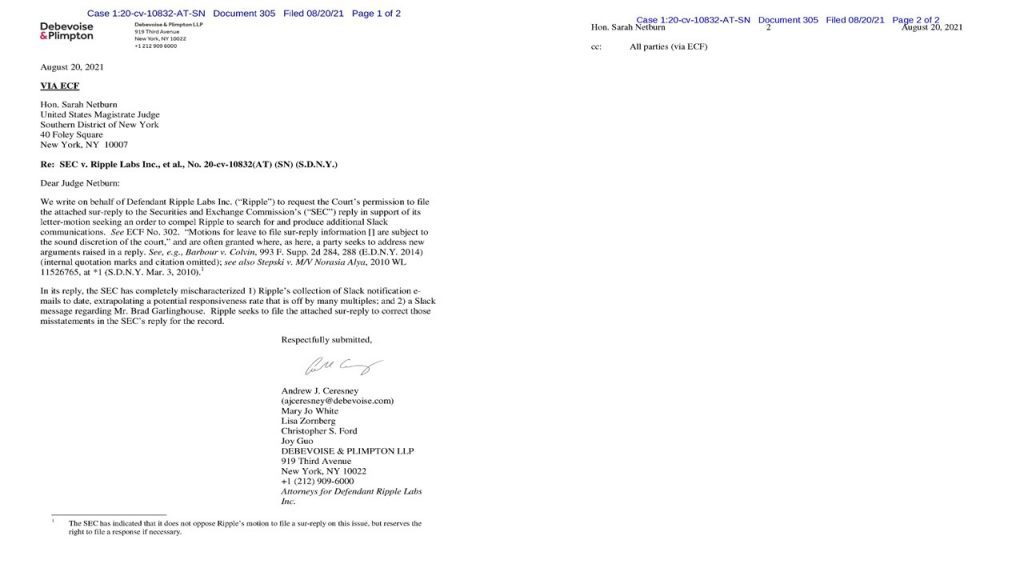
For further arguing, Ripple requests permission from the court to file a sur-reply to the SEC in the letter. Hence, the letter asserted that while the SEC has yet to fully demonstrate why the “missing documents” will practically restore the witnesses’ memory, the requested Slack chats were not vital or uniquely significant.
To support this point, the letter mentioned that previous instances of the same discovery request that is being rejected by other federal courts should preclude SEC’s request from being granted. The point from the letter stated that,
“Other courts that have considered similar discovery requests for Slack data have ruled that Slack discovery is uniquely burdensome and costly and have ruled against motions to compel their production in cases where the moving party has already obtained significant discovery.”
The SEC’s current request, which asks for the court to dismiss the lawsuit against XRP, appears to be another step towards justifying the legitimacy of XRP as security and placing it under the commission’s authority. Ripple said that it viewed XRP like a security, which means that it is acting from the side and contending that XRP is a security. As in the past, this argument works well since in all aspects, XRP is fundamentally different from security.
Earlier this week, SEC Chairman Gary Gensler announced that the SEC is pushing for laws to be put in place for decentralized cryptocurrency exchanges. Former Chairman of Commodity Futures Trading Commission (CFTC) Christopher Giancarlo added that the CFTC does not have jurisdiction over cryptocurrencies because they are commodities.
Other Slack Communications Related Developments
James Filan, Ripple community lawyer, sent out a message to his large number of followers of about 46,611 yesterday and announced that Ripple had already filed a motion to seal documents attached to the agencies’ motion about Slack messages, as well as documents related to the agencies’ opposition to the request. It has been revealed that neither party agrees on what should be sealed, according to Filan.
XRPCommunity and SEC GOV take sides in the XRP debate. In response to the SEC’s motion to seal certain Slack messages, Ripple filed a motion to seal certain exhibits (e.g., exhibits attached to the SEC’s motion and its objection). “Currently, the parties are arguing on what should be sealed.”
The Ripple legal team maintains that this information is nonpublic and would be detrimental to the firm since it could reveal key business data. Meanwhile, at press time, XRP is trading at around $1.1 and has shed about 5.94% over the last day.
Ripple Cites Viral Tweet on Status of XRP in Legal Battle Against SEC
Ripple cites a letter to retail investors from the U.S. Securities and Exchange Commission (SEC) in its ongoing battle against the top American regulator.
A Twitter user named “Frank” claims that after buying XRP he reached the SEC to verify if he had purchased securities. In a popular tweet, the user uploaded a screenshot of the SEC’s response, indicating that the digital asset classification as security had not been determined by the regulator by October 2020.
The SEC filed a lawsuit two months later saying that Ripple issued XRP as non-recorded security. Ripple now cites in a court brief Frank’s SEC email exchange. William Hinman, the former director of the SEC’s corporate finance division, uses this letter to tell the Ripple officer that he regarded XRP as an unregistered security.
Ripple argues the email shows the testimony of Hinman that the SEC’s disclosures to the public “are disputed.” Ripple further says that a depiction of the early history of the SEC with crypto assets by Hinman explains why the situation of the SEC is wrong.
“By the way, Mr. Hinman acknowledged that the application of federal securities laws to digital assets was ‘new for everyone’ before he joined the SEC in 2017 – but years into Ripple’s purported unregistered securities offerings – and nobody knows a great deal’.
He further confessed that at the time when he became an SEC member concerning federal securities and Bitcoin, Ether or XRP, he was not able to recollect a certain work product and that he did not think “people had thought completely… that the securities rules may apply to that business.”
This testimony, the documents produced and possibly documented by the Defendants’ Motion, undermine the SEC’s assertion that the individual Defendants were reticent about not having recognized Ripple’s sales of XRP as unregistered securities offering securities law experts of the stature of Mr. Hinman (to put it mildly).
James Filan, the lawyer who regularly monitors the case, has compiled an outline of significant dates ahead of time. The end of the discovery process, which will enable both parties to learn what the other party knows about the evidence, will end on 31 August.
September 2021 updates: SEC vs Ripple case — ft. John Deaton
As you can see, there has been a lot of legal filing being done against Ripple XRP by the SEC. However, in the midst of all this, we have a lawyer with us, John Deaton, who claims that SEC may have been overstepping its authorities. Not only Deaton but also 20,000 other people claim the same thing.
John Deaton had no idea that he would become one of the most annoying figures in the U.S. Securities and Exchange Commission. John Deaton began questioning the entire enforcement approach of the agency about its role in the $2 trillion markets of cryptocurrency. John Deaton had no interest in this particular area, but now, it seems like this role was made for him, for sure.
John Deaton is a former marine-turned-class-action lawyer who developed an interest in cryptocurrency in the year 2016 and the same year, he invested in Ripple coin XRP. However, in 2020, SEC sued Ripple because there were allegations that XRP was an unregistered or unauthorized security that left Deaton bewildered. But, Deaton wasn’t one of those who would remain silent on such occasions, and thus, he began raising concerns regarding this case.
Over the years, Deaton’s efforts bore success when he started representing thousands of XRP holders. Currently, he’s fighting the case of over 20,000 people who argue that the agency is going beyond its authority. (Deaton also gives regular updates to his clients and other people on his blog, YouTube channel, and Twitter feed).
No doubt, since 2010, the market of cryptocurrency has swelled tremendously, and because of this, SEC wanted to lead in this market. But, the push from the XRP holders has created quite a hurdle for the SEC. The agency claims that it’s protecting the investors, but the investors themselves are rejecting this protection that puts the entire attempts of the agency into jeopardy.
Talking about crypto, it is now termed as a raging ball of fire in many discussions of public policy. In the previous month, there has been a large number of complaints against crypto. Many people state that crypto monopolizes electricity, is not at all environmental-friendly, attracts criminals, and is highly volatile.
Some of the very renowned financial journalists have also started making their statements regarding cryptos such as Diana Henriques, a former New York Times reporter who wrote the book on Bernie Madoff, a Ponzi schemer, and Charlie Gasparino, a correspondent of Fox Business. The chairman of SEC, Gary Gensler, authorized the regulations of crypto before the senate committee. On the other hand, the CEO of Coinbase, Brian Armstrong has emerged in the defense of a crypto product lend (now, demolished), and is threatening the agency over its non-liable suing of this product.
According to Deaton, everything comes to one thing: securing the banking industry from a potential threat. Let’s see what else Deaton has in store for us regarding crypto and the case of Ripple XRP.
Why is a crypto crackdown happening now? Is it all about the numbers?
We interviewed Deaton on his stance on the Ripple XRP, crypto, the allegations of the SEC, and everything related to it. This is how it went.
We all know what’s going on between the crypto investors and the regulators but we also acknowledge that you play a very crucial part in all of this. Not only in the terms of your job but also with the Ripple controversy. So, can you tell us something about it
John Deaton: What started off is with me, I got into Bitcoin and cryptocurrencies, just as an individual interested person. XRP, Bitcoin, Ethereum were primarily my investments. And then I learned of the Ripple case. I’m not a securities lawyer by training or education or practice. But when I read that complaint, I knew that it made absolutely no sense, legally speaking, the way the SEC was approaching it, the way it went down by being filed on the last day of former Chairman Jay Clayton’s tenure at the SEC.
Just there were too many questions. And so, I realized that what was going to happen would be delisting and suspensions of XRP. And the market cap was going to be wiped out. And I got upset that people’s lives were being impacted because of politics. And, and so I filed a writ of mandamus, on behalf of myself, and several people I know, in Rhode Island federal court seeking to order the SEC to limit the charges to the only claims that it can actually prove. And so that’s how this started. Then of course, what this turned out to be is it started as an individual person with a few friends who sort of wanted to take a stand, and then all of a sudden, there were thousands, tens of thousands, actually now up to 20,000 people now who have joined in our fight against the SEC. It’s not about Ripple for us, you know, Ripple has an impressive legal team. They can defend their actions, I don’t defend Ripple. I don’t take a position on what their business model is or any transactions they made. The position I’m taking is that the SEC has made claims that it doesn’t have a good faith basis to make, quite frankly, and it is inconsistent with 75 years of securities laws. And so that’s how I got involved.
Alright. So, if we recap all the things quickly, we know that SEC sued Ripple by claiming that XRP was an unregistered security. And by doing so, they are protecting the investors. On the contrary, you represent about 20,000 XRP holders who state that they aren’t being defrauded and reject the SEC’s protection. Is it correct?
That’s right. See, because the SEC did something that they normally never do. Normally, when they sue a company, they’ll say that the specific sells that you made at these particular occasions, that those were unregistered securities. In this case, the SEC said that all XRP, including today’s XRP that is traded in the secondary market, and from people who have no connection to Ripple, that those are securities. And so that’s the real, unique distinction that separates this case from other cases.
I’ve seen that this ongoing Ripple case has opened up Coinbase investigation as well and because of this, there has been a lot of chatter going around. Some of it is just out on Twitter, just like that. But, it is more confrontational about crypto than any other currency. I’ve also observed that many journalists have started to have their say in the crypto matter whereas normally they don’t cover crypto. What do you think is the reason behind this sudden upsurge in regulating crypto?
This [makes gesture referring to money]. It comes to the money. Listen, today, I don’t know exactly the number, but you’ve got to understand — there is a big difference between a $200 billion total asset class, versus today, it’s almost $2.5 trillion. You have Bitcoin being projected to replace the market cap of gold, or equal the market cap of gold. That’s a $10 trillion asset. You have El Salvador listing Bitcoin as legal tender in its country. And so, basically it has developed into what is projected to be $10s of trillions in market cap.
I think that’s in essence one of the big reasons that it came down and you have what is called a jurisdictional grab, right? You have the SEC and Gary Gensler saying, “Hey, you know, these are securities,” even though he’s on record, when he was [a professor] at M.I.T., saying they were more like commodities. But he’s now the chairman of the SEC and they want their regulatory hands right in the middle of all of that.
That’s what’s going on.
You’ve got this asset class that’s not going away. It’s not a fad. And it’s ballooning and ballooning. It’s gotten the attention of the regulators. And I think that’s the common lay person’s answer, if you will.
Is it this big as you claim it to be?
It’s getting bigger. It’s just getting bigger and bigger. I mean, you have some of the greatest investors in the world, like ARK’s Cathie Wood, you know, just at the SALT conference, saying that a conservative projection of Bitcoin within the next four or five years is half a million dollars per Bitcoin [Editor’s note: current value is about $44,000.] Raoul Pal, you know, a former Goldman Sachs hedge fund manager, is predicting Ethereum is going to go to $20,000 or $30,000 per Ethereum. [Current price per Ether is about $3,000.] And so, if those things happen, [the market] goes from $2.3 trillion today to you know, $50 trillion, $40 trillion, $30 trillion, whatever it is going to be. You can’t ignore it when it grows to this extent.
Crypto is like the wild west – a promising land for the U.S. crypto regulators to grab
SEC Chairman Gensler says that there is a dire need for a regulatory framework because crypto is like the wild west. What do you have to say about this?
I think it’s fair to say that we need regulations. That doesn’t mean we need more regulations. It doesn’t mean we need bigger regulations. What we need are the right regulations, and we need the right jurisdictional body. And so when you have the Wild West, I would agree with them. It’s the Wild West, but from a different perspective. It’s where all of these agencies [are getting involved]. Is it the U.S. Treasury, the [Commodity Futures Trading Commission], the SEC, [the Financial Crimes Enforcement Network]? I mean, you have multiple government agencies that are getting involved here. Look at the Ripple case. In 2015, Ripple was fined $700,000 for violating banking laws, the banking secrecy laws, right? And so, they entered into a settlement agreement with FinCEN and the Department of Justice that they would register all future sales of XRP with FinCEN. But of course, there’s that one line in the agreement that says, “This does not mean that you don’t have comply with other regulatory agencies or securities laws.” So now, you basically have a token that was deemed a convertible virtual currency in 2015, and in 2020 it’s being called a security. That’s the kind of clarity we need.
Obviously, it makes sense if you’re trying to apply the famous test when it comes to what’s an investment contract with the company, the Howey test. You know, it’s probably never been talked about so much as it has in the last several years. It is difficult to take a case that came down from the U.S. Supreme Court in 1946 and apply it to modern-day block chain technology. There’s no doubt the right answer is Congress. Congress needs to step in and make clear which governmental agency is going to be the proper one to exercise oversight, and provide guidance to market participants. Because we’re at a crossroads.
Ethereum went overseas to develop their technology because they were worried about securities laws. They ended up getting a pass in 2018. But you have these technologies that are not setting up their headquarters in the United States because of this lack of clarity. I always hesitate when someone says, “Do we need more, bigger types of regulations?” No, we just need the right type of regulations. There are always going to be bad players, right? I think the SEC does have a role when you have these pump and dump schemes, or you have a fraudulent actor out there. But right now, what they’re doing…listen, we have Coinbase that the SEC is going after, and we have state agencies going after BlockFi. And we just learned yesterday that the state is going after Celsius. And why? How are they protecting investors? They’re protecting me and you from getting 4% interest on our assets, when the banks give us what at this point, .0005%?
“[Crypto] is probably the most disruptive technology to ever hit any type of financial industry. And it threatens incumbent banks. I think we’re seeing the exercise of their influence.”
How is that I can put my money in a bank account, and the bank can pull all of the funds of its other customers and pay me a very slight little bit of interest and there’s no issue. But if I purchase my Bitcoin, or my XRP, or my Ethereum, and I loan it to Coinbase, and then they lend it out, and give me 4% interest, how is that different? Why does that all of a sudden need to be shut down? And so my problem and my criticism is that I believe that regulators today are doing what they always do, and that is to protect incumbents. You have this technology, decentralized finance, it is probably the most disruptive technology to ever hit any type of financial industry. And it threatens incumbent banks. I think we’re seeing the exercise of their influence. I have no hesitation in saying that. I believe that firmly.
What do you think about the testimony of Gensler before the banking committee of the senate?
I think we saw a staged performance between him and Sen. Warren, and I’m just politically speaking, whoever the incumbent is, I vote out, whether they’re Republican or Democrat. I vote not by party lines.
But that, to me, was a performance where Elizabeth Warren said, “I expect the SEC to take the lead,” and she cited Coinbase. And I think that Gary Gensler, as everyone knows, taught at M.I.T., and he taught blockchain technology, and there was this hope because former chairman Clayton was more perceived to be anti-crypto. It’s interesting that now he’s involved heavily in crypto after he leaves. He took more of a hands-off approach except for prosecuting the ICOs [initial coin offerings] and whatnot. And everyone thought that Gary Gensler would be more crypto-friendly, and it’s the opposite, right? I think that when Gary Gensler becomes the chairman, he becomes a politician. What did he say to Congress, he actually said that there is clarity, and that the SEC has provided clarity to markets and that the Howey test is stood the test of time, and that it’s fairly straightforward when it comes to these modern-day technologies. And he talks about all of this great clarity we have, but if we just back up to April 2018 — we’ve discovered a video where Chairman Gensler says the crypto industry needs clarity, and he even states Ripple and Ethereum, the largest market cap players, need clarity. That’s in April 2018, when he was not the chairman. Fast forward three years, and you have even more uncertainty because Ethereum gets a pass yet Ripple and XRP are being prosecuted in court.
There is no doubt that the crypto market has been put on notice. If you saw the tweet from Brian Armstrong, who is the CEO of Coinbase, and founder, he was trying to work with the SEC, and Chairman Gensler testified that they’re open to that — come in, we’ll talk it out. We have to assume that Brian Armstrong is telling the truth, when he says he was informed that the SEC wasn’t taking any meetings with crypto companies. Then they got the Wells notice saying that they’re going to be sued. So if the SEC is going after not just Ripple, but now they’re also going after the biggest publicly traded crypto company in the United States, I think the SEC and Chairman Gensler are sending the message that “we’re coming for you, and we’re coming for your crypto.”
What Deaton would say to crypto critics — no, it’s not just for criminals
I’ve heard a lot against crypto and you may have too. Like, you never know what will happen the next second that it’s too big of a risk that once you invested money in it you can’t take it out, that you can even lose all your money. How do you tackle such criticism?
Well, first of all, I’d say that’s not true. You have debit cards that tell you where you can use your crypto. PayPal is allowing you to spend your crypto as a substitute for fiat. But I’d asked those critics and those people if you ever heard of a company called Amazon, if they ever heard of a company called Google. Those companies were extremely risky companies in their first 10 years. Bitcoin is, what 12 years old, and these other cryptos are a decade maybe.
And so this industry, this asset class is literally in its first inning, if you will, if we’re in a nine-inning baseball game.
And so if you look at the volatility of Bitcoin, absolutely, it’s a volatile asset. And people need to know that, and it has had literally 60%, 70%, 80% market cap declines in rapid moments. So yes, it’s volatile. But so our equities. The equity market isn’t volatile? Is GameStop, was that volatile when it was going up and down? I mean, we have AMC movie theaters, is that a volatile stock
And so I think the volatility argument and the speculation argument, I think are the weakest of all arguments. The only other weaker argument that the critics have, would be where they claim that cryptocurrencies digital assets are used for nefarious reasons and for illegal activities. That was a valid criticism in 2012 because it was in its infancy and you had silk road. But you’d have to be an idiot if you were actually going to try to do drug transactions or any other type of illegal action on a public ledger.
It just doesn’t say “John Deaton,” right? It doesn’t say my name, but it’s a distributed public ledger technology where every single transaction can be seen. And if there is probable cause that there is at least illicit activity, and these transactions show it, you get a search warrant, and you learn the identity of that person. And you have the absolute most clear cut evidence, absent DNA evidence in, in criminal jurisprudence, you know what I mean? So, I think those are just arguments of people who want to protect the incumbent system.
You know about ransomware attacks, don’t you? Now, for the payment of these attacks, many people still utilize crypto. But, didn’t the FBI take it all back at a certain point?
Yeah, they did. But what are we going to do? You know, most drug deals are done with cash, right? Are we going to stop ATM deposits or withdrawals? I just think those are the ignorant types of criticisms. As far as all we can’t, you know, move forward, or it has to be stopped. I mean, you literally have people who have claimed that Bitcoin and all cryptocurrencies should be outlawed. And that just makes no sense to me.
It’s not about what happens if the SEC wins; it’s what happens if the SEC loses.
Let’s go back to the Ripple case for a minute. What do you think will happen to Ripple XRP if SEC wins? We’re not saying that SEC will win but let’s just take all the parameters into account.
Well, I guess the question is, what is a win? If they win outright, of what they’ve alleged in the complaint, then that means that all XRP would be deemed a security. And in essence, Ripple would only be able to sell it with after registering it and sell it to accredited investors where they have certain more specific requirements. They’re [also] seeking $1.3 billion. And so if they received some type of verdict, there probably be would be a fund and XRP holders could get reimbursed to a certain extent. That doesn’t mean Ripple’s out of business. It would certainly transform their business and limit them in many ways.
Would it set a bad example?
Oh, great question. Absolutely, it would be extremely bad. Because the SEC, everyone needs to understand this isn’t like a new cryptocurrency where they’ve offered a fundraising event, and they’re going to develop the blockchain technology. That’s an ICO, and that [case law] is well-settled. This is the SEC going back seven and a half years retroactively. It’s insane that from 2013 until the present day, all the sales of XRP were unregistered securities. [That precedent could have] impact on literally 10,000 cryptos. I’d say that there are a couple hundred of them that are interesting, and the rest of them are garbage, but it would have an absolute detrimental impact. I could name you 10 cryptocurrencies off the top of my head that would then be like, potentially out of business as well.
What’s interesting is that since this Coinbase news and the attacks on decentralized finance, and on BlockFi and Celsius, some of Ripple’s biggest critics actually have acknowledged that they’re rooting for Ripple because of that precedent that could be established. I don’t see that happening. I think that the case is ripe for a settlement where Ripple agrees that early transactions in 2013 to 2017 [were securities offerings] when there weren’t hundreds of thousands of XRP holders and there was a much, much smaller ecosystem. That’s where the SEC has potentially legitimate claims against Ripple. You would imagine that that’s where a deal would be struck where the ongoing future and present-day sales are not deemed securities. But those earlier transactions were and Ripple pays a fine and the market gets some clarity. Unfortunately, whoever the SEC goes after next will have to fight that same fight.
“The more interesting question is what happens if the SEC outright loses…I personally think that they’d be out of business, as far as going after existing [crypto] ecosystems.”
I think the more interesting question is what happens if the SEC outright loses, right? And if that happens, if Ripple was successful, for example, in their fair notice defense, and the SEC has an outright loss, that has the hugest of implications. You know, if you look at Gary Gensler, going back to your question about his testimony, both in his testimony and in his letter to Elizabeth Warren, he actually says that the SEC has never lost a case, right? Like he’s almost boasting that, “Hey, we know what we’re doing. And we never lose.” And so the loss that the SEC would have, and the implication on the industry is huge. I personally think that they’d be out of business, as far as going after existing [crypto] ecosystems. If there is a new coin and it’s not developed yet, they’ll still have their jurisdiction. But if you’re talking about all of the other cryptocurrencies that have been existing for the last 4,5,6,7,8 years, I think the SEC would basically be out of business trying to regulate them.