Author Archives: krcmic.com

What are two core design principles to consider when building Analytics apps or dashboards? (Choose two.)

Below is the answer and explanation for the question in the Salesforce Exams.

What are two core design principles to consider when building Analytics apps or dashboards? (Choose two.)

  • Balance: make sure they have a balance of different charts to get a more interesting design.
  • Clarity: make sure they are uncluttered and easy to interpret. ✅
  • Consistency: make sure they have a sense of familiarity to strengthen your users’ ease of use. ✅
  • Emphasis: make sure they have space for important information, such as headlines and key charts.

Correct Answers

Clarity: make sure they are uncluttered and easy to interpret. ✅
Consistency: make sure they have a sense of familiarity to strengthen your users’ ease of use. ✅

Explanation

Without knowing it, you’ve taken the first step on your design journey. You saw that your predecessor made something with potential that’s not entirely on target. You started to ask questions about how it can be made more useful. Now you’re about to take the steps to get answers.
Here at CRM Analytics, we’ve formulated a strategy for you and others in your boat. You may not think of yourself as a designer, but as soon as you start creating a CRM Analytics app or dashboard, you have to think like one. If you don’t, you risk creating something that doesn’t help your team. And if you do, you can think big and solve problems in ways that can inspire you and your users.

The above question is related to the Salesforce Exams. You can find all the updated questions and answers related to the Salesforce Admin Practice Exam on the “Salesforce Exams” page. If you find the update in questions or answers, do comment on this page to let us know. I will update the answers as soon as possible.

To learn about Salesforce Exams: Salesforce Exams.

An Einstein Analytics Consultant is working with a subscriptions based company to build a dashboard to understand customer renewals. Each subscription is captured as a Closed Won Opportunity within Salesforce and a single Account can only have one active subscription. Unfortunately, the Opportunity record does not specify whether it is a renewal or a net new subscription. Which data transformation should be used to determine if a subscription is new or a renewal?

Below is the answer and explanation for the question in the Salesforce Exams.

An Einstein Analytics Consultant is working with a subscriptions based company to build a dashboard to understand customer renewals. Each subscription is captured as a Closed Won Opportunity within Salesforce and a single Account can only have one active subscription. Unfortunately, the Opportunity record does not specify whether it is a renewal or a net new subscription.
Which data transformation should be used to determine if a subscription is new or a renewal?

  • computeRelative
  • computeExpression
  • augment
  • flatten ✅

Correct Answers

flatten ✅

Explanation

The new dataflow design contains the following changes:

  • Extracts the role IDs from the UserRole object.
  • Uses the Flatten transformation to generate a column that stores a comma-separated list of the role IDs of all parents of each user. When you determinated the predicate in the previous step, you temporarily referred to this column as “ParentRoleIDs”.
  • Link the new column to the OppRoles dataset.

The above question is related to the Salesforce Exams. You can find all the updated questions and answers related to the Salesforce Admin Practice Exam on the “Salesforce Exams” page. If you find the update in questions or answers, do comment on this page to let us know. I will update the answers as soon as possible.

To learn about Salesforce Exams: Salesforce Exams.

Refer to the graphic. Einstein found a recommendation to improve the story; apparently, there are two variables that behave the same. Given there is no additional information, what is the correct action?

Below is the answer and explanation for the question in the Salesforce Exams.

Refer to the graphic. Einstein found a recommendation to improve the story; apparently, there are two variables that behave the same.
Given there is no additional information, what is the correct action?

  • Cancel this story and redefine the dataset.
  • Retain amount; not knowing the size of a deal makes it hard to predict if will be won.
  • Do nothing; they appear to be similar, but there might be differences from the business perspective.
  • Retain promotion; it is an actionable variable and without it, we cannot recommend prescriptive actions. ✅

Correct Answers

Retain promotion; it is an actionable variable and without it, we cannot recommend prescriptive actions. ✅

The above question is related to the Salesforce Exams. You can find all the updated questions and answers related to the Salesforce Admin Practice Exam on the “Salesforce Exams” page. If you find the update in questions or answers, do comment on this page to let us know. I will update the answers as soon as possible.

To learn about Salesforce Exams: Salesforce Exams.

The client is trying to create a SAQL query to predict sales in each sales region. They cannot get the query to return any results, but have identified that the enror is in the timeseries statement. They have asked a Tableau CRM Consultant to review the following query and fix any errors. q = load “sales”; q = group q by (‘Date_Year’, ‘Date_Month’, ‘Region’); q = foreach q generate ‘Date_Year’, ‘Date_Month’, ‘Region’, sum(‘Sales’) as ‘sum_Sales’; q = timeseries q generate ‘sum_Sales’ as ‘Forecasted_Sales’ with (dateCols=(‘Date_Year’, ‘Date_Month’, “Y-M”), partition=’Region’); q = foreach q generate ‘Date_Year’ + “~~~” + ‘Date_Month’ as ‘Date_Year~~~Date_Month’, ‘Region’, coalesce(‘sum_Sales’, ‘Forecasted_Sales’) as ‘Sales’; q = order q by (‘Date_Year~~~Date_Month’ asc, ‘type’ asc); q = limit q 2000; Which timeseries statement will fix the query?

Below is the answer and explanation for the question in the Salesforce Exams.

The client is trying to create a SAQL query to predict sales in each sales region. They cannot get the query to return any results, but have identified that the enror is in the timeseries statement. They have asked a Tableau CRM Consultant to review the following query and fix any errors. q = load “sales”; q = group q by (‘Date_Year’, ‘Date_Month’, ‘Region’); q = foreach q generate ‘Date_Year’, ‘Date_Month’, ‘Region’, sum(‘Sales’) as ‘sum_Sales’; q = timeseries q generate ‘sum_Sales’ as ‘Forecasted_Sales’ with (dateCols=(‘Date_Year’, ‘Date_Month’, “Y-M”), partition=’Region’); q = foreach q generate ‘Date_Year’ + “~~~” + ‘Date_Month’ as ‘Date_Year~~~Date_Month’, ‘Region’, coalesce(‘sum_Sales’, ‘Forecasted_Sales’) as ‘Sales’; q = order q by (‘Date_Year~~~Date_Month’ asc, ‘type’ asc); q = limit q 2000;
Which timeseries statement will fix the query?

  • q = timeseries q generate ‘sum_Sales’ as ‘Forecasted_Sales’ with (dateCols=(‘Date_Year’, ‘Date_Quarter’, “Y-Q”), partition=’Region’, ignoreLast=true);
  • q = timeseries q generate ‘sum_Sales’ as ‘Forecasted_Sales’ with (length=12, dateCols=(‘Date_Year’, ‘Date_Month’, “Y-M”), partition =’Region’);
  • q = timeseries q generate ‘sum_Sales’ as ‘Forecasted_Sales’ with (dateCols=(‘Date_Year’, ‘Date_Quarter’, “Y-Q”), partition =”Region’); ✅
  • q = timeseries q generate ‘sum_Sales’ as ‘Forecasted_Sales’ with (dateCols=(‘Date_Year’, ‘Date_Quarter’, “Y-Q”), partition =’Region’, seasonality=4);

Correct Answers

q = timeseries q generate ‘sum_Sales’ as ‘Forecasted_Sales’ with (dateCols=(‘Date_Year’, ‘Date_Quarter’, “Y-Q”), partition =”Region’); ✅

Explanation

Timeseries crunches your data and selects the forecasting model that gives the best fit. You can let timeseries select the best model or specify the model you want. timeseries detects seasonality in your data. It considers periodic cycles when predicting what your data will look like in the future. You can specify the type of seasonality or let timeseries choose the best fit.
The amount of data, which is required to make a prediction depends on how your data is filtered and grouped. For example, for a non-seasonal monthly model, 2 data points are sufficient, whereas for a seasonal monthly model, at least 24 data points (two seasonal cycles) are required. If you don’t have enough data to make a good prediction, timeseries returns nulls in the data. If no data is passed to timeseries, an empty dataset is returned.

The above question is related to the Salesforce Exams. You can find all the updated questions and answers related to the Salesforce Admin Practice Exam on the “Salesforce Exams” page. If you find the update in questions or answers, do comment on this page to let us know. I will update the answers as soon as possible.

To learn about Salesforce Exams: Salesforce Exams.

Everything you need to know about click farms business and click frauds

What is meant by click farm?

A click farm is a kind of business that is willing to pay its employees on the basis of how much they click on specific elements of a website. This is particularly done to boost the status of a product or a website artificially.

Click farm services exist in those developing countries where the wages are comparatively low by western standards. The employees who are engaged in click farm services make one dollar or a couple of dollars per thousand clicks and this makes a total of about $120 per year.

One of the big click farm websites is Facebook in which the clicks are mostly on the like button of a website. The owners of Facebook pages can buy likes directly from the operators of click farm services (who already operate some Facebook pages). Another way to buy likes is by paying for ads that appear on their pages.

Now, how does this work? In the case of directly purchasing likes, a large number of click farm employees are directed to click the like button for that page. On the other hand, if you go with the ad-purchasing option to promote a specific page, the ads will appear on Facebook pages of other people.

When the click farm workers keep their likes targeted, they can be tracked easily. To avoid this, they engage themselves in clicking on similar links as a normal part of their jobs so that they don’t appear fishy.

We’ve done figuring out what click farm services mean but there are some click frauds that you need to be aware of. Let’s take a look at some click frauds examples.

Click Frauds Examples: List of click farms countries

You may already be familiar with the fact that numerous companies offer fake traffic and engagement on the internet. These likes often appear as ‘genuine traffic’ and you can get a truckload of them. These are primarily designed to get as many likes as you can to increase user engagement on your website.

Despite providing a huge number of likes and user engagement, people are becoming much more aware of click farm services or websites. For example, there is a click farm website known as Russian troll farms. This website is responsible for spreading wrong information and false news all over the internet and it cost the global economy a total of $78 billion per annum.

Another example is that of Silicon Valley that used click farm services to create a false spike in the interest of the users. These services appeared as “pied piper” on Silicon Valley.

However, even if people know that these click frauds exist, there are very few cases that justify this. Therefore, I’ve compiled a list of click farm countries that have been through this kind of expose, a.k.a., police raid. Let’s take a look at such countries.

Click frauds examples #1

Thailand: WeChat click farm services raided (2017)

In 2017, Thai police arrested three Chinese nationals that were operating click farm websites. The police seized about 350,000 SIM cards and myriads of smartphones.

The click farm services provided by these nationals were used to boost engagement on a Chinese messaging app known as WeChat. But the surprising fact here is, these click farm services weren’t shut down because they were illegal, they were taken down because of the immigration status of the men, usage of unregistered SIM cards, and importing of electronic goods without any legal permit.

Click frauds examples #2

Indian click farm: Social media farm in Delhi (2017)

Picture credit: France 24

In the case of India, France24 led an investigation that, in turn, led many journalists to Delhi where they found an Indian click farm website. That man explained all of it by himself on a camera that how he used to spike business ratings on Facebook. This is just a small part of this click farm scamming industry. On a close look, we found out that the total click farm cost came out to be $152 billion per year.

The report contained several images of numerous men operating click farm services and they thoroughly explained how they built up fake profiles so that the user engagement seemed a lot more realistic and true.

Click frauds examples #3

China: A team of clickers runs out from a small office (2017)

Picture credit: https://www.dailymail.co.uk/

While wandering through an unspecified city of China, a Russian man captured a video of several men operating click farm services. According to this video, a large number of cellphones were seen to be connected in a small office, each of them performing similar actions.

Just like other click farm services, these guys were also generating fake reviews and fake user engagement all over the internet.

Click frauds examples #4

Central Asia: Insta clicks (2020)

Till now, we’ve talked about Facebook and how fake likes are created. Now, we’re going to take a look at this click fraud example that involves Instagram. In September 2020, it was revealed that some click farm services are operating in Central Asia, probably Kazakhstan or Armenia. These services were used to create fake profiles and tend to increase user engagement on Instagram.

There are no images present for this because this click farm was operating remotely. However, the click fraud detection services found that a large number of cellphones linked together and they were running from a central location. The click farm employees used a large number of proxy servers, VPNs, etc., to cover their tracks while simultaneously managing hundreds of fake profiles. To shut this network down, click fraud protection service first reported to the parent company of Instagram i.e., Facebook, and then moved further with its investigation.

Click frauds example #6

China: Huge click farm services run by “uniformed” staff (2018)

This click fraud example will leave you shook, my friend. As you can see in the image, hundreds of phones are linked together and they all show the same video or image. This post is originally from TikTok and this happened somewhere in China. From the footage, you can also assume that a very organized operation is going on here because all the click farm employees are wearing uniforms. Sometimes, the click farm employees also worked in an open office area using their tablets. These tablets were networked with the click farm monitors present in the office so that they can multiple each action by a real person.

Click frauds example #7

China: The viral ‘click farm lady’ (2015)

Ladies are working side by side with men in every industry, so why would they leave the click farm industry behind? The mentioned above image shows a lady sitting with a lot of cellphones in front of her. This image first popped up on the internet in 2015 when a Chinese social media site Weibo posted it. According to the report, this lady is being hired to maximize user engagement as well as downloads on the Chinese app store. It is also claimed that it takes about $11,200 to get onto the list of top ten downloads by using click farm services.

Click farm services and the gig economy

We covered the list of click farms countries that were involved in the click frauds and now I’m going to tell you how click farm services can be involved in our gig economy.

As you know click farm websites use remote workers to operate their services. So, they’ll need some people to outsource their work. This is where the freelancers jump in. A lot of outsourcing websites can be used to find the best freelancers in town but these freelancers cost a lot more than regular workers so they will be hired only where there is a dire need of them. However, in 2020, the entire world got hit by the coronavirus pandemic and almost all the people shifted towards work from home jobs. In such circumstances, it is the paid-to-click (PTC) industry that has benefited the most.

Paid-to-click sites are easily accessible and anyone who has internet access can use these sites. Once you get yourself registered, you’re free to click on banners, video ads, captchas, etc. At first, you may only get a few pennies per single click but as you move on, the rates can increase. This can prove a lot beneficial for those people who are living in low-income countries. So, a generous payout like this can be worth all the time invested.

We conducted a little research and found out that these PTC sites remained quite busy in the pandemic years and their remote workers extracted $13 million from their employers. It’s quite a big deal when you can make $10 per day by just clicking on some paid ads and now you can imagine how much these click farm websites or services can make in a year.

Are click farms illegal?

We’ve talked about some click frauds examples and you may be wondering if click farm is illegal?

Generally, no. Click farm services are not illegal. Click farms don’t provide any services that are illegal so they can’t be termed as illegal per se. The work carried out by the click farm websites is quite mundane, to be honest; clicking on some posts on social media, copying and pasting some comments, sharing posts, and following some of the renowned profiles. These activities are quite ordinary and yet click farm services appear to be shady.

As already mentioned, one of the click fraud examples was that of a click farm in Thailand that was raided by Thai police, However, this click farm wasn’t raided and shut down because of its click farm services but because of the illegal usage of cellphones, SIM cards, and other electronic devices by the men operating them. Plus, their immigration status was also a concern for the police officers.

There are no laws that bind these click farm services to be illegal except in China. There is a law named as Chinese anti-unfair competition law (AUCL). This law previously covered the definition of bribery and stealing trade secrets but now it also includes paying a third party to provide ‘unfair advantage’ to various businesses.

Still, all the clicks on paid ads or giving out fake reviews won’t harm the click farms operators but it can lead to exposing potential illegal conduct. But, there is a big chance that action won’t be taken against the click farms operators themselves instead action will be taken against those businesses that use these services.

Hundreds of click farms are operating in those countries that offer minimal employment and labor laws. However, their main legal issues come up on the surface when it comes to wages, working conditions, and rights of the employees. You’ll be surprised to know that the working conditions in these click farms are a lot similar to what you see in the sweatshops but the main difference is that in click farms, you only have to maximize social likes and web traffic and build backlinks instead of making cheap pieces of garments.

According to James, “For most workers in click farms, they see it as a legitimate job… It’s hard work but it is consistent and it pays.”

But when it comes to paying, it is extremely low like that of sweatshop workers. “Yes, most of these workers are on something like $10 a day… People work ten-hour shifts, 24 hours a day.”  If not thousands, there are about hundreds of click farms websites or services present out there and the chance of them getting raided or shut down is very rare. Plus, those services that do get shut down are those that are operated by some vile-minded criminals, for example, 3ve botnet operations or Methbot.

Automated Click farm services

Since, I’ve cleared that click farm services aren’t illegal to use, let’s talk about some automated click farm services.

You can get a truckload of people to click on social media posts and links but isn’t it easier to if you can do it automatically? Bots are quite easy to create and use and that is the prime reason behind their success. Since we’re talking about facts, let me add another. Bots account for 60% of the total internet traffic according to some analysts.

Now, talking about click farm services, bots, and botnets (a network of bots connected) play a major role. I spoke to a programmer in Kenya, Adam, and asked him how he creates bots to increase his internet traffic on Facebook and Instagram. He told me that he uses the same bots to increase his follower list by following people automatically. But here’s the fun part, he told me some things about another bot that he worked on.

He said, “My friend connected 50 phones, all running different Google accounts that click on apps and ads.” Is it this simple? “It is a quite advanced form of bot… But he uses it to collect payments on survey apps. But he makes good money from it… He needs to rotate the accounts, but he can use them to click surveys and make money easily… And they pay with PayPal or Google play vouchers.”

If you want to set up your own websites to host some ads, you’ll need a little bit of technical expertise to give it a go. Once you’ve created your websites, you can reroute your bots to perform their specific actions. In the case of organized click farm websites, automated clicks can prove to be a lot fruitful and quite cheap.

Even when you add ‘buy clicks’ in the search engines, about 165,000,000 search engines results will pop up. So, you get plenty of options to choose from to maximize your internet traffic.

Russia has made it even easier for you guys because they have a vending machine that offers 100 followers for about $1.77 and likes and clicks on your social media posts for 50 rubles (almost $0.89c). Get ready to buy some likes and shoes altogether!

Click farm services and click frauds

We know that click farm websites or services are legal and there are very rare cases when they get shut down. But even these services are not safe from ad fraud. So, how can click farm services generate ad fraud? Let’s find it out.

Some online advertisers have contacted James and asked for his click farm services. According to James, “There are some third-party ad providers who can’t fulfill their order quotas for their customers… So, when the promotion is ending, they will use our services to meet their target.”

I couldn’t quite follow what he said and I think you won’t either. So, I asked him to elaborate. He explained, “These aren’t Google ads or Facebook ads, but… Sponsored content from content providers.”

Then, I mentioned a few renowned content promoters to which he replied, “Similar to those, but smaller companies… The content links have the analytics tracking embedded, but this can be manipulated by click farms.”

It may seem like it but let me tell you, James isn’t a fraud.

“We always tell our clients that our traffic is not organic, but many of our competitors don’t… We don’t offer fraudulent services but there are plenty of smaller and mid-level companies that do.”

He let me have a trip of what he offers to his clients and I was surprised to see that many of his services were backed by click farms and bots. He has a very big selection that includes app reviews and downloads, YouTube views, Twitter retweets and followers, and much more. When it comes to YouTube views, it’s about some pennies or a fraction of a penny per view.

Just to be sure, I asked him if these click farms could be a source of potential click fraud.

He said, “The click farm owners aren’t worried about what they click on, so yes certainly the same click farms that we use for legitimate means will also do this.”

But then again, if a person has a little bit of technical expertise, he/she can make a living out of a few phones that can run bots day and night. There will be no purpose in having those click farm services.

The techniques used by click farm services or websites

The world is advancing at an alarming rate and so are the modern Asian click farm services. They understand the algorithms of advertising platforms a lot better than before and they can easily get their ways without being spotted or tracked.

The Kenyan bot programmer tells me, “You have to be careful because if your bot is too active you can get banned. So, you use software to change IP and MAC addresses… If you have multiple accounts, you can switch between them every few hours.”

James elaborates this further, “We have different quality bots which we use for social following packages. Often the cheaper packages have simpler bots which will eventually be spotted by Instagram or Twitter and be banned. But, we also have bots which are used with more advanced algorithms (and) those followers will last longer.”

If you’re paying someone to buy website traffic, you can choose where it must come from but generally, it will come from one of the biggest click farm websites. For example, James sells his services through US traffic or a global one. If you go with the US traffic, you’ll have to pay double the price of the global one. I asked if this traffic comes from a click farm website and he answered, “Yes, but via VPN so the location still shows as the USA.”

The growth of click farm services and demand for clicks

Despite the onset of click frauds, click farm services are growing and so is their demand. James says, “I’ve been working in this industry for about 7 years and in that time it has grown so much. We used to be one of the only companies offering this service, now it’s saturated.”

Indeed, you can now find a large number of things to click on to boost up your business. We only had Facebook, Instagram, and Twitter before but now we also have Snapchat, Telegram, Reddit, TikTok, Quora, Twitch, and several others.

When a person sees the engagement of the users on a website, it builds up a relationship of trust. So, for a small business, even a thousand followers are more than enough. Similarly, reviews and likes hold the same importance and that is why click farms services are booming.

However, with the increase in the usage of click farm services, we also see an increase in click frauds. Both of these go hand-in-hand and if you want to successfully use these click farms, you must do click fraud monitoring regularly.

Many companies want to stay ahead of the game and so they’d do anything to deplete their competitor’s ad revenue and that includes click frauds.

Beginners Guide to SEO Best Practices 2021

What is meant by SEO?

Driving traffic from the search engines to digital assets is called search engine optimization (SEO).  Generally, SEO drives most traffic towards your website, but it also helps drive it to your mobile app, social media account, or any product listed on your e-commerce site.

You may have heard that it is extremely difficult to understand the working of SEO or that it may take years to fully grasp its concepts, or you may need a refined skill set and talent to understand it.

This is not the case.

It is highly easy to understand if you know how search engines work. But how does SEO generally work? All I’m going to take 30 seconds to answer this. It’s about four essential things:

  1. Keyword research: You have to understand what people look for on the other search engines and Google.
  2. Document relevancy: Make your content easy to understand so that the search engines or robots know what you’re trying to say.
  3. Increasing authority: Make yourself trustworthy and reliable to the users by handling some things that exist outside of your page and make sure your search engines know it.
  4. Technical optimization: Optimize everything that is going on behind the scenes so that it is easy for search engines to locate your content.

Another most interesting thing I’ve heard is that many people are confused about whether SEO is dead or not.

To get rid of this confusion, keep on reading to know more about whether SEO is dead or not. Also, we’ll have a detailed discussion on SEO best practices and how you can implement these strategies on your website to get free traffic.

SEO is still a very effective tool to increase your website traffic  

I know that it becomes difficult to access the internet as the world is advancing but what are the simplest ways to land on someone’s website?

  1. You can directly type the URL of the website into the browser. This approach is known as “direct traffic.” But if you ponder over a little, how many websites have you visited using this approach? 10, 20? I bet it will not be more than this, and I’m counting Google too!
  2. Another approach is known as “referral traffic,” which can occur when a friend suggests you click on a certain (rather dumb) link such as [random/stupid/ridiculous article] or the one you’ve seen on another website.
  3. Another way you can land on a website is by tapping onto a link present in a social media post or an article.
  4. Lastly, you can go to Google directly and find what you’re looking for.

When I looked for the search that drives the most traffic, I got to know that 26% of the traffic is driven by social media posts and articles while 35% of the traffic is driven by the search engines, which is now considered the largest referrer of external traffic.

Now, you can analyze the importance of SEO. If your content is ranked on the search engines, there are higher chances that you will receive steady and continuous traffic on your site.

Now, how can you do this? Let me answer this for you.

HOW TO USE SEO TO INCREASE TRAFFIC?

First of all, there will be a lot of people who will brainwash you into believing that SEO is very complex and you won’t understand a word of it.

Don’t listen to them.

The simplest way to increase your traffic and to learn SEO is by understanding how a search engine works, such as Google.

Let’s take a look at the TL; DR of a search engine’s business model.

  1. In order to provide the most relevant results to the queries of the users, all the search engines compete with one another.
  2. These search engines are used to provide the best answers to the queries of the users, such as Google.
  3. When your users search for something, ads pop up on the search results page. The search engines provide these ads to monetize your users. The more the users, the more the ad revenue will be.

Is it hard to understand? I think not.

Do you want to know the best strategy to understand SEO perfectly?

Help Google in making more money.

But how can you do that?

Provide answers to what the users are asking!

There are four ways to do this:

  1. Keyword search: You need to come up with content that answers every question of your users, and you can do this only if you understand what your users are looking for.
  2. On-page optimization: Make your content easy to understand so your search engines know exactly what you’re trying to say.
  3. Off-page optimization: You know that you can answer the queries of your users but let your search engines know that as well.
  4. Technical optimization: Make sure that your search engines can easily locate your content.

With the help of these four ways, you can help Google in making more money. Let’s explore each one of them a little more comprehensively.

SEO BEST PRACTICES #1

Keyword research: Understand what your users are looking for

An effective SEO strategy can only be put into action if you analyze the queries of your users. This is the art of keyword research that helps you search, arrange, and evaluate your user searches.

What’s surprising about this fact is that this evaluation and analysis of the keywords is what keeps SEO alive.

Keyword research can help you in:

  • Analyzing the demand for your product or service in the given market.
  • Forming a clear understanding of what your target market wants.
  • Exploring all those areas that you may have overlooked otherwise.

One of the SEO best practices is that the keyword data is accessible to everyone, which means you can compete against anyone you like, including those massive companies.

If you want to work on the keyword research like a pro, this is what you need to know:

  1. The popularity of every keyword – how many people are looking for it
  2. What the person is searching when he/she is typing that keyword – it will help you in understanding what kind of content you need to come up with
  3. The competition for each keyword – how difficult it will be to get your keyword ranked
  4. How to create the best content – to fit your keyword in the sales funnel

I’ve seen a lot of people that don’t get past the first step and thus, end up creating a weak SEO strategy.

You’re not going to be one of them.

SEARCH VOLUME

Firstly, we are going to find out the popularity of the keyword and you can find that out by searching for its search volume. This can be done by using a third-party tool (I will explain such tools later in this guide).

Search volume can help you analyze the demand for a certain keyword. It is kind of a metric through which you can evaluate the number of times a user has typed a certain keyword in the search engine.

If there is a larger search volume, it will mean that there is a large demand for a certain keyword. However, the size of the search volume generally depends on the kind of research tool you used.

For instance:
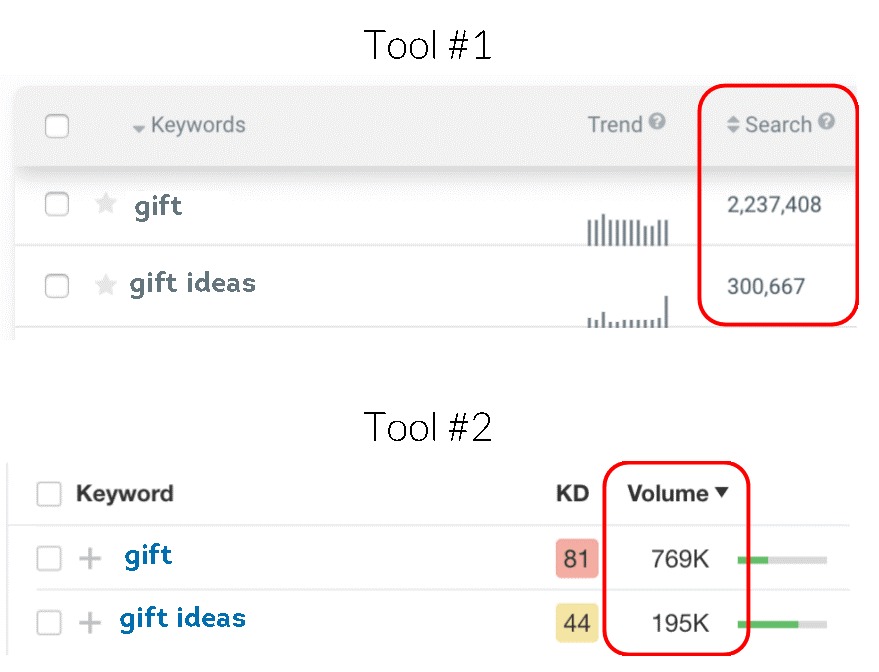
That is why I recommend that you must not consider search volume as an absolute metric. It is simply a relative metric that provides you with an overview of the keyword’s popularity. As you can see in the aforementioned example, the keyword “flowers” has more popularity than the keyword flower delivery and one can conclude that flowers would be a much more promising target than flower delivery.

Intent of the searchers

Once you’re done searching the popularity of a keyword, it is now time to find the searcher’s intent. You can find it out by typing the keyword in Google by yourself. This will give you an idea of what your users are looking for.

This is important because there are often times when you misunderstand what your users really want.

For example, you come across a keyword such as “how to write good”. You assume that such people are looking for some copywriting tips and many companies can use this keyword to promote their content marketing services.

You’re absolutely wrong.

People who are putting this keyword into Google are searching for the autobiographical book that has the title “how to write good” inscribed by a famous YouTuber.

Now, you know what I mean when I talk about searcher intent? Thus, if you want to research your keyword, you need to know the popularity of the given keyword along with what users really mean when they put this keyword in search engines.

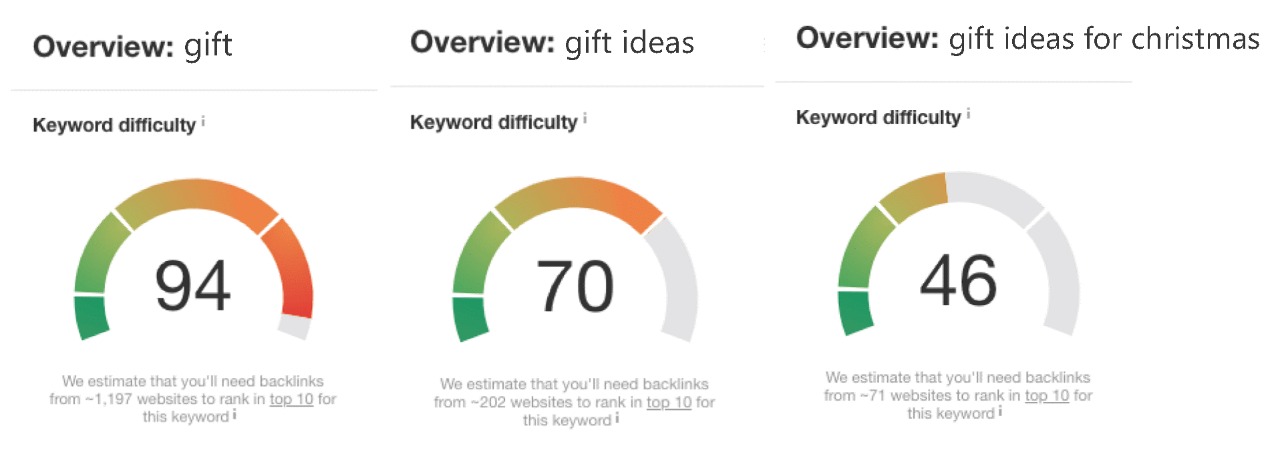
KEYWORD DIFFICULTY

The third major thing that requires your utmost attention is keyword difficulty.

If you’ve found the right keyword for your website or business, there are a lot of other businesses or websites that have found it right as well. There are higher chances that you’re not the first one to find it.

If you’ve found that keyword that belongs to big companies’ websites and they are all ranked on the first page of search engines, it is better to start exploring different keywords for your website.

You can figure out the website authority in several ways (we will learn more about this in the section of off-page optimization) but some of the tools already contain some metrics through which you can check the difficulty of a given keyword.
Funnel Stage

This is the final stage of doing keyword research and in this stage, all you have to do is to map out your keywords against the sales funnel. Basically, you need to pinpoint where the searcher is present in the buyer’s journey. Here’s how you can do it.

  • The users who are most interested in your business topic will be found at the bottom of the funnel while the ones who’re showing minute interest will be present at the top.
  • Then comes the part where you need to add an extra layer. This is done to define your customer persona, their needs, and their location in the funnel.

To clear it out further, take a look at this example of a website that sells real estate in New Hampshire.

Now, if you want to attract people, preferably newlyweds, you will need to come up with such content that will persuade the newlyweds to buy a house.

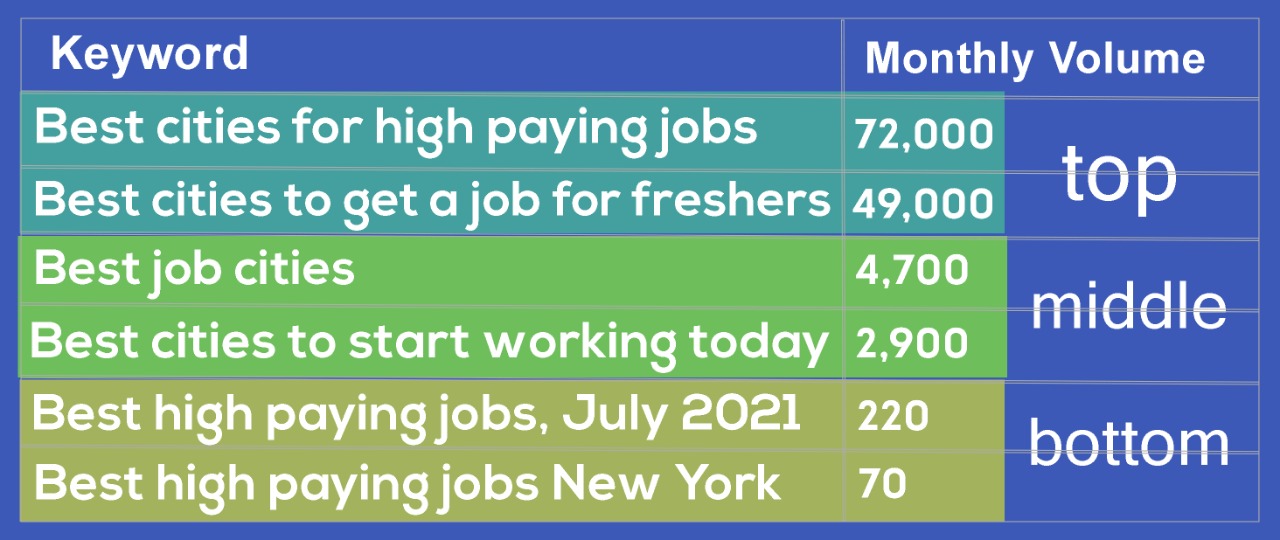
Now, let’s say you’ve found your perfect keyword and its search volume per month by doing some research. Now, you need to divide them up and pinpoint where exactly they are in the sales funnel.

For instance, the top of your funnel queries may show keywords like “best cities for high paying jobs” or “best cities for fresh grads employee”.

The middle part of the funnel can give you keywords like “Best job cities” or “best cities to start working today”.

However, when you see the bottom of your funnel queries, you’ll come across keywords like “best high paying jobs, November 2017” or “best high paying job NewYork” which can be found at the bottom of the funnel.

The sales funnel for these keywords can show up like:
Let’s rewind what we learned

There are four points that you need to keep in mind if you want to be in the top 5% of the people who can do keyword research like a pro.

  1. Come up with those keywords that people actually want and look for
  2. Understand the searcher’s intent before you come up with a keyword
  3. Create those keywords that can actually compete with the others and provide a good ranking
  4. Critically analyze where your keyword resides in the sales funnel

If you want to get started right ahead, I suggest you take a look at these resources. They can help you a lot.

  1. The keyword strategy master-class
  2. Keyword research guide by Mangools
  3. How to do keyword research for SEO

SEO BEST PRACTICES #2

On-page optimization: Help your search engines understand what you’re trying to say through your content

The process of on-page optimization enables you to create that content that your search engines can easily understand. The algorithm of Google may be extremely efficient but it won’t be able to understand your content like you and I can.  Robots are wonderful in everything that they do but they can’t do everything (yet).

For instance, if you put the keyword ‘bat’ into the search engines and a webpage shows up, search engines need to figure out what kind of page content it is supposed to show. Three types of content can show up for ‘bat’ and these are:

  • The mammal
  • The baseball equipment
  • The British-American group of tobacco

You can probably figure it out with just one look but computers need several clues before they can properly understand what you’re trying to say.

Talking about the clues, they can appear as:

  • Keywords (and how these keywords are placed on the webpage)
  • Image alt text
  • Synonyms.
  • Contextually relevant keywords
  • The theme of the webpage and of the entire website that published this webpage.

However, with time, search engines have cracked the code of how the users interact with your content. This can also be a great way to understand what you’re trying to communicate.

For instance, if you put the phrase “baseball bat” in Google, you will get three of the following options:

  1. Five reasons why bats are the coolest mammals
  2. Where can you buy second-hand bats (or other equipment of sports)
  3. A critical analysis of British-American group of tobacco

If you select the second option, you’re letting your search engine know that your content is about baseball bats.

Now, let us examine what kind of user signals your search engines look at:

  • Click-through rates (CTR): It demonstrates the percentage of those people who click on the search result for a given query.
  • Bounce rates: It demonstrates the percentage of those people who land on a website but leave after looking at just one page.
  • Time on page: I guess this one explains itself
  • Pages per session: This one explains itself too.

The more accurately your page answers the queries of your users, the more clicks you will get on your website. You will get lesser bounce rates and people will spend more time on your website looking for answers from one page to another.

These are the clues that a search engine looks for and if you’re successful in providing all of them, they can provide better answers to all the queries of your users. Once your users get everything they’re asking for, they will help to increase your ranking which will, in turn, help you in making more money.

It’s a win-win situation, guys!

But do you know the best part? Everything you do under on-page optimization is totally in your hands and you get to control everything. Moreover, it is one of the most dominant components of SEO. Amazing, right?

TITLE TAGS

We’re going to start by discussing the most essential components of on-page optimization and one such component is the title tags. Title tags hold immense importance when it comes to your click-through rates and ranking.

However, with title tags, you need to pay close attention to these three things:

1. Truncation limits

Many people tend to cross this limit and then suffer the consequences. But what is this truncation limit? The truncation limit is a 65-character limit on Google which means that your title tag should be within this limit.

If you have a large enterprise and you want your website to have a higher ranking, it is better if you add as many keywords as you can in the title tag but make sure that you stay within the truncation limit.

2. Click-through rate

When it comes to writing your title tag, click-through rate plays a very important role.

I know I’ve said that you can put as many keywords as you can but you can’t stuff them all up. Make them interesting and eye-catching so that people feel the urge to click on them and land on your pages.

3. Uniqueness

You must never use the same keywords for each of your website pages. They must be unique.

If you use the same keywords for different pages, you’ll come up with duplicated titles that will create a lot of problems with the various systems of content management. Therefore, unique keywords are essential to avoid such problems.

META DESCRIPTIONS

Now, the second important component of on-page optimization is the meta description. It doesn’t have any effect on your rankings but it can affect your click-through rates.

Meta descriptions and title tags have a lot in common such as:

  • Meta description must not exceed the 160-character limit.
  • You should put your primary keyword in this description because you need to bold it.

Now, comes the most frustrating part of meta descriptions. You may spend days coming up with an attractive meta description that can also help you in business marketing but in the end, Google may refuse to use it.

Instead, if Google finds a shred of text that is somewhat better than what you’ve come up with, your carefully inscribed meta description may get replaced with it.

Despite this replacement, you should create such meta descriptions that compel the users to click on your page.

Before writing it on your page or website, read it aloud and if it feels good to the ears, use it. Otherwise, work on them a little longer. Google may indeed reserve the right to not use your meta description but you can’t pretty much do anything about it.

URLS

There are two rules that you must always remember:

  • If you’re creating a new website and you’ve done your research on your primary keywords that will get bolded, you’re ready to add that keyword into the URL.
  • If you’re working on your old website and you’re now figuring out SEO best practices and you’re like, “well, none of my primary keywords are in the URL”, keep your URL just the way it is. Don’t change.

While putting your keyword into your URL can be extremely helpful, it can also have dreaded consequences if you try to change it because it can impact page migrations. Therefore, I recommend that you don’t make any changes to your URL.

Changing your URL can prove to be a lot riskier if your website draws a large amount of traffic towards it. However, there are several ways that you can take into account to minimize the effect of URL migrations.  For example, you can go with a 301-redirect from your old URL to the new one. But, even if you use this approach, you might lose some of your traffic while doing this.

Apart from the aforementioned rules, the most significant one is to keep your URLs closest to the root domain because only then, it will be considered as one of the SEO best practices. 

For instance, instead of using “website.com/folder/folder/folder/page”, it is better to use “website.com/page”.

Now, if you pay close attention to it, it’s not a major crisis that can’t be averted and you don’t need to re-architect your whole website. However, if you’re creating a brand-new website, this can come in handy.

Now, most of you may question, “Should I re-architect my site because I want to place my blog posts closer to the domain? I have several blog posts and all of them are one sub-folder level deep (like website.com/digitalmarketing/page), so should I go for it?

I would never recommend that.

Firstly, it won’t be worth all of your effort because if we look at it, the setbacks outweigh the benefits as there are numerous ways in which things can go wrong.

For example, PayPal is optimizing a page for “send money online” as:

Generally, you would think that it will be better to place this page closer to the root domain as:

But in order to place the page closer to the root domain, you will need weeks or even months to do it. Plus, let’s not forget about the problems that will take place around office politics and the whole enterprise.

Since this URL already has a primary keyword so I suggest you leave it just the way it is and save yourself from all the hassle.

HEADERS

Headers make us layout our webpage in the most promising way. You know them as H1, H2, H3 tags. Your primary keyword should be in the H1 tag and the rest in the H2 or H3 tags.

I’ve seen a lot of people debating on whether you should put your primary keyword only in H1 and not others. In my opinion, this is rather small and you don’t get many benefits from it either.

Let’s clear this up with this example.

For instance, I run a WordPress site and I have to post an article with the title “15 of the best email marketing campaigns examples you’ve ever seen” and my primary keyword is “email marketing campaign examples”. 

See, the H1 tag contains my title and primary keyword.

BODY COPY

Body copy refers to the text on your page apart from the headers. It is generally recommended that your primary keyword must appear about 2-3 times in the body copy.

Now, you may wonder what should be the length of your content to rank it on Google. But there’s not any specific limit to the number of words but I guess, your content must comprise at least 100 words.

However, if you have lengthy text on your page, it will be better than just having 100 words. But the length of your content highly depends upon the type of your business.

  • If your website is filled with heavy content then you’d have no problem incorporating your keywords into the body copy.
  • If your website is filled with heavy images then you’d have a lot of difficulty in placing those keywords in your text because your text will be really small. Plus, it will be difficult to rank it in Google.

For example, I optimize a page with the title “coffee shop San Francisco”. As you can see, I used the word “coffee” multiple times so my content is good to go.

IMAGE ALT TEXT AND FILENAME

Images play a very important role when it comes to on-page optimization. Search engines can’t see the images like we humans do so what can you do to make them acknowledge your images?

You give them a correct name i.e., “alt tag”. This alt tag helps the search engines to understand the content of your image. However, you have to be careful with this because this part of SEO can be over-optimized quite easily.

A lot of excitement can kick in when it comes to naming your images to make them SEO like “Nike-shoes-buy-Nike-shoes-online-discount-Nike-shoes-online-for-sale.png.”

Never do this.

Now, the exact opposite of this is to use a highly un-optimized name for your image like “home-page-graphic-6.png”.

The most suitable one to use would be “red-Nike-shoes.png”.

Describe your keyword but don’t get too excited. Figure out some synonyms of your primary keyword or latent semantic indexing keywords and get it all in there in the most suitable way.

Don’t worry, you won’t have to spend months renaming all of your images on your site. I think this part of SEO should be left at the end or you can prioritize others over it because all the mentioned above SEO practices are more helpful than renaming your images.

For instance, Zappos has posted a shoe picture and named it “men’s-boat-shoe. Jpg.” Now, its alt tag is known as “men’s boat shoe.” This one’s acceptable.

INTERNAL LINKS AND ANCHOR TEXT

TL; DR

It is very important to put links from other pages on the site but you need to be careful while choosing the text in those links. This text is what helps your user and search engines to discover what more you have in store for them.

The text you use on those links is known as “anchor text” and it is used by the search engines to know more about the page that you have linked.

  • Keeping this in mind, some awful anchor texts are “this website”, “learn more”, “click here”.
  • But, on the other hand, some great examples of anchor text would be “black Reebok shoes,” “brown shoes,” or “men’s boat shoes.”

If you use understandable text to your links, your users and search engines will know what you’re trying to communicate. Thus, name your links properly.

No doubt, the text of your link is important but its location is equally essential as well. Google values your links based on where it is located on your document. Whether it is on the footer navigation, on the top of the page, or the sidebar blogroll navigation, Google decides the location of your text.

For instance, if your site gets linked in the first paragraph by an author of the New York Times, Google will find your site a lot more valuable. The basic rule to follow here is that you need to put your links there where your users can find them easily. But don’t put them on the sidebar, in the footer, and the top navigation.

Wikipedia provides a great internal linking example. Check this out.

Wikipedia is considered to be the king of internal linking. Look at how certain words are linked to some other articles of Wikipedia. I suggest you keep Wikipedia in mind whenever you link out your documents.

LINK NEIGHBORHOODS

I know it’s very important to create a good resource for your users but what if you can use the resources that your users already trust? It seems a bit controversial but I love it.

What I mean is that you can link your documents to the content of your competitors. This is what I do. I choose my primary keywords and then look them up on Google. I select the top 4 results (maximum 10) to link out my documents. This helps me to signal Google that my resource is of high-quality and I should be counted in the high-quality neighborhood.

In this way, you’re telling Google that you’re associated with a good neighborhood and, believe it or not, it really helps you when it comes to on-page optimization.

FRESHNESS AND RECENCY

In 2011, Google announced that it will now prefer that content that is much more recent over the old one. But one thing to understand here is that you don’t have to recreate your old content using the same keywords or that your old content is practically useless.

What I want to say is that you need to keep updating your old content that was a blast in its times. This will help in increasing the results as more people will start clicking on it. So, keeping the URL same, all you need to do is to fix the dates, polish it up a bit by adding a couple of things or removing some and you’ll be good to go.

If you want to see a significant boost in your traffic, go through your content, give it everything it lacks, and sort it according to the SEO requirements. You’ll definitely see an increase in your traffic.

WRAPPING UP

We’ve covered almost everything regarding how you can make your documents optimized for search engines such as Google.

If you want to start your on-page optimization, take a look at the complete on-page SEO guide.

SEO BEST PRACTICES #3

Off-page optimization: Prove that you can efficiently answer the questions of your users

You may already be familiar with the fact that search engines try their best to provide the most suitable answers to the questions of your users.

Did you know that Google indexes more than one hundred trillion (damn, these are a lot of zeroes) web pages and for each query, only ten results show up per page? Amazing, right? But how does Google figure out which result would be the most relevant one to your user’s query

First of all, the web pages get filtered by relevance that we covered in the previous section (on-page optimization one). But even after this filter, you’ll see a lot of results for your search query. The number of results is mentioned on the top of the match like this:

So, what does it all come down to? Popularity.

Search engines prioritize those web pages that are more popular or authoritative (including the website the page belongs to) and they think that because these pages are more popular, they will provide better answers to the user’s queries.

There are no specific authority metrics that the search engines use but over time, some tools have built up some of their own metrics to check the authority of the page or a website:

(UR is the abbreviation of URL rating and DR is the abbreviation for domain rating – metrics used by ahrefs to check the popularity or authority of a website and its pages.)

When it comes to SEO, you can determine the authority of a page with the help of links, particularly those links taken from another site.

Consider these links as votes.

It is an act of authorization. When you link your site to another popular one, search engines will affirm the content present on your site.

All in all, off-page optimization is one of the SEO best practices that is also named link building. It is a strategy through which you obtain links from a third party and use them on your site. In this way, you increase the authority or popularity of your website and its pages.

To understand it better, let’s consider this cookie recipe website.

LINK QUANTITY

You just have to go out there and collect tons of links from several other websites and post them on your content. All the search engines including Google will consider your website as one of the most popular, trustworthy, and authoritative websites.

As you can see in the example below, they’re both the same sites but the site that has more links definitely wins the popularity competition.

Another thing that you need to keep in mind is that you must use several domains (websites) to link to your websites. If you use various websites such as website-a.com or website-b.com to link to your website or pages, search engines will consider this much more valuable as compared to linking only one website dozens of times.

LINK QUALITY

No doubt, the number of links matters but the quality of those matters the most. If you’ve linked a lot of websites but they’re from spammy or low-quality websites, it will bear no fruit.

On the other hand, if you use high-quality websites, even if it’s just for two links, it will be much more valuable.

As mentioned by the example below, one site has only two links and that is from stanford.edu and nytimes.com which have more importance as compared to the other.

My site will definitely win because of the high-quality links I used.

LINK RELEVANCE

The next step for perfect link building is the relevance of the links.

If you’re linking tons of low to medium websites to your pages, they may be considered valuable over the high-quality ones.

How can this happen when I just preferred quality over number?

It’s all about relevance. If those low-quality websites are more relevant to your content they will be preferred over standford.edu and nytimes.com.

So till now, quantity, authority, and relevance are extremely important when it comes to link building.

LINK PLACEMENT

With time, Google has developed a clear understanding of how the websites should be laid out and how this layout is related to the relevance of the content. For instance, if you’ve placed a link “vegan cookies” on the footer of the page, Google may think that it’s a side-wide link and it’s not related to the content at all.

That is why it is important to put your links in the body copy or on the top of the page where Google and other search engines can easily pinpoint. It is also much more valuable to place links in these areas rather than in the footer, top navigation, bottom of the page, sidebar, etc.

LINK ANCHOR TEXT

As already mentioned in the on-page optimization section the text used to describe the links is very important to let the search engines understand what your linked page is about. This text is known as the anchor text.

So, you should come up with descriptive anchor texts such as “brown shoes,” “black Reebok shoes,” “men’s boat shoes,” etc., instead of using terrible anchor texts like “learn more”, “click here”, “this website”, etc.

LINK BUILDING SUMMARY

Here’s the summary of what we covered in this section:

  • It is much more beneficial to use links from several domains instead of one (for instance, use 12 links from 12 different websites instead of using 12 links from the same website)
  • It is much more beneficial to use links from high-authority web pages and sites (use those websites that have tons of links pointing towards them)
  • It is much more beneficial to use links that are relevant to your content (use links from those websites that contain similar content rather than using those that are completely unrelated to your topic or theme)
  • It is much more beneficial to use relevant keywords (for instance, it is better to use your primary keyword instead of just jotting down “click here”)
  • It is much more beneficial to place your links in the body copy or on the top of the page (rather than placing them in the footer, header, sidebar, etc.)

Off-page optimization is considered one of the hardest SEO best practices, but if you understand it, it can prove to be more valuable than others.

Companies acquire an immense amount of traffic just because they know how to gain links from popular websites and make them optimized.

If you want to start your link-building journey, take a look at this guide first: The beginner’s guide to link building.

SEO BEST PRACTICES #4

Technical optimization: Make it easy for search engines to locate your content

So, till now, we’ve covered the top three SEO best practices and now, we’re going to learn about the fourth one, technical SEO.

Think of SEO like you’re building a brand new house, you’ve managed to build a firm foundation, added walls, roof, and polished it up nicely by adding furniture and stuff. Now, the only thing that is left to do is wiring, plumbing, and electrical fitting. Power and water supply won’t add to the aesthetic appeal of your house but without these, you won’t be able to live in the house.

That’s how important technical SEO is. With the help of technical SEO, you make it easier for search engines to find your content. If the word ‘technical’ freaks you out, don’t worry, I got you.

You just need to keep these four things in your mind:

1. MAKE SURE SEARCH ENGINES CAN INDEX YOUR PAGES

First of all, if your search engines can’t find your content, they won’t be able to index it.

There are two ways through which you can avoid this:

  1. Give an XML sitemap to your search engines
  2. In the page you want to rank, make sure that the robot.txt file isn’t blocking any crawlers

In order to do that, you can take some help from the following resources:

—What is an XML sitemap and why should you have one?

—What is a robot.txt file?

2. FIX ERRORS AND BROKEN LINKS

Your search engines may find some errors when they crawl into your website. These errors may result because you accidentally removed a piece of your content and now the URL is showing up with a 404 error.

This can have severe consequences for your URL because if your URL is connected to several other third parties, this error can stop the valuable information from passing down from your URL to the connected sites. These links are termed “broken links”.

One way to solve such errors is to continuously check your website. If you’ve found an error you can’t neglect, you can opt for redirecting to a new URL. I will also talk about some tools (later in this guide) that you can use to fix these errors.

But if you want to start fixing your errors right away, check out these guides:

—HTTP explained: The HTTP status & response code guide

—How to create and verify a 301 redirect

3. MAKE SURE YOUR SITE IS MOBILE-FRIENDLY

Every one of us browses the internet on our mobiles phones and it gets really frustrating when the site doesn’t respond as you want it to.

We want to provide a better experience to our users and so do our search engines. That is why Google and other search engines have come up with another ranking factor known as mobile-friendliness.

WordPress, Shopify, and Squarespace have already cracked this code due to the modern content management systems.

If you’re going through a similar crisis, you need to talk to your developer to make your website mobile-friendly as soon as possible. If you just want to test the mobile-friendliness of your website, you can go through this handy tool designed by Google

—Mobile-friendly test

4. SPEED UP YOUR SITE

The last thing that we need to make sure of is that your site loads up in milliseconds. Google has also justified it by saying that the faster your content loads up, the more your users are going to engage with it.

You can speed up your sites by improving your caches, avoiding needless codes, and optimizing your content images. If your site takes forever to load, you definitely need a trip to your developer and ask him/her to fix it. However, if you want to check the speed of your content or website, use this test created by Google.

—Pagespeed Insights

Now, remember that this tool can state every little problem on a list. You don’t have to cover all of them. Just pick out the big ones, fix them, and you’ll be good to go. Because if you fix the smaller ones, it will have little or no effect on your rankings or the user experience. Plus, you’ll be wasting your time. So, focus on the big ones. They are the real game-changers.

TECHNICAL SEO SUMMARY

Technical SEO is all about these four issues – indexing, errors, mobile-friendliness, and speed. Once you grasp their concepts, you’ll get rid of almost all the issues associated with your website.

If you want to learn more about technical SEO, take a look at these resources:

—The complete 32-point SEO checklist.

—The ultimate SEO audit.

SEO BEST PRACTICES #5

STATS: METRICS THAT MATTER FOR SEO best practices

So, we have gone over the top SEO strategies and now we’re going to probe deeper into the nerdy stuff of SEO best practices.

When it comes to operating a digital marketing channel, you’ll feel a lot intimidated by a number of metrics present to measure the SEO performance of your site.

But don’t worry, I’m not going to talk about all of them. I’m just going to focus on the top five metrics that are essential for SEO. These top five metrics are – domain authority, ranking, backlinks, organic traffic, and business metrics.

1. Domain authority and page authority

PageRank is a metric designed by Google to check the authority of the website and content but soon, it stopped functioning. That is where MOZ, an SEO analytics company, came into the business and gave us two metrics – domain authority and page authority.

After some time, some third-party tools also came up with their own metrics such as ahrefs developed domain rating and URL rating. On the other hand, SEMRush developed domain score and page score. Don’t be scared of all these terms. You can use any one of them because all of them do the same thing.

  • Domain authority/domain rating/domain score: As the name indicates, you can measure the authority of your domain (your whole website) with this metric. This is measured by the number of links and their characteristics pointed towards your website (we covered this in the off-page optimization section above)
  • Page authority/URL rating/page score: As the name indicates, you can measure the authority of a single page (a single URL) with this metric. This is measured by the number of links and their characteristics pointed towards your pages (we covered this in the off-page optimization section above)

It is generally believed that page authority is much more important than domain authority in the eyes of search engines.

For instance, if you compare two URLs that have similar content, that URL will rank higher that will have the highest page authority. But if they have the same page authority then you can use domain authority to check which one will be ranked higher.

Plus point: If you want to see how your website is working, go through this tool to inspect the authority of your domain.

2. Rankings and CTR

SEO is obsessed with this metric and that is rankings. The rankings given by the search engines are a way to tell the position of a specific page in the search results whenever you type in a query in the search engines.

According to the default settings of the search engines, they are bound to show 10 results on each page of the search result. So, if you want to be on the first page of Google, you need to be in those top 10 results for a given keyword. But this isn’t enough anymore.

According to various studies, over 50% of the people only click on the first three results shown by Google. So, whenever you perform SEO, you need to have a low ranking but a higher clickthrough rate.

3. Backlinks

The backlinks metric is the metric that measures the number of links from third parties’ sites to one specific site. You can acquire a backlink profile if you associate backlinks metrics to that of domain authority and page authority of the linking sites. In this way, you will be able to analyze both the quantity as well as the quality of the links pointing towards a certain site.

When it comes to SEO, you need to have:

  • A large number of backlinks should be provided by high authority websites
  • More backlinks should come from unique sites instead of having several backlinks from less unique sites
  • More backlinks should come from the sites that are related to the topic or theme of your site instead of those that come from sites that contain totally unrelated content.

4. Organic Traffic

We’ve covered the top three SEO metrics but none of them will bear any fruit if you don’t have much traffic.

Organic traffic comprises all those numbers of visits to a specific website that are referred by Google and other search engines.

Undoubtedly, the more organic traffic you have, the better it is for your website.

This metric provides you with a lot of benefits like with the help of this metric, you will be able to analyze the behavior of your visitors much better, the value of an organic visitor, and the average rate of conversion.

But you need to make sure that you can differentiate between the branded and non-branded searches.

  • Branded searches are referred to those searches that contain the name of your website in the main keyword. Not everyone has the same brand name so whoever looks for your website definitely knows you. So, in the case of branded searches, your organic traffic will be a lot similar to the direct traffic (i.e., people who directly type your website’s URL into the search engines)
  • Non-branded searches are the opposite of the branded searches. These searches don’t contain the name of your website in the main keyword. In the case of SEO, you need to focus more on the non-branded searches because these searches allow you to gather new visitors who aren’t aware of your website.

5. Business Metrics

Business metrics help to figure out whether this SEO traffic is generating valuable results or is it just attracting the wrong traffic towards your site or content.

Let’s take a look at some examples.

  • If you want to measure the success of your blog post, you can examine the conversion rate from organic traffic to leads or you can examine the number of new leads generated from organic traffic. This can only be possible if your blog post is optimized to convert your traffic into leads.
  • If you want to measure the success of your pricing page, you can examine the average value per organic visitor or you can measure the number of customers it gathers from the organic traffic. This can only be possible if your pricing page is optimized to make visitors purchase from your website or brand.

You can utilize Google analytics to check the impact of SEO best practices in these metrics. You will be able to tone down to a few specific URLs, strain your organic traffic, and analyze the overall performance of your website.

If you want to examine your business metrics, use this website analytics guide.

BEST SEO PRACTICES #6

POWER-UPS: THE BEST SEO TOOLS for SEO best practices

We’re done discussing the SEO best practices and the metrics used to measure the performance of your website. Now, we will talk about execution and the tools we need to execute.

SEO contains a lot of areas and it might take years to specialize in each area. Similarly, the more areas it has, the more tools you’ll have to use to perform various tasks.

However, I’ve listed the most important ones below that can help you get started on the SEO best practices.

Basic SEO tools for SEO best practices

These basic SEO tools are essential to understand if you want to work on SEO best practices.

  • Google analytics: Everybody is familiar with this world-famous web analytics tool. Google analytics can be used to track your organic traffic as well as analyze the behavior of those visitors when they visit your website along with several other things. Learn more about Google analytics.
  • Google search console: Google designed this tool in such a way that it helps you to organize your search engines. Google search console will figure out the clickthrough rates, latest search rankings, and indexing errors to fix your website. Plus, it also notifies you if you commit any penalties. Learn more about the Google search console.
  • Google cache search: If you want to check the cached pages of a website or want to know what the old version of a website looked like, you can use this Google cache search tool.

Keyword research tools

Keyword research tools will help you gather information regarding the search volume, opportunities, and competitiveness of your keywords.

Google ads keyword planner:

Many people used this keyword planner but since you can get a limited amount of data, SEOs have stopped using this platform. But you can get a huge sum of data if you can spend thousands of bucks on this. I don’t recommend that you use this platform but if you don’t have anything else, this can prove to be good. Something is better than nothing, I guess. Learn more about Google ads keyword planner.

KWFinder:

If you’re a beginner, this is a must-have keyword research tool. It has a welcoming user interface with a lot of helpful features. Learn more about KWFinder.

Ahrefs:

In my opinion, ahrefs is one of the best keyword research tools to utilize. Not only the keyword research but it also offers the largest keyword data database. You can find a great many easy-to-use features in this tool just like KWFinder. But in addition to these features, it offers several advanced features that can prove to be fruitful for an experienced SEO. Learn more about ahrefs.

On-Page Optimization Tools

On-page optimization is one of the SEO best practices that is done to optimize the content on your web page or a website so that the search engines can understand it better. Now, below mentioned are some tools that can be used for this SEO best practice.

Yoast SEO:

WordPress and Yoast plug-in is a lethal combination and this combination can make SEO (on-page and technical SEO) 10x easier for you. It can provide a simplified layout of your metadata that includes titles, meta descriptions, and slugs. Learn more about yoast SEO.

LSI graph:

This tool can efficiently add LSI or contextually relevant keywords to your content. These keywords will assist search engines in understanding your content better. Learn more about the LSI graph.

Link Building Tools

Link building is another one of the SEO best practices that can be quite intimidating if you don’t fully understand it. Therefore, these link building tools will make this challenging process extremely easier for you.

Ahrefs:

This is hands-down the best link building as well as keyword opportunities finding tool. It also provides abundant information regarding the backlink profile of thousands of websites that you can utilize to reverse-engineer their strategies of link building. Learn more about ahrefs.

BuzzStream:

The easiest part of link building can be locating the keyword opportunities but gathering a bunch of links by reaching out to various other websites is a totally different story. This link building tool can also be taken as a link building CRM that can pinpoint and store valuable information, reach out to your contacts and maintain good relationships, and launch capacity-building campaigns. Learn more about BuzzStream.

Rank Tracking Tools

The name of this tool defines itself. The rank tracking tool is used to track your search engine rankings for huge sets of keywords.

Google search console:

This tool is better to use if you don’t have enough money because it can gather some data regarding your rankings directly from Google and it’s absolutely free. But one setback of using this tool is the data may be incomplete and you won’t be able to analyze it effectively due to the poor user interface. However, if you’re serious about SEO, you will not stay at this tool for long. Learn more about the Google search console.

SERPWatcher:

This is the best rank tracking tool I’ve found on the internet. It provides you with daily updates of your rankings and you can track the rankings of infinite domains. Learn more about SERPWatcher.

Ahrefs:

You may think that ahrefs? Again? I can’t do anything about this either because it has everything including this rank tracking feature as well. But with this tool, you won’t get daily updates like SERPWatcher. However, if you’re already using ahrefs, use it as a rank tracking tool as well. I won’t recommend you spending money on two different tools. Learn more about ahrefs.

HELPERS: PEOPLE AND COMPANIES WHO WILL MAKE SEO EASIER FOR YOU

We’ve covered the tools that can help you with your SEO and now we’re going to bring the human factor into it.

Shady business is everywhere including the digital marketing world. You can differentiate between a legit business and a not-so-legit business. And now, we have a sub-industry that has gained a lot of visibility in a few years known as the SEO media industry.

The SEO media industry comprises various websites and website owners that will provide you with a humungous amount of not-so-helpful information. Plus, they will make you feel that are missing out on tons of important SEO events by making everything “newsworthy”.

To keep you safe from such fraudulent industries and people, I’ve compiled a list of people that can actually benefit you in the SEO world and make your SEO life a lot easier.

ALEYDA SOLIS

If you want to stay up-to-date on all the technical aspects of SEO, especially international SEO, you need to read the guides of Aleyda and watch her tutorials as well.

Go through Aleyda’s blog

GLEN ALLSOPP

Meet this finest link building expert, Glen Allsopp. I’ve shortlisted Glen because of his creative content and the way he pushes people to extremes to extract the best link building skills through his case studies.

Go through Glen’s blog

AHREFS

Ah, ahrefs, again! So, now you probably know that this company is our favorite. Ahrefs not only has a wide range of SEO tools for SEO best practices but it also has valuable blogs that will help you in starting your SEO journey. Ahrefs blogs are worth reading, especially for beginners.

Go through ahrefs’ blog

MATTHEW HOWELLS-BARBY

Matthew is a co-founder of a private SEO community known as a traffic think tank and he is also an acquisition director at Hubspot. If you want to read something interesting and helpful, check out his blogs.

Go through Matthew’s blog

NAT ELIASON

If you want to know about some tactics to increase organic traffic and to make your content SEO, Nat’s blogs can prove to be a lot helpful.

Go through growth machine’s blog

QUICKSTART GUIDE: HOW TO ACCELERATE YOUR SEO SKILLS

We’ve done with the technical and nerdy stuff regarding SEO best practices and tools. We’ve also done with the people that can help you. But now, we’re going to talk about you, what you can do to accelerate your SEO skills.

All I’m asking you to do is practice. As much as you can. The better you execute your SEO campaigns, the more it undermines any blog posts that you read in the past.

If you’re a beginner and want to gain some experience, keep these three things in mind:

  • Grow your business with SEO best practices. If you are starting a new business and want to increase the traffic, simply apply what you’ve already learned.
  • Look for that business that can help you with SEO. Make sure that this business lets you make some changes to its content and also lets you publish some of your own. (this business can be one of your friend’s or a person that lives near you)
  • If you’re unable to find that business that lets you do all of this, you can make your own website and blogs and gather organic traffic. But don’t go for digital marketing or other SEO-related niches because it will get competitive and you won’t have the experience to tackle all of that since you’re a beginner.

If you choose the last option, it may take some time to generate valuable results because you’re building a brand new website. On the other hand, this gives you the privilege that you can do anything with it. You can make it, break it, or fix it. It’s in your hands. You can try out new things without risking the business and, who knows, you may come up with a valuable asset after all.

Either way, you can follow the below-mentioned setup:

  1. Finish reading this guide

Outcome: Before you start working, you must have a basic understanding of SEO, search engine rankings and how you can improve them, and how you can increase your traffic from search engines.

  1. Do keyword research to discover various keyword opportunities, measure out the competitiveness of those keywords, and also figure out the searcher’s intent.

Outcome: You must be able to come up with a detailed list of your searched keywords with appealing search volumes. Make sure those keywords are similar to your searcher’s intent and have low competition.

  1. The keyword opportunity you found out in the previous step should be utilized in this step by creating and optimizing content according to it.

Outcome: You must come up with several different pages (2-5) each of which is optimized for its own specific keyword.

  1. Discover backlinks opportunities and run outreach campaigns to create links to the content you came up with in the previous step.

Outcome: You must be able to extract at least one link from a third-party website that has content relevant to your niche and add it to your content.

  1. Thoroughly examine your website and make sure it is free from all kinds of technical errors.

Outcome: Your content must not return any errors and it must be correctly indexed. In addition to this, your website must load up quickly and it must be mobile-friendly.

  1. Lastly, keep a track of your search engine rankings and organic traffic by measuring the impact of your SEO efforts. You can use this free SEO report to check the success of your SEO efforts.

Outcome: Make use of all the tools mentioned in the previous section of this guide and check the performance of your campaigns or website. If something is not going as it’s supposed to be, you can repeat 2-5 steps and then check your website’s progress again. In this way, you will be able to grow your organic traffic and your business.

How Google My Product Works?

Google consistently updates Google My Business. Therefore, you might have wondered how it works to profit businesses. Firstly, you need to check your ‘Google My Business’ profile and spot any modifications. For instance, suppose Google launches any new beta versions that aids organizations disseminate details of products. You should then include your products. The products of GMB, also called ‘collections’, are in beta (like most other features of Google). Nonetheless, Google has made it accessible to local traders now and mostly it is a component of every Google My Business profile. All of this instantly makes one wonder how Google My Business products operate. Let’s go through it in detail.

Firstly, what does Google My Business Products means?

Basically, Google My Business Products enables organizations to display the details of their items. This is a bit like services, accessible to consumers for quite a while). Google describes the operation of the GMB as follows:

“The Product Editor allows merchants to build a presence on mobile and the computer to showcase their products and drive consumer interactions. Consumers will see a more curated showcase of a store’s products on the Business Profile Products tab on mobile, or the Product Overview module on the computer. Items added through the Product Editor appear in Business profiles on the computer and mobile version of Google Search.”

Since a considerable span of time, we have been witnessing Google My Business products extending into a bulk of our customer’s GMB profiles. It has been noted by Google that the Product editor tilts to medium-to-small organizations, although exceptions are there. Furthermore, for bigger businesses or chain organizations, Google provides more detailed guidance on how to display their products/items.

GMB products Features

Go to your GMB profile to spot the accessibility of GMB items. If ‘Products’ (Beta) has been included as a component of the menu (to the left), it means program experimentation is available.

Secondly, a collection needs to be built. Expectedly, the user interface is friendly. On the basis of other GMB data, Google commences with a string of prompts for creating item details. If the name of the product is not visible, you need to click on ‘something else’ and then you are brought to the existing menu.

Each product is linked with a collection. According to Google, at least 3 products should be included in a collection, although exceptions are there. As per our initial experiments, whether it is 1 or 30 products, the GMB Products gives the same results.

Some fields are necessary, for example, the item images. The screenshot below shows that Google doesn’t publish any item unless this is done. For instance, when you upload an image, the ‘Publish’ tab changes color to blue, and ‘Add’ appears as text.

Moreover, you can go to the product page through an option, supposedly making things easier for companies. A dropdown menu is provided by Google which lets you click the desired text. The most feasible option for e-commerce organizations is a call-to-action ‘buy’ button. By contrast, options like ‘learn more’ provide potential customers the opportunity to jump to your website to know your product in detail.

Like the image, when you choose a link, a gray color appears on the ‘publish’ button unless you give the correct link. Eventually, for reviewing and updating, the Product collections come in an easy-to-use format. You just need to click on the 3 perpendicular dots for making changes and the item details roll down. This is an easy process, like all the others.

Lastly, when someone googles your organization, they see the GMB items in your Google My Business profile. The following screenshot shows different products from a group of product collections.

Would Google My Business Work for me?

Why not?

Especially the latest Google My Business Products and their collections allow you to uphold your cellphone turf. For instance, on cellphones, it is in the Products tab below product posts that the Product Collection exists. Moreover, once you press the collection button, you can view that collection and all the products inside it. This can be seen in the screenshot attached underneath.

Furthermore, Google My Business products aids in spotlighting prominent items by providing different offerings. According to Google, such items can be seen separately from the Product Collections.

“In addition to showcasing products in collections, you can also highlight featured products that will display independently from the Product Catalog in the “From Product Posts” carousel. To add products to “From Product Posts,” simply add product posts for the products you want to feature. You may add up to 10 product posts at a time. After a week, the products will be removed from the business listing overview but will remain in the “From Product Posts” carousel. The post will still be available in the “Posts” tab.”

Does it come with any disadvantages?

Unfortunately, it has some. Firstly, on Map views, Product Collections are not visible. Therefore, it is only useful for searches related to your company. Conventionally, in the Map view, a number of local SEO measures try to rank high. However, this is not helped at all (or at the very least transform consumers in the Map view).

Lastly, small-to-medium type organizations are helped by Google My Business Products because GMB makes it simpler for future clients to access their products. Seemingly, Google My Business Products is a component of the consistent attempts to unite GMB characteristics with small-to-medium type organizations’ interests.

“Combined with the aforementioned updates to Products and Services, GMB really is turning into an online shop window for your business. Once this feature is fully rolling out, searchers will have an immense amount of information at their fingertips on GMB, significantly reducing the need to visit your website. I expect to see a crossover with Google Shopping very soon.”

It is recommended that you take it slow especially because you will be engaging with a 3rd party platform. Particularly, in the initial phases of beta testing, it may not be worthwhile to spend long hours and energy on loading details of items. Still, putting the key items at the top level assists organizations in adding more links to the Google milieu. This also enables more clients to come and view their items.

Additional Information on GMB:

In addition, Google has been making efforts to fine-tune its working and it is speculated that the platform will attract more traction. Recently, news about a Google My Business subscription made rounds.

Initial reports suggest that the key advantage of this subscription provides a Guarantee from Google. Just like the Google Local Service Ads’ Guarantee, this one offers a bit of comfort to future customers.

What does it mean by Google Guarantee?

Reputation can make or break a business. Google offers ads in Local Services which makes it vulnerable to some risks pertaining to the dependability and trustworthiness of the advertisers. Therefore, the initiative offers a Google Guarantee.

“The Google Guarantee badge is available for businesses that pass a Google screening and qualification process through Google Local Services. If you’re backed by the Google Guarantee, and your customers (that came to your business through Google) aren’t satisfied with work quality, Google may refund the amount paid for the service.”

Companies have to undergo a monitoring procedure to get the Google Guarantee to ensure that the background of all workers has been checked for dealing with future clients. Generally, such checks are supposed to ensure that workers are licensed and insured to undertake the job.

How does Google Guarantee square with Google My Business?

Even though all the data is not available, the Guarantee would mark the start of the GMB subscription. This will eventually extend to cover further fine-tuning. Local Ads investigation has shown that marketers have enjoyed an increase in click-through rate; however, the relevant data is not in the public domain. Moreover, the initial price is speculated to be smaller than other competitive products, for example, Yelp.

Minor business often doesn’t want to splurge on ads, GMB provides an advantage because of its organic-based. Moreover, experimentation will not end as Google persists to look after small-scale organizations. It has also been confirmed by a Google representative.

“We’re always testing new ways to improve our experience for our advertisers, merchants, and users. This experiment will show the Google Guaranteed badge on the business profile. We don’t have anything additional to announce right now.”

Lastly, as Google continues to be the big cheese of the internet, organizations that have some budgetary freedom might want to experiment with Google My Business subscription. Particularly, it continues to make the most of the leverage of GMB and continues to provide incentives. It also gives one the opportunity to stand out from the rest if one’s competitors aren’t using GMB (particularly if a continual stream of reviews interests you). If you don’t notice any change in the revenue, you should stick to your organic platform to target potential customers.

March-August 2021 Updates of SEC vs. Ripple: Developments in the XRP lawsuit

Ripple Accused SEC of Causing $15,000,000,000 Damages, in early December, the United States Securities and Exchange Commission (SEC) settled its gaze on Ripple for legal inspection. The problem arose when the SEC suspected that Ripple sold its digital currency XRP without legally going through the registration process. XRP, worth $1.38 billion, was sold during 2013-2020. The illegal act was conducted even though SEC stated that lawyers had made Ripple aware of the legal standard procedure. According to SEC, Ripple ‘choosing to ignore’ the issued memos was bound to get it in trouble.

The quarreling over details of the content of those memos continued, according to news reports. On one end, Ripple presented its view on the memo it was issued as Ripple believes they have legitimate reasons to believe that XRP is not a security. Nonetheless, Ripple was charged by the SEC in a vicious lawsuit for selling over $1.3 billion in unregistered securities. The lawsuit in itself resulted in a traumatic loss for Ripple and XRP users in a total sum of $15,000,000,000. The news brought forward devastating reputational crisis reports around the payments, and now XRP is going downhill and affecting its investors negatively.

Stuart Alderoty stated;

“Today, Ripple filed our answer to the SEC’s amended complaint. Notably, with full transparency to the SEC: XRP was listed on 200+ exchanges, billions of dollars in XRP were bought/sold monthly, many market makers had daily XRP transactions, and 3rd party products (not developed by Ripple) used XRP. We’re looking forward to learning more about the SEC’s meetings with major XRP market participants who asked for guidance but were never told that XRP txns would be subject to the federal securities laws. Full filing here.”

SEC was accused by Stuart Alderoty, General Counsel at Ripple, for knowing that Ripple’s asset was already amongst the list of several exchanges. Despite SEC alleging that XRP’s sale has been illegal, throughout the past decade, SEC had been kept in the loop about XRP’s status, and yet they never guided them in the past over those major exchanges. Hence, Ripple is fighting back the accusations by putting forward evidence regarding SEC’s failure to disclose that XRP could be prescribed as a security lawfully. Some may be concerned that Ripple is simply trying to save a sinking boat, especially a boat that is drowning in the U.S. market. Nonetheless, this is merely news reports speculating.

Organizations such as MoneyGram (a money transfer business platform) have revoked their access that Ripple had. They have disassociated several investors before they face a serious loss as Ripple did. Fortunately for Ripple, 5% of their customers are from the U.S. market; they will recover soon enough once the lawsuit is settled. The value Ripple touched was around $0.63 in the previous month, but it came tumbling down to $0.2 after the SEC accusation.The CEO of Ripple, Brad Garlinghouse, was confident, as he stated, having acquired 15 new contracts with banking organizations internationally. He claimed that Ripple’s customers were majorly not from the U.S. in the first place, around 95%.  He simply looked at the matter as an obstacle only faced in the United States market to slow down innovation. In the Asia Pacific region, the liquidity of Ripple has mainly grown, especially in Japan. The Financial Service Agency declared that they did not view XRP as a security in Japan.

In some ways, it can be looked at as SEC stumbled in the Ripple case and lost itself in a maze they created. When they filed that lawsuit against the blockchain technological giant company Ripple, the event happened at a peculiar time. The cryptocurrency XRP was declared to not simply be a distribution of digital tokens in a payment platform. A commonly observed judgment was how the SEC took seven years to make this accusation against XRP. Billions of XRP’s tokens flowing through secondary markets of cryptocurrency were in the process, and the accusation was made in the midst of it. An incredibly odd noticeable portion was the retirement of Chairman Jay Clayton(now Ex SEC Chairman). With the new administration in line and filings heating cases, one may only conclude the SEC’s judgment being misguided. The developments that followed made it further seem like a disastrous move. Gary Gensler, presumably the incoming chairman, will not deal with the aftermath of Clayton’s mess.

The hurricane was unforeseen by the SEC but well understood on January 1, as XRP holders prepared to fight back with clear intentions to fully expose the scandal for what it is. Rhode Island attorney John E. Deaton struck back and exposed the weakness SEC’s lawsuit had within. He filed a petition in the U.S. District Court in support of the CRP holdings to not be described as a security lawfully. XRP wasn’t bought by him as an investment contract, as it is not a security and all SEC lawsuits resulted in was damage for him and several other investors in the run. The value of the cryptocurrency went spiraling down, and they were removed from lists in crypto exchanges. Many XRP retail holders were willing to backup John E. Deaton when he stood up to fight this case, and they wanted to stop the delisting of this token.

An incredible argument was carried out last Friday by the SEC as they responded to John. E Deaton. SEC simply tried to avoid Deaton by establishing that they were still not settled on whether XRP was a security or not. Hence, they believe that his petition should be completely dismissed. This is where one is utterly shocked at how the SEC blatantly filed a lawsuit about something they are still not quite sure about; who will now account for the losses? Another question that arises is how they will not defend themselves and which segment exactly of the 193 Securities Act will SEC use to struggle its way out of the hole they dug up for itself? Lastly, what does it really take to operate lawfully in the United States?

On March 3, New York judges were sent letters by Garlinghouse and Chris Larsen (co-defendants) regarding ‘fair notice and due processes.’ The SEC’s response supported them as the Security and Exchange Commission failed to show up with their respective attorneys to attend the Zoom meetings to communicate effectively. Ripple had filed the Freedom of Information Act to ensure that the internal documents of SEC and communications could present that all those years, the developments that occurred relating to XRP didn’t go noticed as unclear. The SEC was moving in contradicting ways and only seems lost in their maze.

Another example of SEC’s confusion was observed when they sent a letter to the New York judge in a rush demanding that the ‘fair notice’ defense shouldn’t be accepted.  They used the words ‘improper’ and ‘spurious’ to describe Ripple’s defense and urged for an immediate hearing. If things align with what SEC hurriedly demanded, it would raise suspicions,and Ripple’s FOIA request would come in handy to discover the hidden weaknesses. 

William Hinman (former Director of the SEC’s Division of Corporation Finance) announced in 2018 stating that Ethereum (ETH) was not a security, even though it shares similarities with XRP.

“And putting aside the fundraising that accompanied the creation of Ether, based on my understanding of the present state of Ether, the Ethereum network and its decentralized structure, current offers and sales of Ether are not securities transactions.”

One may wonder what internal work took place behind the decision of that announcement. Certainly, some crypto exchanges must’ve asked SEC whether the legal status of XRP is stable enough to list it. What did SEC respond to them for the guidance of usage of those tokens? Since 2013, Ripple and XRP holders have been working smoothly, and yet SEC did not take a single opportunity to question XRP’s status. Why did they choose not to interfere then?

Each development that we notice in this case makes it more and more shocking. The entire future of the U.S. cryptocurrency will be impacted by how this lawsuit pans out. Making enforcement through trials due to the arrogance of regulators is unethical, and through SEC’s actions, it is obvious that they do not care about the investors they swore to protect. SEC is demanding to be heard and viciously fighting the case with lack of evidence, but it realizes the waves it can create to damage companies. There has been a definite backlash, and it was witnessed not too long after the class action lawsuit.

However, an encouraging development was made this week as Rep. Patrick McHenry (R-NC), senior Republican in the House Financial Services Committee, may inaugurate a public-private working setting that is led by the Commodity Futures Trading Commission (CFTC) and SEC. Through this, they will begin a transparent regulatory framework for all digital assets. McHenry seemed eager and determined to put an end to the overreach of the agency. He mentioned it on a crypto regulation session in January in a ‘Real Clear Policy Panel’ discussion. This event took place on the same day President Biden had nominated Gary Gensler for the SEC chair position.

Gary Gensler stated regarding his Senate confirmation hearing in February how he believed that the SEC should stay within its capacities without using enforcement resources for events that don’t need to be addressed in the markets. Hence, it is now expected that Gensler may finally be the one to acknowledge this problem and settle the crypto markets by investigating further. He may invest SEC into McHenry’s working group rather than focus on the Clayton lawsuit that has already caused too much trouble for the agency.

Meanwhile, Ripple CEOs and SEC agreed on their timeline for arguments. They finally settled on dates concerning the discussion for a motion to dismiss. It may run through June 2021; the attorney James K Filan, who represents Christan Larsen –the former CEO Ripple, had tweeted a copy of the letter that SEC filed with the Southern District of New York. Filan will also be representing Garlinghouse in the SEC suit. The letter provides clear details that both sides have settled on dates to present their arguments and shreds of evidence relating to whether the defendant should dismiss the case.


The details specifically mention a request to the court for accepting their timeline. The defendants will open on April 12, 2021, and the SEC on May 14,2021. Later, the defendant will have time until June4, 2021, to reply and conclude if possible. Dates that have been mentioned are solely regarding the motion to dismiss from the defendants. It will provide clear insight nonetheless on what the bigger picture may turn out to look like.

For the Southern District of New York, the legal letter informed Judge Analisa Torres at the U.S District Court of a motion to dismiss, but the SEC’s complaint “still fails to state a claim against Mr. Larsen.” Mainly, the complaint is focused around Larsen “knowingly providing substantial assistance to a person in violation of [Section 5] of the 1933 Securities Act.” referring to the amended complaint filed in the previous month.

Hester Pierce, SEC Commissioner, stated that the SEC might potentially settle this out of court near the end as it often does.

“Often, you’ll see that the litigation ends in a settlement — sometimes it goes through and the litigation actually plays out in court.”  

On the other hand, this cryptocurrency lawsuit is unlike any they’ve ever filed before, which is why there’s no guarantee whether this will be settled out of court. Overall, it is unlikely that this may end before summer 2021.

Ripple itself was stipulated formally by the Security and Exchange Commission in Dec 2020. XRP was charged by SEC for the sale of unregistered securities, and Garlinghouse and Larsen were accused of raising further $600 million by XRP sales. Ripple Labs rejected the charges, and they claimed that XRP functioned similarly to other cryptocurrencies price-wise.

Larsen’s lawyers, on those grounds, had stated that the SEC didn’t prove that he was aware at that time about XRP units being securities and continuing illegal activities.

“The SEC’s own allegations are not only deficient but affirmatively show it cannot meet this standard. At a minimum, the SEC must allege that it was ‘so obvious’ that XRP transactions were securities and Ripple’s conduct was improper that Mr. Larsen ‘must have been aware of it.”

The state of New York, cleared by the Financial Crimes Enforcement Network (FinCEN) in 2015, recognized XRP as a digital currency. The lawyers made several points regarding this, including that FinCEN and the Justice Department had both regulated XRP as a virtual currency, which is inconsistent with the claims of labeling XRP as a security.

Several corporate giants such as MoneyGram were involved with XRP trading for international transactions; however, many exchanges have delisted it. MoneyGram itself is currently facing a lawsuit as it allegedly misled investors about the cryptocurrency XRP. Even if the damage and case were to be folded soon, the damage would remain irreparable.

16 August: XRP Price Update

In addition, the price of XRP has spiked above the $1.00 threshold because Ripple is working on preparing documentation for an upcoming regulatory filing.

Another Twitter user, James K. Filan issued a timely update about upcoming events related to XRP. A Ripple spokesman said they will have their response to the SEC’s motion for communication with the Slack messaging platform on August 16th. In the meanwhile, the SEC will return to this subject the next day. August 31st is the deadline for fact discovery, with the October 15th expert discovery deadline now approaching.

Moreover, Stuart Alderoty replied to RollCall in his tweet and stated,

It’s increasingly obvious to many in the industry that the outcome of this case (and what is learned along the way) will set a precedent for crypto innovation in the U.S.

Cryptocurrency specialists are watching the conflict between Ripple Labs Inc. and the SEC closely in anticipation of a precedent-setting case.

In an action brought by the U.S. District Court for the Southern District of New York, the court issued the company, CEO Brad Garlinghouse, and chairman of Ripple Labs Chris Larsen, arguing that they had a legal obligation to register XRP as a security under federal securities laws. Because Ripple and its management are confident that the allegations will be dismissed in court, they have recommended the lawsuit be dismissed and the charges be dropped.

As a result, Ripple has gained preliminary injunctions granting access to the SEC’s internal data and protection of the company’s executives’ private bank records, among other things. A pending legal action is being taken by the XRP holders as well.

According to Drew Hinkes, a legal counselor at Carlton Fields PA in Miami who works on cryptocurrency matters. If Ripple has a valid complaint, then this is setting a precedent for the SEC’s control over digital currency offerings (ICOs).

According to Hinkes,

“This is a significant case. Ripple has tremendous financial resources, has assembled an incredible team of well-respected lawyers, and has one of the most high-profile projects in the industry.”

It is estimated that once it gets to the 2nd Circuit Court of Appeals or the Supreme Court, Hinkes predicts this case will provide industry-wide direction that is more dependable than the current amount of case law, court judgments, and settlements that is circulated at the district level.

He also stated that,

“The 2nd Circuit is incredibly sophisticated in this area, and it will be very interesting to see how they rule on these keystone issues,”

Suit Over Registration

Ripple is a blockchain-based real-time payment settlement network that was launched in 2012 in San Francisco. A judicial document reveals that the sale of 14 billion XRP units generated $1.38 billion in money. The market capitalization of $70 billion puts it in fourth place as the world’s fourth-largest cryptocurrency.

Ripple does fit the SEC’s definition of security, and that is why it is legal to trade it. According to a complaint, section 5 of the Securities Act is very comprehensive. Former SEC enforcement lawyer Thomas Gorman, who was previously the head of the SEC’s office of enforcement’s market abuse unit, believes the SEC wants to put the spotlight on whether XRP qualifies as a digital currency.

In investing, pools of investors each expect to be rewarded by being a shareholder. If that is the case, Gorman explained to CQ Roll Call, it is almost certainly security that has to be registered. Ripple claims that XRP is neither a security nor an investment contract. Instead, it is a medium of exchange like cash or other cryptocurrencies. To comply with the terms of the settlement, the corporation had to register as a money services firm with both the Department of Justice and the treasury department’s FinCEN (Financial Crimes Enforcement Network), which was reached in 2015.

As a result, the SEC does not have jurisdiction over these cryptocurrencies, which implies they are commodities, not securities. Ripple sued and received access to the government’s records about how it decided to treat XRP differently.

Though Ripple and its executives claim that the SEC was unable to substantiate their claim that they were aware of the fact that XRP needed to be registered and that they remained silent for years as the XRP market grew globally.

According to Linda Jeng, a former SEC lawyer and adjunct professor at Georgetown Law School, court records show that delay that is too long can constitute reasonable cause.

Linda Jeng further added,

“As a former regulator, I am disappointed to see the SEC wait so many years after the introduction of a product to launch an enforcement action,”

Jeng holds that regulators should be slow, precise, and predictable in their application of authority. Inaction on the part of the agency creates the impression of capriciousness and undermines their credibility.

Despite Hinkes’ attempts to damage the government’s case, their stance is not only damaged, but it is even tardy because the government’s agency is late in classifying other cryptocurrencies. However, it is to be understood that this does not mean the agency lacks the authority to prosecute this person. One of the attorneys that spoke out about the complaint noted that there is a wide range of enforcement possibilities for the SEC, and it appears that the complaint was filed inside the statute of limitations.

More and More General

Gorman expects the court will concentrate on the decision of the investment contract analysis and underplay the length of time between when the lawsuit was filed and when it was heard.

Gorman said,

“The SEC has been increasingly broad in recent years as to what constitutes intent to pool an investment, so greater clarity on that issue would be beneficial,”

Gorman believes that the judge granted Ripple broad access to the evidence. Since the SEC is expected to reveal its internal notes when they are discovered, there will not be any surprises. But industry insiders are curious to know what is happening behind the scenes.

Hinkes stated the following,

“To my knowledge, these documents have not been publicly disclosed before. Though it’s unclear whether they’ll be made public here, I imagine many in our industry would find those interesting.”

Changes in leadership 

On Dec. 22, 2020, the SEC filed a lawsuit against Ripple, the day before Jay Clayton resigned. Considering this event, Jeng stated that,

“It made it seem more political,”

She maintained that regulators should not be seen as biased or having a political agenda, and they must act impartially and apply the law uniformly.

The SEC chose not to respond to the comment request. The fans of the incoming SEC Chairman Gary Gensler said that they believe he is more than ready to go into more detail about the regulations for crypto tokens. However, Gensler has said he is unwilling to compromise or withdraw the Ripple case and hence is unlikely to reach a quick agreement.

Jeng argues,

“I think the SEC has already headed down this path and they’re not turning back,”

Ripple’s General Counsel, Stuart Alderoty, said,

“Ripple isn’t backing down either.”

Furthermore, Alderoty told CQ Roll Call,

“The SEC is out of step with the rest of the world. This is much bigger than Ripple. It’s about the future of digital assets in the U.S.”

Moreover, if we look forward to the news of August 4, 2021, Brad Garlinghouse shows no signs of anxiety or concern even though the company in question has found itself entangled in a dispute concerning its digital currency. He stated,

“We can’t ignore governments. We can’t ignore regulation,”

Brad Garlinghouse joined Ripple as the company’s Chief Operating Officer (COO) in 2015 and then became CEO in 2016. He is a technology industry veteran who previously worked at Yahoo, and gained infamy after writing a scathing 2006 article called the “Peanut Butter Manifesto.”

Crypto suffered a heavy loss in Washington the other day. While it may be discouraging for the industry to have been condemned as a “shady network of online funny money” at a Senate banking committee, it does nothing to encourage the industry.

However, while the CEO of the business-facing authorities in the most aggressive crypto legal action thus far had positive things to say about the congressional proceedings, his thoughts were considered to be unusual by other company executives.

Prior to the Senate hearing concluding, Ripple CEO Brad Garlinghouse expressed his appreciation for the Senate’s commitment to comprehending the complexities of crypto.

To reinforce his point, he brought up Senator Elizabeth Warren, a longtime critic of cryptocurrencies, and her observation that “our current banking and payments systems need improvement.” While several individuals in the crypto industry are known to have stated that their mission is to “to provide access to those who have consistently been left out” Garlinghouse expressed hope that Massachusetts Rep. Jayapal would also share this purpose.

It was interesting to notice that tweets mentioning Ripple and the federal government had contrasting views on crypto and blockchain.

Ripple, an innovator in blockchain technology and cryptocurrencies, has adopted blockchain for processing payments and offers XRP as its currency. The SEC filed a lawsuit against Ripple, CEO Chris Larsen, and executive chairman Brad Garlinghouse, claiming that the business and its founders sold unregistered securities by distributing XRP coins in December. XRP is security according to the SEC, and so it must abide by the rigorous securities rules.

When the legal action took place, XRP’s value plummeted substantially. Ripple (XRP) trading on the main crypto platform Coinbase was temporarily banned. Many in the industry predict that the legal fight will have significant ramifications for the whole crypto business. The accomplishment will further cement Garlinghouse’s claim to being the trailblazer in the blockchain business.

In the memo, a Wall Street Journal article states that Garlinghouse, who was Yahoo’s senior vice president at the time, compared the company’s strategy to “spreading peanut butter across the myriad opportunities that continue to evolve in the online world,” concluding that the company was lacking focus.

Garlinghouse wrote,

“I hate peanut butter. We all should,”

Garlinghouse said in an interview with Protocol that he is optimistic about the increased attention from governments on crypto and blockchain, noting that he sees Ripple’s chances in the SEC lawsuit and in the court battle. Garlinghouse also talked about the impact of the Peanut Butter Manifesto on his role today.

August 10: SEC wants ‘terabytes’ of Slack communications from Ripple

Previously, the SEC claimed that Slack message production by Ripple was incomplete. They say a massive amount of data was not captured. The United States Securities and Exchange Commission (SEC) is pushing for more access to Ripple’s internal communications in its legal struggle with the company.

On Monday, the Securities and Exchange Commission (SEC) filed a motion with the Southern District of New York. They urged Judge Sarah Netbrun to order Ripple to turn over and provide Slack chat records for all of its employees.

It alleges that, due to a data processing mistake, Ripple’s prior Slack communications to the SEC were incomplete, with the firm later admitting that this was caused by a “data processing mistake.” The SEC believes that the number of Slack communications that Ripple obtained was limited, and it thinks there could be a “significant amount” of Slack data that has not been searched or collected. 

Because of this, the SEC’s case is already prejudiced by the data inaccuracy and failure to produce many documents by Ripple. According to the filing, The SEC had served 11 former Ripple witnesses with citations that did not include relevant records.

According to the SEC, the missing records, which comprise over 1 million communications, eclipse Ripple’s enormous email productions. The agency explained that prior Ripple Slack chats contributed very valuable information that was not otherwise included in emails or other paperwork.

Following the filing of Ripple’s move to extend the time to answer to the SEC’s motion addressing the Slack communications from Thursday, August 12 to Monday, August 16, Ripple requested to extend the deadline to respond to the SEC’s motion to August 16.

This line of reasoning leads Ripple’s legal team to conclude that the Slack messages cause the discovery period to extend. According to the e-discovery vendor, collecting all of the correspondence (not just Ripple’s) will take between 12 and 15 weeks. That means the present scheduling sequence would be changed if the SEC’s motion is granted.

For further arguing, Ripple requests permission from the court to file a sur-reply to the SEC in the letter. Hence, the letter asserted that while the SEC has yet to fully demonstrate why the “missing documents” will practically restore the witnesses’ memory, the requested Slack chats were not vital or uniquely significant.

To support this point, the letter mentioned that previous instances of the same discovery request that is being rejected by other federal courts should preclude SEC’s request from being granted. The point from the letter stated that,

“Other courts that have considered similar discovery requests for Slack data have ruled that Slack discovery is uniquely burdensome and costly and have ruled against motions to compel their production in cases where the moving party has already obtained significant discovery.”

The SEC’s current request, which asks for the court to dismiss the lawsuit against XRP, appears to be another step towards justifying the legitimacy of XRP as security and placing it under the commission’s authority. Ripple said that it viewed XRP like a security, which means that it is acting from the side and contending that XRP is a security. As in the past, this argument works well since in all aspects, XRP is fundamentally different from security.

Earlier this week, SEC Chairman Gary Gensler announced that the SEC is pushing for laws to be put in place for decentralized cryptocurrency exchanges. Former Chairman of Commodity Futures Trading Commission (CFTC) Christopher Giancarlo added that the CFTC does not have jurisdiction over cryptocurrencies because they are commodities.

Other Slack Communications Related Developments

James Filan, Ripple community lawyer, sent out a message to his large number of followers of about 46,611 yesterday and announced that Ripple had already filed a motion to seal documents attached to the agencies’ motion about Slack messages, as well as documents related to the agencies’ opposition to the request. It has been revealed that neither party agrees on what should be sealed, according to Filan.

XRPCommunity and SEC GOV take sides in the XRP debate. In response to the SEC’s motion to seal certain Slack messages, Ripple filed a motion to seal certain exhibits (e.g., exhibits attached to the SEC’s motion and its objection). “Currently, the parties are arguing on what should be sealed.”

The Ripple legal team maintains that this information is nonpublic and would be detrimental to the firm since it could reveal key business data. Meanwhile, at press time, XRP is trading at around $1.1 and has shed about 5.94% over the last day.

Ripple Cites Viral Tweet on Status of XRP in Legal Battle Against SEC

Ripple cites a letter to retail investors from the U.S. Securities and Exchange Commission (SEC) in its ongoing battle against the top American regulator.

A Twitter user named “Frank” claims that after buying XRP he reached the SEC to verify if he had purchased securities. In a popular tweet, the user uploaded a screenshot of the SEC’s response, indicating that the digital asset classification as security had not been determined by the regulator by October 2020.

The SEC filed a lawsuit two months later saying that Ripple issued XRP as non-recorded security. Ripple now cites in a court brief Frank’s SEC email exchange. William Hinman, the former director of the SEC’s corporate finance division, uses this letter to tell the Ripple officer that he regarded XRP as an unregistered security.

Ripple argues the email shows the testimony of Hinman that the SEC’s disclosures to the public “are disputed.” Ripple further says that a depiction of the early history of the SEC with crypto assets by Hinman explains why the situation of the SEC is wrong.

“By the way, Mr. Hinman acknowledged that the application of federal securities laws to digital assets was ‘new for everyone’ before he joined the SEC in 2017 – but years into Ripple’s purported unregistered securities offerings – and nobody knows a great deal’.

He further confessed that at the time when he became an SEC member concerning federal securities and Bitcoin, Ether or XRP, he was not able to recollect a certain work product and that he did not think “people had thought completely… that the securities rules may apply to that business.”

This testimony, the documents produced and possibly documented by the Defendants’ Motion, undermine the SEC’s assertion that the individual Defendants were reticent about not having recognized Ripple’s sales of XRP as unregistered securities offering securities law experts of the stature of Mr. Hinman (to put it mildly).

James Filan, the lawyer who regularly monitors the case, has compiled an outline of significant dates ahead of time. The end of the discovery process, which will enable both parties to learn what the other party knows about the evidence, will end on 31 August.

September 2021 updates: SEC vs Ripple case — ft. John Deaton

As you can see, there has been a lot of legal filing being done against Ripple XRP by the SEC. However, in the midst of all this, we have a lawyer with us, John Deaton, who claims that SEC may have been overstepping its authorities. Not only Deaton but also 20,000 other people claim the same thing.

John Deaton had no idea that he would become one of the most annoying figures in the U.S. Securities and Exchange Commission. John Deaton began questioning the entire enforcement approach of the agency about its role in the $2 trillion markets of cryptocurrency. John Deaton had no interest in this particular area, but now, it seems like this role was made for him, for sure.

John Deaton is a former marine-turned-class-action lawyer who developed an interest in cryptocurrency in the year 2016 and the same year, he invested in Ripple coin XRP. However, in 2020, SEC sued Ripple because there were allegations that XRP was an unregistered or unauthorized security that left Deaton bewildered. But, Deaton wasn’t one of those who would remain silent on such occasions, and thus, he began raising concerns regarding this case.

Over the years, Deaton’s efforts bore success when he started representing thousands of XRP holders. Currently, he’s fighting the case of over 20,000 people who argue that the agency is going beyond its authority. (Deaton also gives regular updates to his clients and other people on his blog, YouTube channel, and Twitter feed).

No doubt, since 2010, the market of cryptocurrency has swelled tremendously, and because of this, SEC wanted to lead in this market. But, the push from the XRP holders has created quite a hurdle for the SEC. The agency claims that it’s protecting the investors, but the investors themselves are rejecting this protection that puts the entire attempts of the agency into jeopardy. 

Talking about crypto, it is now termed as a raging ball of fire in many discussions of public policy. In the previous month, there has been a large number of complaints against crypto. Many people state that crypto monopolizes electricity, is not at all environmental-friendly, attracts criminals, and is highly volatile.

Some of the very renowned financial journalists have also started making their statements regarding cryptos such as Diana Henriques, a former New York Times reporter who wrote the book on Bernie Madoff, a Ponzi schemer, and Charlie Gasparino, a correspondent of Fox Business. The chairman of SEC, Gary Gensler, authorized the regulations of crypto before the senate committee. On the other hand, the CEO of Coinbase, Brian Armstrong has emerged in the defense of a crypto product lend (now, demolished), and is threatening the agency over its non-liable suing of this product.

According to Deaton, everything comes to one thing: securing the banking industry from a potential threat. Let’s see what else Deaton has in store for us regarding crypto and the case of Ripple XRP.

Why is a crypto crackdown happening now? Is it all about the numbers?

We interviewed Deaton on his stance on the Ripple XRP, crypto, the allegations of the SEC, and everything related to it. This is how it went.

We all know what’s going on between the crypto investors and the regulators but we also acknowledge that you play a very crucial part in all of this. Not only in the terms of your job but also with the Ripple controversy. So, can you tell us something about it

John Deaton: What started off is with me, I got into Bitcoin and cryptocurrencies, just as an individual interested person. XRP, Bitcoin, Ethereum were primarily my investments. And then I learned of the Ripple case. I’m not a securities lawyer by training or education or practice. But when I read that complaint, I knew that it made absolutely no sense, legally speaking, the way the SEC was approaching it, the way it went down by being filed on the last day of former Chairman Jay Clayton’s tenure at the SEC.

Just there were too many questions. And so, I realized that what was going to happen would be delisting and suspensions of XRP. And the market cap was going to be wiped out. And I got upset that people’s lives were being impacted because of politics. And, and so I filed a writ of mandamus, on behalf of myself, and several people I know, in Rhode Island federal court seeking to order the SEC to limit the charges to the only claims that it can actually prove. And so that’s how this started. Then of course, what this turned out to be is it started as an individual person with a few friends who sort of wanted to take a stand, and then all of a sudden, there were thousands, tens of thousands, actually now up to 20,000 people now who have joined in our fight against the SEC. It’s not about Ripple for us, you know, Ripple has an impressive legal team. They can defend their actions, I don’t defend Ripple. I don’t take a position on what their business model is or any transactions they made. The position I’m taking is that the SEC has made claims that it doesn’t have a good faith basis to make, quite frankly, and it is inconsistent with 75 years of securities laws. And so that’s how I got involved.

Alright. So, if we recap all the things quickly, we know that SEC sued Ripple by claiming that XRP was an unregistered security. And by doing so, they are protecting the investors. On the contrary, you represent about 20,000 XRP holders who state that they aren’t being defrauded and reject the SEC’s protection. Is it correct?

That’s right. See, because the SEC did something that they normally never do. Normally, when they sue a company, they’ll say that the specific sells that you made at these particular occasions, that those were unregistered securities. In this case, the SEC said that all XRP, including today’s XRP that is traded in the secondary market, and from people who have no connection to Ripple, that those are securities. And so that’s the real, unique distinction that separates this case from other cases. 

I’ve seen that this ongoing Ripple case has opened up Coinbase investigation as well and because of this, there has been a lot of chatter going around. Some of it is just out on Twitter, just like that. But, it is more confrontational about crypto than any other currency. I’ve also observed that many journalists have started to have their say in the crypto matter whereas normally they don’t cover crypto. What do you think is the reason behind this sudden upsurge in regulating crypto?

This [makes gesture referring to money]. It comes to the money. Listen, today, I don’t know exactly the number, but you’ve got to understand — there is a big difference between a $200 billion total asset class, versus today, it’s almost $2.5 trillion.  You have Bitcoin being projected to replace the market cap of gold, or equal the market cap of gold. That’s a $10 trillion asset. You have El Salvador listing Bitcoin as legal tender in its country. And so, basically it has developed into what is projected to be $10s of trillions in market cap.

I think that’s in essence one of the big reasons that it came down and you have what is called a jurisdictional grab, right? You have the SEC and Gary Gensler saying, “Hey, you know, these are securities,” even though he’s on record, when he was [a professor] at M.I.T., saying they were more like commodities. But he’s now the chairman of the SEC and they want their regulatory hands right in the middle of all of that.
That’s what’s going on.

You’ve got this asset class that’s not going away. It’s not a fad. And it’s ballooning and ballooning. It’s gotten the attention of the regulators. And I think that’s the common lay person’s answer, if you will.

Is it this big as you claim it to be?

It’s getting bigger. It’s just getting bigger and bigger. I mean, you have some of the greatest investors in the world, like ARK’s Cathie Wood, you know, just at the SALT conference, saying that a conservative projection of Bitcoin within the next four or five years is half a million dollars per Bitcoin [Editor’s note: current value is about $44,000.] Raoul Pal, you know, a former Goldman Sachs hedge fund manager, is predicting Ethereum is going to go to $20,000 or $30,000 per Ethereum. [Current price per Ether is about $3,000.] And so, if those things happen, [the market] goes from $2.3 trillion today to you know, $50 trillion, $40 trillion, $30 trillion, whatever it is going to be. You can’t ignore it when it grows to this extent.

Crypto is like the wild west – a promising land for the U.S. crypto regulators to grab

SEC Chairman Gensler says that there is a dire need for a regulatory framework because crypto is like the wild west. What do you have to say about this?

I think it’s fair to say that we need regulations. That doesn’t mean we need more regulations. It doesn’t mean we need bigger regulations. What we need are the right regulations, and we need the right jurisdictional body. And so when you have the Wild West, I would agree with them. It’s the Wild West, but from a different perspective.  It’s where all of these agencies [are getting involved]. Is it the U.S. Treasury, the [Commodity Futures Trading Commission], the SEC, [the Financial Crimes Enforcement Network]? I mean, you have multiple government agencies that are getting involved here. Look at the Ripple case. In 2015, Ripple was fined $700,000 for violating banking laws, the banking secrecy laws, right? And so, they entered into a settlement agreement with FinCEN and the Department of Justice that they would register all future sales of XRP with FinCEN. But of course, there’s that one line in the agreement that says, “This does not mean that you don’t have comply with other regulatory agencies or securities laws.”  So now, you basically have a token that was deemed a convertible virtual currency in 2015, and in 2020 it’s being called a security. That’s the kind of clarity we need.

Obviously, it makes sense if you’re trying to apply the famous test when it comes to what’s an investment contract with the company, the Howey test. You know, it’s probably never been talked about so much as it has in the last several years. It is difficult to take a case that came down from the U.S. Supreme Court in 1946 and apply it to modern-day block chain technology. There’s no doubt the right answer is Congress. Congress needs to step in and make clear which governmental agency is going to be the proper one to exercise oversight, and provide guidance to market participants.  Because we’re at a crossroads.

Ethereum went overseas to develop their technology because they were worried about securities laws. They ended up getting a pass in 2018. But you have these technologies that are not setting up their headquarters in the United States because of this lack of clarity. I always hesitate when someone says, “Do we need more, bigger types of regulations?” No, we just need the right type of regulations.  There are always going to be bad players, right? I think the SEC does have a role when you have these pump and dump schemes, or you have a fraudulent actor out there. But right now, what they’re doing…listen, we have Coinbase that the SEC is going after, and we have state agencies going after BlockFi. And we just learned yesterday that the state is going after Celsius. And why? How are they protecting investors? They’re protecting me and you from getting 4% interest on our assets, when the banks give us what at this point, .0005%? 

“[Crypto] is probably the most disruptive technology to ever hit any type of financial industry. And it threatens incumbent banks. I think we’re seeing the exercise of their influence.”

How is that I can put my money in a bank account, and the bank can pull all of the funds of its other customers and pay me a very slight little bit of interest and there’s no issue. But if I purchase my Bitcoin, or my XRP, or my Ethereum, and I loan it to Coinbase, and then they lend it out, and give me 4% interest, how is that different? Why does that all of a sudden need to be shut down? And so my problem and my criticism is that I believe that regulators today are doing what they always do, and that is to protect incumbents. You have this technology, decentralized finance, it is probably the most disruptive technology to ever hit any type of financial industry. And it threatens incumbent banks. I think we’re seeing the exercise of their influence. I have no hesitation in saying that. I believe that firmly.

What do you think about the testimony of Gensler before the banking committee of the senate?

I think we saw a staged performance between him and Sen. Warren, and I’m just politically speaking, whoever the incumbent is, I vote out, whether they’re Republican or Democrat. I vote not by party lines.

But that, to me, was a performance where Elizabeth Warren said, “I expect the SEC to take the lead,” and she cited Coinbase. And I think that Gary Gensler, as everyone knows, taught at M.I.T., and he taught blockchain technology, and there was this hope because former chairman Clayton was more perceived to be anti-crypto. It’s interesting that now he’s involved heavily in crypto after he leaves. He took more of a hands-off approach except for prosecuting the ICOs [initial coin offerings] and whatnot. And everyone thought that Gary Gensler would be more crypto-friendly, and it’s the opposite, right? I think that when Gary Gensler becomes the chairman, he becomes a politician. What did he say to Congress, he actually said that there is clarity, and that the SEC has provided clarity to markets and that the Howey test is stood the test of time, and that it’s fairly straightforward when it comes to these modern-day technologies. And he talks about all of this great clarity we have, but if we just back up to April 2018 — we’ve discovered a video where Chairman Gensler says the crypto industry needs clarity, and he even states Ripple and Ethereum, the largest market cap players, need clarity. That’s in April 2018, when he was not the chairman. Fast forward three years, and you have even more uncertainty because Ethereum gets a pass yet Ripple and XRP are being prosecuted in court.

There is no doubt that the crypto market has been put on notice. If you saw the tweet from Brian Armstrong, who is the CEO of Coinbase, and founder, he was trying to work with the SEC, and Chairman Gensler testified that they’re open to that — come in, we’ll talk it out. We have to assume that Brian Armstrong is telling the truth, when he says he was informed that the SEC wasn’t taking any meetings with crypto companies. Then they got the Wells notice saying that they’re going to be sued. So if the SEC is going after not just Ripple, but now they’re also going after the biggest publicly traded crypto company in the United States, I think the SEC and Chairman Gensler are sending the message that “we’re coming for you, and we’re coming for your crypto.”

What Deaton would say to crypto critics — no, it’s not just for criminals

I’ve heard a lot against crypto and you may have too. Like, you never know what will happen the next second that it’s too big of a risk that once you invested money in it you can’t take it out, that you can even lose all your money. How do you tackle such criticism?

Well, first of all, I’d say that’s not true. You have debit cards that tell you where you can use your crypto. PayPal is allowing you to spend your crypto as a substitute for fiat. But I’d asked those critics and those people if you ever heard of a company called Amazon, if they ever heard of a company called Google. Those companies were extremely risky companies in their first 10 years. Bitcoin is, what 12 years old, and these other cryptos are a decade maybe.

And so this industry, this asset class is literally in its first inning, if you will, if we’re in a nine-inning baseball game.

And so if you look at the volatility of Bitcoin, absolutely, it’s a volatile asset. And people need to know that, and it has had literally 60%, 70%, 80% market cap declines in rapid moments. So yes, it’s volatile. But so our equities. The equity market isn’t volatile? Is GameStop, was that volatile when it was going up and down? I mean, we have AMC movie theaters, is that a volatile stock

And so I think the volatility argument and the speculation argument, I think are the weakest of all arguments. The only other weaker argument that the critics have, would be where they claim that cryptocurrencies digital assets are used for nefarious reasons and for illegal activities. That was a valid criticism in 2012 because it was in its infancy and you had silk road. But you’d have to be an idiot if you were actually going to try to do drug transactions or any other type of illegal action on a public ledger. 

It just doesn’t say “John Deaton,” right? It doesn’t say my name, but it’s a distributed public ledger technology where every single transaction can be seen. And if there is probable cause that there is at least illicit activity, and these transactions show it, you get a search warrant, and you learn the identity of that person. And you have the absolute most clear cut evidence, absent DNA evidence in, in criminal jurisprudence, you know what I mean? So, I think those are just arguments of people who want to protect the incumbent system.

You know about ransomware attacks, don’t you? Now, for the payment of these attacks, many people still utilize crypto. But, didn’t the FBI take it all back at a certain point?

Yeah, they did. But what are we going to do? You know, most drug deals are done with cash, right? Are we going to stop ATM deposits or withdrawals? I just think those are the ignorant types of criticisms. As far as all we can’t, you know, move forward, or it has to be stopped. I mean, you literally have people who have claimed that Bitcoin and all cryptocurrencies should be outlawed. And that just makes no sense to me.

It’s not about what happens if the SEC wins; it’s what happens if the SEC loses.

Let’s go back to the Ripple case for a minute. What do you think will happen to Ripple XRP if SEC wins? We’re not saying that SEC will win but let’s just take all the parameters into account.

Well, I guess the question is, what is a win? If they win outright, of what they’ve alleged in the complaint, then that means that all XRP would be deemed a security. And in essence, Ripple would only be able to sell it with after registering it and sell it to accredited investors where they have certain more specific requirements. They’re [also] seeking $1.3 billion. And so if they received some type of verdict, there probably be would be a fund and XRP holders could get reimbursed to a certain extent. That doesn’t mean Ripple’s out of business. It would certainly transform their business and limit them in many ways.

Would it set a bad example?

Oh, great question. Absolutely, it would be extremely bad. Because the SEC, everyone needs to understand this isn’t like a new cryptocurrency where they’ve offered a fundraising event, and they’re going to develop the blockchain technology.  That’s an ICO, and that [case law] is well-settled. This is the SEC going back seven and a half years retroactively. It’s insane that from 2013 until the present day, all the sales of XRP were unregistered securities.  [That precedent could have] impact on literally 10,000 cryptos. I’d say that there are a couple hundred of them that are interesting, and the rest of them are garbage, but it would have an absolute detrimental impact. I could name you 10 cryptocurrencies off the top of my head that would then be like, potentially out of business as well.

What’s interesting is that since this Coinbase news and the attacks on decentralized finance, and on BlockFi and Celsius, some of Ripple’s biggest critics actually have acknowledged that they’re rooting for Ripple because of that precedent that could be established. I don’t see that happening. I think that the case is ripe for a settlement where Ripple agrees that early transactions in 2013 to 2017 [were securities offerings] when there weren’t hundreds of thousands of XRP holders and there was a much, much smaller ecosystem. That’s where the SEC has potentially legitimate claims against Ripple. You would imagine that that’s where a deal would be struck where the ongoing future and present-day sales are not deemed securities. But those earlier transactions were and Ripple pays a fine and the market gets some clarity. Unfortunately, whoever the SEC goes after next will have to fight that same fight.

“The more interesting question is what happens if the SEC outright loses…I personally think that they’d be out of business, as far as going after existing [crypto] ecosystems.”

I think the more interesting question is what happens if the SEC outright loses, right? And if that happens, if Ripple was successful, for example, in their fair notice defense, and the SEC has an outright loss, that has the hugest of implications. You know, if you look at Gary Gensler, going back to your question about his testimony, both in his testimony and in his letter to Elizabeth Warren, he actually says that the SEC has never lost a case, right? Like he’s almost boasting that, “Hey, we know what we’re doing. And we never lose.” And so the loss that the SEC would have, and the implication on the industry is huge. I personally think that they’d be out of business, as far as going after existing [crypto] ecosystems. If there is a new coin and it’s not developed yet, they’ll still have their jurisdiction. But if you’re talking about all of the other cryptocurrencies that have been existing for the last 4,5,6,7,8 years, I think the SEC would basically be out of business trying to regulate them.

5 Tips for UX design pop-ups to improve user experience on your website

All profit-driven online stores are determined to get more conversions from their website visitors, encouraging them to purchase or at least subscribe.

Numerous e-commerce stores are using onsite retargeting to increase their conversion rates, and their results speak volumes. Using pop-ups on the well-planned UX Design will improve the user experience.

The common feature that made these campaigns successful is that pop-ups were used without ruining the user experience. The campaign desired to make their pop-up helpful for their visitors with relevant content so their pop-ups were not viewed as “obstacles.”

In this article, we’ll go over 5 techniques to use onsite retargeting without damaging the user experience on your website. Let’s look at the ways you can create a successful onsite retargeting campaign with user-friendly pop-ups.

1. Engagement-based Display pop-ups- avoid entry pop-ups

There are many things that are more annoying than a traditional entry pop-up. These are pop-ups that contain irritating ads and appear as soon as you open a website.

Entry pop-ups:

  • are very agitating.
  • disturb the reading and browsing flow.
  • stop visitors from viewing their preferred content.
  • Usually contain old or unrelated content.
  • Confuse the visitors.

All in all, they will ruin the user experience as they are more irritating than useful.

You must have closed your share of frustrating entry pop-ups while scrolling down the web.

Google has created webmaster guidelines to avoid the overuse of traditional entry pop-ups that contain undesired ads, and using them can affect your search results. They disturb the visitor’s activity by opening up in a new window, which is why they are restricted. Hence, you should avoid using entry pop-ups.

Rather than disturbing your visitors with entry pop-ups, let your visitors get accustomed to your website. When their behavior demonstrates, they are ready for a secondary message, and you may display your pop-up.

Below are some standard solutions to show engagement-based pop-ups and make the visitor’s experience more user friendly:

  • Show the pop-up after ‘X’ second(s) when someone is visiting your website to grab the attention of non-functioning users. These users may need more information to carry on with shopping, as they may need help.

  • Display the pop-up after a visitor has scrolled down on your website at least ‘X’ percent to grab the attention of active users- a visitor may be ready for new information when they have scrolled down and are done reading the article.

  • Regain your deserting visitors by showing your pop-up on exit-intent. It grabs the attention of users who leave your website without converting from a visitor to a customer.

Though you must consider the number of times, a pop-up can appear for each visitor. You may want to limit the maximum number of times a pop-up can appear for each visitor to 1-2 times. You can also mention the time interval between the two pop-ups.

Here is an example of how to use engagement-based pop-ups. The phone case retailer, dodocase.com, shows the below pop-up to its users who have spent 15-30 seconds on their site.

When a user is found doing some activity on the site, they show them their next pop-up to increase the urge to purchase from their store.

Did you notice something? They’re still giving the same 15% off, but the way to interact with its user is changed. They are now giving a “PROMO CODE” to get a 15% off, which increases the chances for users to make a purchase.

2. Divide your visitors

Your visitors will only appreciate your pop-up if it offers them a solution to their problems. However, it’s difficult to learn each visitor’s problem separately without contacting them. But by dividing your visitors, you may determine groups of visitors with the same problems and characteristics.

These divisions differ by industry and product line. Though, all businesses can divide their visitors into groups based on their needs, interest, or the stage of the purchasing process.

To figure out your visitor divisions, try thinking like your customers; Who are they? What do they want? When do they want that? Are they ready to purchase? Also, think about your “customer journey”; what are the steps for gaining customers? Do your visitors need extra information or urging before purchasing?

Let’s view some typical division options:

Customers vs. New Visitors:

Returning visitors are generally more likely to buy than people visiting your website for the first time.

Cold vs. Hot Prospects

Rather than dealing with all your visitors like “hot prospects” (who are ready to purchase instantly), you should create various conversion aims for hot and “cold prospects” (who need more engagement before deciding to buy something.

The conversion aim for hot prospects is simple; you should urge them to make an instant purchase. Content that includes discounts, sales, or deals must be visible to these visitors.

However, for cold prospects, you need a secondary conversion aim; to make them sign up to you. After they provide you with their contact details, you should communicate with them and develop your relationship until they are ready to purchase. Hence, provide cold visitors with content that makes them sign up, such as a downloadable eBook, in return for subscribing.

Picture credit: wishpond.com

You need to engage with your visitors with relevant messages, depending on their stage in the purchasing process.

Assume that you’re running a fitness and nutrition-related product store, so you can offer a FREE eBook to those visitors who are interested in your products but aren’t ready to make an instant purchase. The eBook must be problem-solving, which pushes the buyer to make a purchase later.

To get an eBook pop-up, you can download the free template from wishpond, and read the guide on how you can use it, and add it to your site.

Geotargeting

if your business is selling internationally, geo-targeting is a great way to increase conversion. Using location-based targeting, you can create various kinds of messages for numerous target countries.

Dividing your visitors based on their location permits you to provide them with deals on shipping, such as:

Targeting users based on their place in the purchasing process:

Typically, in a “sales funnel” or a purchasing process, your first aim is to get visitors into the funnel- this is known as “awareness.”

You also need to guide them through the following purchasing process; interest, consideration, intent, evaluation, and finally purchase.

It isn’t practical to provide the same message to early-stage visitors, advanced-stage visitors, or visitors who have at least thought of buying a solution for their problems.

You can recognize the following customer groups:

  1. Early-stage customers = awareness + interest stage
  2. Middle-stage customers = consideration + intent stage
  3. Late-stage customers = intent + evaluation stage

Now, start creating different messages for each of these groups:

  • Your main aim for early-stage visitors is to increase their engagement and awareness of your deals. They can also be used to increase your retargeting lists by adding them to your “cold traffic” list. Engagement and awareness for early-stage visitors can be increased by using helpful blog posts, updates on social media, infographics, audio and video podcasts, digital and printed magazines, etc.
  • More engaged customers such as middle-stage visitors are now accustomed to your business. For these customers, your main aim is lead generation or creating lists. These visitors are known as “warm traffic,” so it is essential to include them in a different remarketing list than early-stage visitors. It’s better to use informative and helpful resources such as webinars, events, offers, or even surveys and quizzes for middle-stage visitors. This helps in providing the visitor with the most relevant message at this stage in the buying process, and in turn, helps you gain customers.
  • The most valuable visitor are late-stage visitors. They are your most engaged customers, so lead nurturing is your main aim. Additionally, you need to keep striving to increase perceived value to reach a sale. It is also essential to increase your retargeting list at this stage. For instance, you can create a specific list for users who desert their shopping cart. You can communicate with late-stage visitors by giving them offers, discounts, coupons, etc. You can also provide sample products and free trials, showing successful reviews, showing different comparisons, and conducting webinars and events.

Moreover, you also need to consider your customer’s onsite behavior to engage them with the most relevant offer. Based on this, you can take control of who can see your pop-up. For instance, the customers who:

  • have been on the subpage for at least ‘X’ seconds
  • came from specific source URLs
  • haven’t opened at least ‘X’ number of page(s)
  • are scrolling through one of these pages
  • have visited these pages before
  • have spent at least ‘X’ seconds scrolling through the site
  • filled in or are already aware of the campaign
  • have not visited the page recently
  • have the following specific variables set
  • have custom items in their shopping cart

This helps you in showing different pop-ups to users coming from Facebook and AdWords ads. Display another campaign to users who have visited a special landing page but ended up not buying anything, or even target users who have already added some items to their shopping cart.

3. Instead of using the “one size fits all” approach, customize your message

The phrase “If you’re selling to everyone, you’re to no one” is particularly true for pop-ups on your website. Your customers are different individuals; they have different problems and needs, and they are looking for different items to reach different goals, so why would you treat them all the same?

Once you have sorted your customers into groups based on their interests, demographics, geographic variables, or stage in the purchasing process, you can communicate the most relevant message.

For example, if your business deals in clothing and the customer is interested in T-shirts, displaying “15% OFF on T-shirts” is much more effective than displaying “15% OFF on pants”.

Your pop-up message can be customized on four main levels

1. Same message for everyone

Displaying a general message to all of your website visitors; however, this is not suggested.

2. Hot prospects and cold prospects

Segmenting your audience based on their engagement, even this simple division, can help make a difference.

3. Numerous offers for each of the main visitor groups

You segment your customers into several groups based on appropriate variables and re-engage with them through customized messages.

4. Customized message for everyone through Dynamic Text Replacement

This is the most appropriate method which makes one-on-one customization possible, ensuring a user-specific experience.

Dynamic Text Replacement

It will update the message in your pop-up on its own, based on the variable you select.

Changing text dynamically permits you to gather leads more effectively, as it allows you to show highly customized messages to different customer groups by using only one pop-up. You can make one template, and then you may keep changing its content based on the needs of your audience. Using this method will reduce the amount of effort and ensure that all your customers receive a customized message.

4. Focus on value proposition and aim at a time

Convincing your visitors that they will benefit from your product is known as a value proposition. By limiting one value proposition per pop-up, you will maximize conversion with onsite retargeting.

Trying to achieve numerous goals with your pop-ups may minimize the chances of completing any of them. It will confuse your visitors and delay decision-making if you tell them to take multiple actions at the same time. That will make it difficult for users to understand your message and the value of your deals, and it will hinder them from buying anything or subscribing.

It is also essential to show your message clearly in your pop-up rather than using distracting graphics, so the readers can easily read the text. For instance, the pop-up below highlights the main focus, which is “$10 OFF”.

Focusing on one value proposition and aim at a time will make your pop-ups more effective. Below mentioned are several goals that you can achieve by using onsite retargeting and how you should achieve them by focusing on value proposition:

  • Reaching sales:
  • Offers deals and discounts
  • Promote special deals
  • Redirect to your best-selling products and deals
  • Provide a “save cart” option
  • Remind visitors who chose a deal
  • Creating your email list:
  • Emphasize signing up for your newsletter
  • Promote VIP membership
  • Suggest email-only-deals
  • Offer deals and incentives
  • Whitepapers and eBooks
  • Host a contest or sweepstakes
  • Free giveaways and item samples
  • Eliminate visitors deserting their shopping carts
  • Simple cart notice
  • Propose an incentive to complete checkout
  • Build a sense of urgency
  • Tell the visitors about the uniqueness of your offer
  • Cart notice with Nano-bars
  • Upselling and Cross-selling
  • Promote features and services
  • Upsell and cross-sell items
  • Cross-sell items enthusiastically
  • Creating a better customer experience
  • Inquire about feedback
  • Show customer service options
  • Divide your customers
  • Redirect to landing pages
  • Expand social media
  • Stress on your guarantee and return policy

5. Avoid asking too much personal information

The benefits of using onsite retargeting lie in giving value to your customers. Provide special rewards in return for people signing up for your newsletter, for instance: coupons, free eBooks, email-only deals, gifts, VIP membership, etc.

However, the value of your giveaway will not matter if you ask for excessive information, and no one will subscribe to your newsletter. New visitors may be uncertain and busy providing detailed information about themselves. On the flip side, you need to know as much data as possible for every potential client to communicate personalized messages.

So, compromise by keeping “less is more” in your mind. The less information you ask, the more conversions you will have. Keep your forms easy to understand so that more people sign up.

In numerous cases, asking for an email is sufficient, for instance:

As shown below, Vogue uses another popular “less is more” technique where they only request the email address of the visitor.

Picture credit: Vogue.com

Here is another example below from the “TimeToAct” campaign, where they have added optional fields to get more information.

All in all, any element on the form should be easily understood by the subscribers. You may end up losing leads if your form is hard to understand.

Here are more examples of the “less is more” approach to create pop-up forms:

  • Restrict the number of form fields
  • Text fields should be simple and named
  • When any visitor enters the wrong information, error messages should also be clear and easy to understand.

Conclusion

Follow these important guidelines to use pop-ups on your website without destroying the user experience. Firstly, instead of using entry pop-ups, create engagement-based pop-ups on your website.

The next step is to describe customer divisions and then showing appropriate deals. You can maximize the customization by using dynamic text replacement, which updates the content of your pop-ups for each visitor group on its own. Whichever division you are focusing on, prevent using the “one size fits all” strategy and focus on only one value proposition at a time.

Without ruining the user experience, you can maximize conversions, improve sales and subscriptions. By following these instructions and showing appropriate content, you can even improve the user experience.

In your opinion, which instruction is the most important for the pop-ups on your site? Let me know in the comments section below.

How To Do Local SEO for Businesses Without Physical Location in 2021

Local SEO refers to the process of increasing clarity for physical sites related to search results. It creates high-quality traffic and manages transactions for local businesses. It also supports businesses to compete with well-known brands.

It is valuable for all businesses as it helps in locating more customers for your company who wouldn’t have reached out in the first place. Local SEO offers the best results based on proximity and purpose.

A lot of individuals have many questions about conducting local SEO for businesses. These include processes that control managerial listings and do local SEO even while working from home. Besides, these also suggest some basic ideas for performing local SEO for customers like Credit Sesame and Mint that help consumers through virtual resources. 

Such questions about local SEO for businesses related to poor physical sites and varied patterns for client satisfaction concern frequently asked questions (FAQs) about AMA and are popular topics for marketing aspects. 

Few company holders and advertisers are not yet aware of the guidelines implemented carried out by Google. They often think about marketing strategies for promoting their non-brick-and-mortar businesses. Google always tries to update its policies. It is more likely to make errors, look over updates, and miss out on favorable chances.

What is more shocking is that there are many promotional plans available to almost all kinds of businesses. However, individuals need to determine what techniques are to be applied as every business is unique and different.

This article will help you perform local SEO for your business by increasing the number of your local clients according to the categories discussed below.

Find Your Business Model

Suppose you want to perform local SEO for your business. In that case, the chances are that it falls under the following categories:

Service Area Business (SAB)

This type of business does not have a physical storefront area. However, the seller does offer services to the client’s ultimate location. Several home-based services like interior-designing lie in this category. Your business might or might not have a physical site for your operations. Thus, the main feature of your business is to provide services to your clients at their locations.

Home-based Business

It refers to a type of business that runs from the owner’s home-based office or physical location. You can offer services to clients at your site that operate as an office or visit their places. You can also choose to perform a blend of these options (like a doctor who treats patients at a clinic and provides his services at his home-based clinic as well).

Suppose you do operate your business from home but haven’t ever met your customers in person for offering services. In that case, you fall under the below-mentioned category.

Virtual Business

According to Bizfluent, this term refers to a business that allows its employees to work remotely regardless of their physical location. 

It lets you perform transactions virtually through various telecommunication tools like computers, laptops, and Mobile phones. Your business can categorize as an e-commerce business (like Shaver Shop and American Crew) or offer digital services (like Personal Capital and Mint), or sell through other remote mediums. Virtual companies allow you to run your business from several physical locations. They attract customers from around the globe without them having to visit your actual location. The main feature of your business is that you never meet your clients in-person. 

Hybrid Business

As stated by Market Business News, a hybrid business is a company that operates virtually as well as has a brick-and-mortar location.

A hybrid business tends to present all features combined that other business models have to offer. An example would include a restaurant preparing a meal, retailing bottles of wine, and fulfilling customer orders. 

Another alternative would be a company running chains of family-style restaurants while advertising spices and other edibles. 

Yet another model for this type of business is Apple. It implements a hybrid business model, selling goods (iPhones) that support its platform (App Store).

This type of business model became increasingly popular in 2020 because of the COVID-19 pandemic and several other factors. These are combined when business owners want to increase visibility for their clients in local districts or regions. 

You can categorize your business according to the categories mentioned if you are advertising a hybrid business model. It allows you to use brick-and-mortar models with possible opportunities to create a plan aiming to achieve geographical visibility.  

Things to avoid while doing local SEO for your business model

Several business models meet many difficulties concerning local SEO, which can be challenging at times. Before any business acts upon local SEO opportunities, it is preferable to take safety measures to avoid any loss. Despite what your business model categorizes as, you should avoid the following steps that may result in local rankings for your business:

  1. Do not build any virtual offices without any employed staff or even P.O. boxes to fake a physical location in an attempt to produce local business listings.
  2. Avoid listing several locations through homes of employees, family, or even friends to pretend to be working from several addresses. 
  3. Avoid introducing your listings as holiday sites or vacant plots. Try listing sales offices or warehouses of these companies but not those premises that are to be sold or leased.
  4. Do not ever violate Google’s Guidelines. For any purpose, if you and your customer opt to violate these guidelines, then you are most likely to face possible bans. So, you should always first seek your client’s approval before taking any decision.
  5. Try to be mindful while making commitments related to results or agreeing to goals that seem unachievable compared to brick-and-mortar businesses. Google might or might not favor locations that display their addresses, which is still highly debatable.

Nevertheless, working for higher local visibility with brick-and-mortar brands is indeed frustrating. It is advisable to make plans according to demands that are possible to fulfill rather than goals that are not possible to achieve. It concerns how Google manages results for essential search phrases for various business models. 

Ways To Perform Local SEO For Your Service Area Business

Several people have a similar question regarding this type of business. How does a service area business allow individuals to search for them on Google? It may seem very simple by creating a Google My Business listing, but it is not. It does allow you to produce a visual so that clients can determine if your business is located somewhere nearby. Recent changes in Google guidelines for Service Area Businesses have created more favorable opportunities for you to take advantage of. We can list down essential strategies in three categories for you to follow: local, organic, and paid.

Local marketing for SABs

You can make your business successful by following the guidelines provided by Google, especially for SABs. SAB business models can now display their locations collectively. You can choose the service area of your liking. This change will be a helpful step for SABs around the world. You should thoroughly read these guidelines on the link provided, although you can find many of their important features mentioned below:

In-person Contact Required

SABs must contact clients in-person to become qualified for a Google My Business listing. Nonetheless, due to the on-going pandemic, do not worry that switching to a contact-less service will exclude you from the listing. The business model you want to advertise can still be categorized as a SAB, even if it offers housekeeping as a service or delivering products while maintaining social distance. 

Requirement for hiding location

You will be providing Google your location for creating a SAB listing. Providing an address is a requirement, even if it is the address of your home, warehouse, or other buildings. Furthermore, Google’s guidelines state that individuals should hide their location while creating SAB listings. It asks if individuals want to add a location that clients can visit. If they respond with a no, then Google automatically does not display your location. There are several reasons why many companies complain about this guideline. As stated above, it is questionable if hiding an address might influence a listing’s local rankings. It may or may not affect the rankings. However, listings without addresses do not have pins visible on Google maps, opposed to their brick-and-mortar competitors. This feature may serve as a limitation related to visual aspects. Hiding an address might impact the behavior of a client. It depends if they believe if the location of a business is somewhere nearby or not. This factor may also result in a decreasing the number of calls and leads.

However, Google holds the authority to determine if the specified business model should hide its location and remove it from the GMB panel if it previously had one. 

Setting service area allowed

Previous GMB listings had an option that allowed you to create an area displaying your location of service. Yet, for the recent listings, individuals must add cities (their business runs in) and their postal codes to show the place where your SAB operates. You are allowed to mention 20 locations. These locations should not exceed two hours of driving distance from where the SAB is situated.

There has been no research yet, to say whether displaying your service areas affects your local rankings. If you decide to show them, it is only for providing added guidance to your clients. 

More than one listing is allowed selected business models

Suppose a SAB has several physical locations with separate staff, which are about two hours away from each other and even has no intersecting service locations. In that case, they are allowed to create more than one listing. It is advised to keep a different contact number for every office, if possible. 

Sterling Sky has briefly discussed common queries related to this concept. The answer to this query includes the fact that Google previously only allowed for a single listing for SABs but not for franchises. The recent change in guidelines related to the two-hour interval has made these instructions clear. Google will categorize multiple services as a single business that is qualified only for a single listing. 

Few points to remember for SABs

Some important tips:

  1. Google categorizes ghost kitchens as a SAB; hence, the guidelines mentioned earlier are applicable for this type of business model.
  2. It depends upon you if you want to link your website’s homepage or a local page with your SAB GMB listings. Both of these options provide different benefits to the user. It may increase your rankings as homepages tend to have the greatest page authority, while the other option may serve as a good UX for your clients. 
  3. Do not miss the opportunity to design better service menus for your GMB dashboard. Try to mention all the services that your SAB offers.
  4. With Google as an exception, other business platforms do not make listings for SABs difficult related to hidden locations. You can display your locations on other platforms as you want unless it states that you cannot. This step will allow potential customers to know that the location of your SAB is nearby. 

Organic marketing for SABs

Every SAB aims to design and publish the best website as it can. Similarly, like a brick-and-mortar business, your website should be suitable for mobiles and user-friendly as well. It should also have an excellent internal link structure, quality content that appeals to the consumer, and domain authority obtained from inbound links. It would be best to get your website the highest rank possible for your important search phrases.

Things tend to be difficult that relate to SABs for organic marketing; this usually concerns landing pages. Thus, this concept is important when it comes to doing local SEO.

Brick-and-mortar businesses should design a different site landing page for every physical store they have. These individual pages aim to provide services to a particular local audience with quality content catering to their needs about the SAB’s location.

The mentioned pages can rank higher through the organic method. They can also serve as landing page URLs for GMB listings concerning different locations. A SAB with different physical locations can use such pages to show clients they truly categorize as a local SAB even if they do not visit such stores in-person.

However, the most important question is whether SABs should offer their services over areas past their physical location or if these landing pages for a SAB can only serve the locality they offer their services to. 

Following this, you should design service area landing pages for SABs. You can use this technique if every service city has something different to offer and restrict your areas to an appropriate measure. 

For instance, an architect in San Francisco Bay Area can create some excellent landing pages highlighting houses he has designed in San Francisco, Oakland, Berkeley, San Mateo, and Mill Valley. He can still design buildings or homes even if he does not have a physical office at every location. Every landing page should concentrate on various previously completed projects, historical data related to the city’s structure, the number of satisfied customers in each city, etc. If these landing pages rank higher, then they can help attract customers very well.

Things that a SAB marketer should avoid

  1. Designing similar or near-similar service area landing pages as there are almost no different features related to services offered or clients connected to various cities. 
  2. Producing a number of these pages for getting an individual SAB location to rank higher over a large area such as multiple states or countries. 

Select an appropriate method for the client, and concentrate on quality content to satisfy their queries and meet their requirements. Create a strong internal link layout for these pages, and earn some useful inbound links. You can also follow their rankings for specified keyword phrases in the localized-organic category. 

Paid local marketing for SABs

Any individual who advertises a SAB knows that one reason for their lower rankings across their service areas is Google’s guidelines related to user-to-business proximity. 

Despite a separate set of guidelines for SABs, Google still handles these business models like brick-and-mortar storefronts. It just focuses on higher rankings related to their locations (hidden). 

Google’s Local Services Ads plan allows you to pay to fill in the gaps when you fail to get the desired visibility through local and organic efforts. If the SAB you’re marketing suits a particular industry or an area, you can create ads for several jobs you would do in the area of your choice by paying Google for the leads they offer. 

At the same time, SABs can also run Google Ads for further paid coverage.

LSAs and Google Ads’ drawbacks are that they demand an investment (compared to the “free” visibility that local and organic methods offer). Following, these local brands also rely on Google for income.

Remember to work hard to convert all Google leads into customers besides Google’s lead gen loop. An advantage that paid Google advertising offers is that it allows you to pay for visibility when there is no other method to earn it. If it produces a good ROI for the business you’re marketing, then it may prove to be a valuable investment.

Ways To Perform Local SEO For Your Home-Based Businesses


SABs might feel that they are at a loss due to the recent change in Google’s guidelines as it asks them to hide their locations. Though, for several home-based businesses, the case might be very different. Many home-based business owners do not want to display their addresses. This situation arises as they do not want their clients to be confused if they reach their homes expecting a physical storefront. 

Every home-based business owners have different demands and opportunities. When you advertise a home-based brand, ask the owner that which of the situations are suitable for their business model:

1. I offer services to my clients in-person at my place and hence want my location to be publicly displayed

A few examples could be a tutoring academy, personal yoga instructors, or home-based clinics. In this particular scenario, a home-based business should use street-level signage and gain several other benefits by advertising itself as a brick-and-mortar business.

If this business model includes appointments only, Google suggests that you do not restrict your operating hours. Upon the basis of your selected GMB category, you might qualify for using Google’s booking features. Further, you can also specify in the business description window that services are accessible only by prior appointments. 

2. I offer services to my clients in-person at my place and thus do not want to disclose my location

Google did not provide clear instructions for this business model, but you need to run it as a SAB that does not want to display its location. It also wants you to remove any addresses from the information section on the Google My Business panel. However, you may select a service area for your SAB.

Suppose you think privacy is essential for your specific business model. In that case, you should know that Google may have recordings of your location. Defects or changes in guidelines can make your location publicly visible in the future. 

Beyond Google, you can register your home-based business model in the list that does not display addresses. It is less likely for you to design location landing pages with this particular business model. However, it would be best to create quality content on hyperlocal city and neighborhood terms to gain more nearby organic visibility without displaying your address.

3. I operate my business from home and offer services to customers at their locations

Services suitable for this business model may include plumbing, accountancy, and housekeeping. It can even have a similar situation where the business’s base office is the owner’s home. However, traveling nearby for work may serve as a requirement for work.

The specified business model is an example of a regular SAB that Google wants to hide its location and service areas for listing.

Furthermore, it is essential to note that home-based SABs cannot access Google Maps products. Yet, they may use Google My Business if they do not disclose their addresses; otherwise, it may result in a ban or removal of the listings.

Beyond Google, it’s up to you whether you hide your address or not for your listings. You can also register with directories that do not disclose addresses. Similarly, like several SABs, you should analyze the section mentioned earlier if your business operations will create high-quality landing pages to showcase different cities in the area your business model operates. 

4. I offer services from my home and do not meet any customers in-person

These guidelines made this situation extremely unclear in the year 2020 when coronavirus forced people to work from home. Several business models displaced in-person services with online or tele-appointments, as well as, other sorts of communication. 

Previously, virtual businesses were not allowed to access Google My Business listings. The whole world has transformed since the outbreak of the coronavirus. Still, it is yet to determine whether Google is going to make changes in its guidelines or not!

Google was asked how experts like therapists should list themselves as, who previously worked from their offices but are now working from homes through telemedicine and online appointments. As the model is currently virtual, have they become unsuitable for categorizing for a GMB listing, or will they be listed as home-based businesses?

Here is the response I got:

In line with this spokesperson, if the business model previously offered services to customers in-person and hopes to continue in-person appointments in the future, then it will still be eligible. List your business model like a regular home-based business, applying the criteria mentioned above. It would be useful if Google decides to renew its guidelines to share such information.

Nonetheless, if the business model has always been virtual and does not offer services to customers in-person, then please move forward to the following section:

Ways To Perform Local SEO For Your Virtual businesses

E-commerce businesses fall under a virtual business category as they offer digital goods and provide services without any storefronts. Thus, frustrated virtual brands ask the most common question in this sector related to restrictions of competing with local and physical brands for online visibility.

It helps provide clear instructions for virtual businesses about what they can or can’t do to avoid wastage of time and resources on useless strategies. Any grey areas must be highlighted as well.

To avoid wasting time and resources on dead-end strategies, it’s best to clearly outline what virtual brands can and can’t do to compete. And, we should also highlight grey areas.

Things you can’t do

If you do not offer in-person services, then the business model does not qualify for a Google My Business listing. You can list your brand in other categories but Google’s. So, don’t even try wasting time on competing for local pack/local finder/maps rankings. 

Things you can do

You can get organic rankings through the content you create and the links you obtain to increase that content’s Page Authority.

Options for paid visibility are readily available through Google Ads with locations targeting in important areas for your business model.

Grey areas

There are few scenarios in which a virtual brand may be eligible for a GMB listing. This is applicable if they have staffed physical offices that need to be publicly displayed for associates like B2B partners.

In case, suppose these businesses have national or overseas clients, then this listing will not benefit them in terms of nation-wide local pack rankings. 

Localized organic visibility for virtual businesses

Recently, Google representatives have declared that 46% of the searches were local and that a user’s location plays a major role in search engines than other personalizations.

For fully virtual businesses, this does not seem like a good idea. Google’s new guideline for localization of organic SERPs makes it difficult for e-commerce and other digital brands to compete. 

In a seminar organized by Moz, a member of the audience asked how car insurance companies can rank higher in searches like “Car insurance near me.” He was worried as it seems that Google is likely to favor local businesses and known brands.

Virtual brands have to produce organic authority as much as possible. A common technique you should not use is creating copies of city-level landing pages for all cities in the country. 

You can see several examples on the Internet filled with links to various poor city-level pages.

Instead, brands who fight for difficult terms need to invest in creating an authority to challenge Farmers Insurance or a Geico. They should use this method to present themselves to Google as relevant for prime organic visibility for head terms.

And in situations where it’s more likely, try designing landing pages for the top cities with quality content on them, a few times improving optimization to achieve favorable longer-tail terms.

Several virtual businesses have to pay for placements rather than organic rankings.

Brands should search for their relevant geographic market competitors and examine them if competition exists with the right combination of authority and better search phrases. 

Local Market Analytics now offers you multiple samples for brands to view their competitors in their area of choice for the search phrases you need for quality content.

Conclusion

There is a simple local marketing process for every non-brick-and-mortar brand. Though, 2021 may turn out to be the year for further change in guidelines.

Indeed, several brick-and-mortar brands will use digital sales in the following months to follow social distancing demands and shifting to hybrids.

Retailers with physical storefronts will apply complex solutions on their websites while secretly advancing towards Google Shopping with its “available nearby” filter.

Digital brands will proceed to try the Warby Parker method of shifting from DTC sales to creating physical storefronts. Hence, qualifying them for local pack rankings. I would say that 2021 might seem less promising for such methods than the previous years due to the implementation of social distance guidelines.

Due to the outbreak of coronavirus, entrepreneurs who worked hard in the previous year searching for opportunities to establish themselves might now be enjoying fruits of success. 

All brands relevant to brick-and-mortar, SAB, virtual, and hybrid models will now operate from the boundaries of their homes. 

It’s now Google’s responsibility to have proper check and balance in its updated guidelines and see if it fits with current commercial reality or needs new updates. Always search for opportunities that come from a change in policies and new Google features over time.  Businesses and their advertisers need to recognize easy, medium, and hard local and organic approaches related to the specific business models. Also, you can improve your approach with paid inclusion if there is no other way possible.