

CAC
Customer Acquisition Cost (abbreviated as CAC) is a key financial metric that expresses the average cost it takes a company to acquire one new customer – that is, all expenses incurred on marketing, advertising and sales, divided by the number of newly acquired customers in a given period.
The goal of the CAC metric is to measure the efficiency of acquisition activities and determine whether the costs of acquiring customers are proportionate to their long-term value (LTV – Lifetime Value).
What is CAC used for?
CAC helps companies determine how efficiently they use their marketing and sales budget.
It’s most commonly used when:
- evaluating return on investment in marketing and advertising,
- comparing the performance of individual campaigns or channels,
- setting acquisition goals and budgets,
- determining optimal product or service pricing,
- analyzing business profitability and scalability.
How is CAC calculated?
The basic formula for calculating CAC is simple:
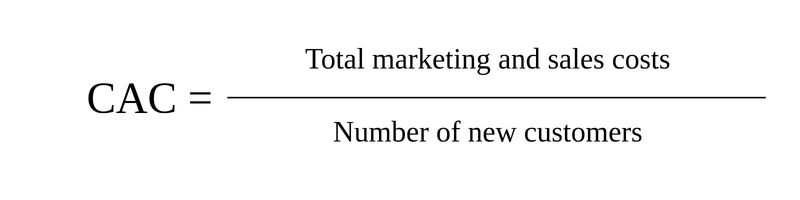
CAC = Total marketing and sales costs / Number of new customers
For example, if a company spends 500,000 CZK on marketing and sales activities during a quarter and acquires 1,000 new customers, its CAC is 500 CZK per customer.
What all is included in CAC?
The calculation includes all direct and indirect costs associated with customer acquisition:
- advertising costs (online campaigns, TV, outdoor, print, etc.),
- salaries of salespeople, marketing team and external agencies,
- commissions and bonuses for closing deals,
- technology and tools for CRM, emailing, analytics,
- production and operational costs for campaigns and lead generation.
Why is CAC important?
CAC is a crucial metric for managing growth and profitability.
It shows how expensive it is to acquire a new customer and whether this process pays off. It helps to better assess:
- the efficiency of marketing and sales channels,
- sustainability of the growth model,
- when it’s appropriate to scale investments in acquisition or conversely increase emphasis on retention,
- the optimal ratio between acquisition costs and customer value.
Relationship between CAC and LTV (Customer Lifetime Value)
The CAC value alone has no meaningful value if it’s not assessed in relation to how much the company actually earns from the customer over time.
Therefore, in practice it’s always compared with the LTV (Customer Lifetime Value) metric – that is, with the total value that a customer brings to the company during their entire “lifetime” (for example, during the subscription period or average cooperation length).
If CAC is high but customers simultaneously have high LTV, the acquisition strategy can still be healthy. Conversely, low CAC may not be a success if customers leave quickly and their LTV is low.
The point is for investments in customer acquisition to pay off in the long term. For this reason, the LTV / CAC ratio is monitored, which helps determine the efficiency of acquisition strategy.
- LTV / CAC > 3 – healthy ratio: the customer brings the company at least triple the value compared to what their acquisition cost,
- LTV / CAC ≈ 1 – acquisition model is on the edge of profitability,
- LTV / CAC < 1 – the company spends more on acquiring a customer than it earns from them.
The relationship between CAC and LTV is thus one of the most important indicators for growth sustainability, profitability and efficient budget allocation between customer acquisition and retention.
What to watch out for with the CAC metric
When working with CAC, it’s important to consider context and time perspective:
- CAC can differ by channel – performance marketing has different costs than direct sales,
- short-term higher CAC may be fine if LTV or customer retention increases long-term,
- it’s advisable to calculate CAC separately for new and returning customers,
- during rapid scaling, it’s necessary to monitor whether CAC is not increasing faster than revenues and margins.
Related metrics
- LTV (Lifetime Value) – customer lifetime value,
- LTV/CAC Ratio – ratio between customer value and their acquisition cost,
- Churn Rate – customer departure rate, which directly affects LTV and the derived LTV/CAC ratio.
Was this article helpful?
Support us to keep up the good work and to provide you even better content. Your donations will be used to help students get access to quality content for free and pay our contributors’ salaries, who work hard to create this website content! Thank you for all your support!
Reaction to comment: Cancel reply