

QoQ
Quarter on Quarter (abbreviated as QoQ) is a comparative metric used in analysis to compare economic, financial, or operational indicators between two consecutive quarters – that is, between the current and previous quarter.
The goal is to assess the development of a company’s, industry’s, or market’s performance over a shorter time horizon and quickly identify trends that may signal growth, slowdown, or stagnation.
What is QoQ used for?
To evaluate quarterly performance – for example, in:
- tracking revenue growth, profit, and operating margin between two quarters,
- analyzing productivity, inventory turnover, or cash flow,
- reporting results of publicly traded companies,
- monitoring macroeconomic indicators such as GDP, industrial production, or inflation,
- evaluating the impact of seasonal factors and economic cycles.
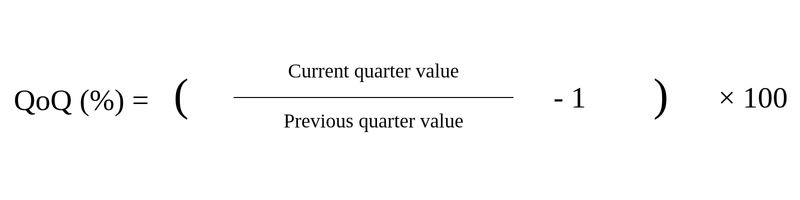
The Quarter-on-Quarter (QoQ) metric shows by what percentage a given indicator has changed between two consecutive quarters (current vs. previous quarter).
And how do you calculate Quarter-on-Quarter (QoQ)?
Notes:
positive QoQ (%) = growth compared to the previous quarter
negative QoQ (%) = decline compared to the previous quarter
0% = no change
How is QoQ expressed/How to correctly interpret the Quarter on Quarter metric?
Quarter-over-quarter changes are typically expressed as percentages.
The notation looks like:
+2.7% QoQ or -0.9% q/q
This notation shows by what percentage the indicator’s value increased or decreased compared to the previous quarter.
Example
Apple announced revenue growth of +2.7% QoQ in the second quarter of 2025.
This means that the company’s revenue was 2.7% higher than in the first quarter of 2025 -for example, if revenue reached $90 billion in the first quarter, it increased to approximately $92.43 billion in the second quarter.
Quarter-over-quarter comparison helps reveal the current trend in revenue development and provides a quick overview of the company’s short-term performance between individual periods of the fiscal year.
Why is quarter-over-quarter comparison important?
QoQ is among the fundamental tools of financial analysis and reporting because it enables tracking performance development within a single year and evaluating results without waiting for annual data.
Unlike the year-over-year metric (YoY), which shows long-term trends, QoQ provides a view of the current pace of growth or decline and helps identify changes that may precede broader economic shifts.
It helps to better assess:
- short-term growth or performance slowdown,
- the influence of seasonal trends between individual quarters,
- the effectiveness of new strategies or marketing measures,
- the speed of a company’s response to market fluctuations and demand.
This makes QoQ a metric frequently used by analysts, investors, and management in quarterly earnings presentations and strategic decision-making.
Difference of QoQ from other metrics
- MoM (Month on Month) – month-over-month comparison that tracks rapid and short-term changes.
- QoQ (Quarter on Quarter) – quarter-over-quarter comparison that provides an overview of performance development within one year (the term QoQ and its explanation and description are the focus of our entire article above).
- YoY (Year on Year) – year-over-year comparison that displays long-term trends without the influence of seasonality.
- CAGR (Compound Annual Growth Rate) – accounts for an entire multi-year period and compound interest, providing the most accurate view of long-term trends.
What to watch out for with the QoQ metric
When interpreting QoQ results, it’s important to consider seasonal influences, the length of quarters, and extraordinary events (such as new product launches or one-time expenses).
Quarter-over-quarter growth may appear positive but does not necessarily indicate a long-term trend.
QoQ should therefore always be supplemented with year-over-year comparison (YoY), which allows identification of whether the change is sustainable over a longer period.
Was this article helpful?
Support us to keep up the good work and to provide you even better content. Your donations will be used to help students get access to quality content for free and pay our contributors’ salaries, who work hard to create this website content! Thank you for all your support!
Reaction to comment: Cancel reply