


MoM
Month on Month (abbreviated as MoM) is a comparative metric used in analysis to compare economic, financial, or operational indicators between two consecutive months—that is, between the current month and the previous month.
The goal is to capture short-term changes and trends that signal the immediate development of a company’s performance, sales, demand, or the effectiveness of marketing activities.
What it’s used for
To evaluate short-term movements—for example, in:
- tracking monthly growth or decline in revenue, profit, or margins,
- analyzing website traffic or conversion development,
- monitoring the development of costs, productivity, or inventory turnover,
- monitoring the performance of advertising campaigns and changes in demand,
- operational financial reporting and cash flow management.
How is MoM calculated (Month on Month formula)
The calculation of month-over-month change (MoM) is straightforward and based on a simple comparison of values from two consecutive months.
Formula for calculating MoM:
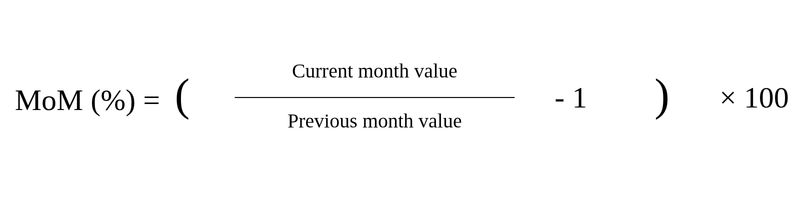
MoM (%) = ((Current month value - Previous month value) / Previous month value) × 100
Calculation example:
A company had revenue of $500,000 in February and $540,000 in March.
MoM = ((540,000 - 500,000) / 500,000) × 100 = (40,000 / 500,000) × 100 = 0.08 × 100 = 8%
Revenue thus increased month-over-month by +8% MoM.
If, on the other hand, March revenue dropped to $475,000:
MoM = ((475,000 - 500,000) / 500,000) × 100 = (-25,000 / 500,000) × 100 = -0.05 × 100 = -5%
Revenue would thus decrease by -5% MoM.
How is Month on Month interpreted
Month-over-month changes are typically expressed as percentages.
The notation looks like:
+5.4% MoM or -1.8% m/m
This notation shows by what percentage the indicator’s value increased or decreased compared to the previous month.
Example
Netflix recorded an increase in new subscribers of +5.4% MoM in March 2025.
This means that in March it gained 5.4% more customers than in February 2025 – so if 1 million new users were added in February, there were approximately 1.054 million in March.
Such a comparison helps quickly assess whether the company is growing or facing a short-term decline in demand, and allows for timely response to market changes.
Why month-over-month comparison is important
MoM is crucial for operational management and reporting because it enables tracking of development dynamics in a short period.
While year-over-year comparison (YoY) shows long-term trends, MoM provides a current view of performance and reveals rapid shifts in data.
It helps to better assess:
- the effectiveness of short-term marketing and sales activities,
- the immediate impact of price changes, discounts, or promotions,
- the actual dynamics of cash flow and sales channels,
- short-term fluctuations caused by seasonality or external factors.
This makes MoM an indispensable tool in every monthly financial or marketing report.
Difference from other metrics
- MoM (Month on Month) – month-over-month comparison that tracks rapid changes and serves as an early indicator of development (the term MoM is described and explained in this article above).
- QoQ (Quarter on Quarter) – quarter-over-quarter comparison, suitable for evaluating quarterly results.
- YoY (Year on Year) – year-over-year comparison that shows long-term trends and eliminates seasonality.
- CAGR (Compound Annual Growth Rate) – accounts for an entire multi-year period and compound interest, providing the most accurate view of long-term trends.
What to watch out for with the MoM metric
When interpreting month-over-month results, it’s important to consider the influence of seasonality, holidays, vacations, or extraordinary events that may temporarily affect the outcome. The MoM metric should therefore always be supplemented with year-over-year (YoY) comparison to distinguish whether it’s a permanent trend or just a temporary deviation.
Was this article helpful?
Support us to keep up the good work and to provide you even better content. Your donations will be used to help students get access to quality content for free and pay our contributors’ salaries, who work hard to create this website content! Thank you for all your support!
Reaction to comment: Cancel reply