

AI Overviews (AIO) – what is it?
If you work in digital marketing, SEO, publishing, or content creation, you may have come across a new term shaking up the industry: AIO.
This abbreviation stands for AI Overviews – a groundbreaking (and increasingly controversial) feature recently rolled out by Google. At its core, AIO refers to automatically generated summaries that appear at the top of search results, powered by generative artificial intelligence.
These AI Overviews are designed to answer user queries directly, without requiring a click-through to a website. While they promise faster, more convenient information for users, they’re also triggering serious concerns across the web – from declining organic traffic to questions about content ownership and visibility.
So what exactly are AI Overviews, how do they work, and why are they raising alarm bells among SEO professionals and publishers alike? Let’s take a closer look.
What Is AIO (AI Overviews)?
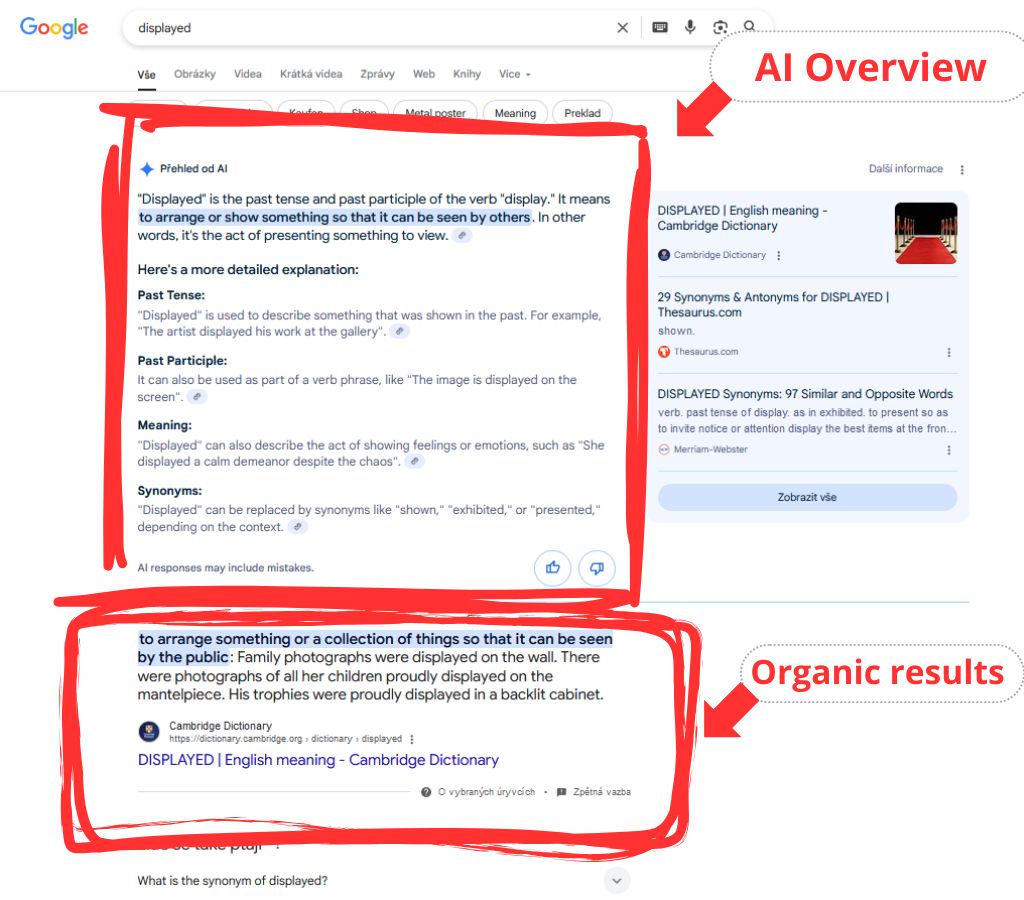
AIO stands for AI Overviews – a feature in Google Search that provides users with a concise, AI-generated summary at the top of the search results page. Think of it as a supercharged version of the traditional featured snippet – only now, it’s not just pulling content from one source, but generating its own answer based on multiple web pages.
These summaries are produced using generative AI models trained by Google to synthesize information from across the web. In some cases, they include citations to original sources – in others, they don’t. The result is a single, synthesized overview that tries to answer your question right away – no click required.
How Does AIO Work?
When a user submits a query (especially an informational or exploratory one), Google may trigger an AI Overview. This overview is generated in real time by analyzing and summarizing content from multiple authoritative websites. It aims to provide – A quick, natural-language answer to the question – Links to supporting content below the summary – Follow-up questions or suggested next searches.
For example, if you search for “Is coffee good for your heart?”, instead of showing a list of 10 blue links, Google might display a paragraph-long AI-generated answer explaining recent studies, health considerations, and the current scientific consensus – sometimes without needing to click anywhere else.
Why Is AIO a Big Deal?
AI Overviews represent a fundamental shift in how search engines deliver information. Traditionally, Google Search acted like a curator – organizing links and pointing users to the best sources. Now, it’s becoming more of an answer engine.
Here’s why that matters:
- It reduces the need to click – many publishers, especially in media, health, finance, and education, rely on search traffic. If users no longer click through to articles because the AI Overview gives them everything they need, that traffic – and the revenue behind it – could drop sharply.
- It blurs the line between aggregation and authorship – Google is using others’ content to generate new summaries – but does that make Google the author? And what happens when it gets something wrong? Accountability is a growing concern.
- It challenges SEO strategies – optimizing for featured snippets is one thing. But how do you optimize for AI-generated summaries based on multiple pages? Traditional SEO tactics may no longer be enough. AIO introduces a new kind of competition – one where your site may power the answer but never receive a click.
Who’s Affected by AIO?
The short answer – everyone with a stake in online visibility. But some groups are more directly impacted:
- Publishers and bloggers may see lower traffic and engagement.
- E-commerce sites might lose valuable informational search traffic.
- SEO professionals are being forced to rethink content strategies.
- Users get faster answers, but potentially less depth or context.
- Advertisers face questions around ad placement and click-through rates.
More information about AI Overviews (AIO) you will find also in this article.
Was this article helpful?
Support us to keep up the good work and to provide you even better content. Your donations will be used to help students get access to quality content for free and pay our contributors’ salaries, who work hard to create this website content! Thank you for all your support!
Reaction to comment: Cancel reply